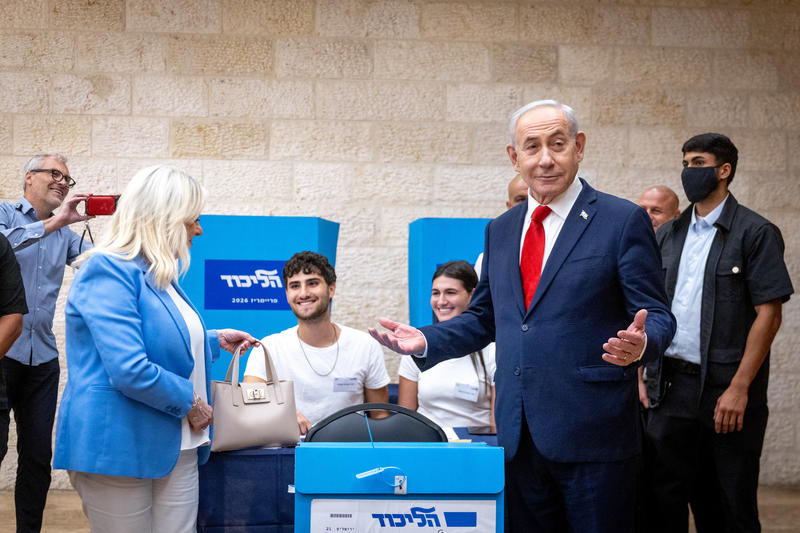

What’s happened: Prime Minister Netanyahu arrived in Washington and had dinner with President Trump in an event that was not open to media.
- Before the meeting, Trump announced that talks on a new nuclear deal with Iran were scheduled and he once more pledged to do everything to ensure Iran would not acquire nuclear weapons. “We have scheduled Iran talks,” he said, “and they want to talk. They took a big drubbing, I think, when we hit the three sites, really, I would say the three sites, not just the one. The one was a big one.”
- Israeli officials in Washington briefing journalists claimed that talks in Doha on a new hostage deal were reaching a conclusion. One much quoted anonymous source said that the deal was “80 to 90 percent agreed on.” In other places, the quote, attributed to a senior official briefing reporters on the flight to Washington, was that Israel had achieved “80 to 90 percent” of its goals in the negations in Doha.
- Kan News’ diplomatic correspondent Suleiman Maswadeh reported from Washington that according to Israeli sources there it was possible that an agreement would not be signed this week but rather next. Maswadeh further reported that the delays last week were caused by Hamas rejecting the Witkoff framework, and that Hamas categorically rejected the conditions that might have led to an immediate release of all hostages, rather than the emerging framework for a partial release during the ceasefire.
Gaza: Five IDF soldiers were killed and fourteen others injured yesterday in an incident in Beit Hanoun, in the northern Gaza Strip.
- All five served in the Netzah Yehuda Battalion of the Kfir Brigade. They were identified as Staff Sergeant Meir Shimon Amar, 20, from Jerusalem; Sergeant Moshe Nissim Frech, 20, from Jerusalem; Sergeant First Class (res.) Benyamin Asulin, 28, from Haifa; Staff Sergeant Noam Aharon Musgadian, 20, from Jerusalem; and Staff Sergeant Moshe Shmuel Noll, 21, from Beit Shemesh.
- 37 soldiers have been killed since the end of the ceasefire in March this year. 888 IDF soldiers have been killed in total since the war began on October 7, 2023.
- The deadly incident in Beit Hanoun occurred roughly one kilometre from the border fence in an area that has been in full control of the IDF since the ground operation began in late October 2023 — including during the two ceasefires. Army Radio reports that it is still unclear how a terrorist squad was able to operate in the area, to plant at least four explosive devices that were remotely detonated.
- In Khan Yunis in the southern Gaza Strip, IDF Chief of General Staff Eyal Zamir met with troops and reiterated his commitment to the war’s two principal objectives, defeating Hamas and liberating the hostages. “Alongside Iran, the central theatre is in Gaza. We are determined and we will lead here to victory… All roads lead to one place: hostages and victory.”
Context: The talks in Washington are focused on the hostage deal, the anticipated nuclear talks with Iran and wider regional moves towards normalisation between Israel and Sunni Arab states.
- Talks in Doha dealt not just with the proposed 60-day ceasefire and partial hostage release, but with some general terms regarding the end of the war that would be negotiated during the ceasefire. Leaks to Israeli media suggest that the Israeli Government still rejects a role for the Palestinian Authority in the Strip after the war. “There will be another force in the Strip that will include Palestinians, for sure, but not the PA,” according to the senior Israeli official briefing reporters on the flight to Washington.
- Israel Hayom claims that Prime Minister Netanyahu rejected proposals from Washington that would have included a rhetorical commitment to a Palestinian state as a way of securing a peace agreement with Saudi Arabia. According to the report, the Prime Minister’s position remains that Palestinian statehood “was permanently removed from the table in the wake of the October 7 massacre.”
- The US lifted sanctions against Hayat Tahrir al-Sham, the organisation that was led by Syrian President Ahmed al-Sharaa until he seized power in the country. As of June 23, the organisation is no longer designated as a Foreign Terrorist Organisation by the US State Department.
- On a visit to Damascus on Saturday, the Foreign Secretary, David Lammy, also announced that the UK would be resuming diplomatic ties with Syria. Despite this, Hayat Tahrir al-Sham remains a proscribed organisation.
- American mediated talks seek to reach an agreement between Israel and Syria. US officials are reported to believe that an agreement with Syria will soften Netanyahu’s position on Gaza and allow him to make concessions during the negotiations to end the war during the ceasefire he might otherwise have struggled to push through politically.
- Lebanon, too, is looking to reach an agreement with Israel. Lebanese Prime Minister Nawaf Salam announced that he seeks a security arrangement with Israel which would see the latter fully withdraw from Lebanese territory and commit Lebanon to disarming Hezbollah.
- Besides the regional peace initiatives, another goal of the Prime Minister’s visit in Washington is to secure US commitments on Israel’s interests in Iran. Specifically, the Prime Minister reportedly wants US support for a future attack on Iran should the Islamic regime either move its stockpile of highly enriched uranium or rebuild the core facilities damaged by Israeli and US air strikes in June, including not just those related to its nuclear programme but also its missile production sites.
- Additionally, Israeli officials seek a US commitment to demand zero enrichment on Iranian soil as a condition for any future nuclear agreement, a position the Trump administration was deliberately ambiguous about in the earlier negotiations conducted in the spring of this year.
Looking ahead: Defence Minister Yisrael Katz has asked the IDF to prepare a “humanitarian city” to be built on the ruins of Rafah in the southern Gaza Strip
- A key indicator of progress in the hostage talks will be when US envoy Witkoff joins the talks in Doha.
- Netanyahu will remain in Washington for at least two more day: Later today, he will meet Vice President JD Vance and Speaker of the House of Representatives Mike Johnson. Tomorrow, he is scheduled to meet with Secretary of Defence Pete Hegseth and on Thursday with leaders of the Jewish community. Sources in the prime minister’s entourage said there is no intention of extending the visit to the US into the weekend this time.