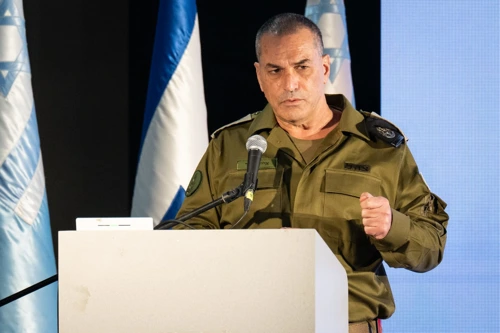
What’s happened: The IDF Chief of Staff Eyal Zamir addressed the Senior Command Forum on Monday and spoke out against “unethical incidents.”
- Zamir stressed that the army is built on values. When reviewing two and half years of intense combat, he reiterated, “unethical incidents we have seen are not justified. We must not compromise on our values. Erosion of values and standards can be as dangerous as operational threats.”
- He continued, “The phenomenon of looting, if it exists, is disgraceful. If such incidents occurred, we will investigate them. I define clearly here as well: IDF personnel, in both regular and reserve service, will not use social media as a tool to spread controversial messages or for self-promotion. This is a red line that must not be crossed, and those who do so will face disciplinary action. The uniform we wear is a symbol of where we serve and of our values, we must not use it irresponsibly.” He was referring to the relatively new phenomenon of soldiers adding non-military badges onto their uniform.
- Adding further, “We will not allow political discourse in our ranks. The public looks to us and relies on us. We will not ask what others will say about us, but what is right for the IDF. We will continue to act according to a clear moral compass and will not allow deviation from the proper path.”
- He also related to the role of women serving in the military, “Women are an integral part of the IDF and of its operational strength. There will be no exclusion of women in the IDF. Their integration is rooted in values and equality and is an operational necessity that must be pursued fairly and without prejudice.”
- Among the IDF values taught to every recruit includes the obligation to protect human dignity of every individual, regardless of their ethnicity, religion, nationality, gender or status.
- On Sunday Prime Minister Netanyahu also tried damage mitigation (following the recent image of IDF soldiers damaging a statue of Jesus in southern Lebanon) by meeting with a group of Christian soldiers serving in the IDF. He referred to them as an “extraordinary group of young men and women. These are Christian soldiers, men and women, in the Israeli Defence Forces. They fill all the important positions in our incredible military and they do incredible work.”
- Netanyahu added, “This is completely contrary to what is presented outside. It’s not only that Israel fights for the rights of Christians around the Middle East, but that Israel has Christian soldiers who fight for the defence of Israel and for our Christian brethren throughout the area, throughout the region and beyond….Israel is the one country in the Middle East where the Christian community is thriving, is growing and it’s expanding.”
Context: The IDF Chief of Staff also addressed the ongoing operational issues as the IDF remains deployed across multiple fronts.
- He related to the new security posture, and how across all sectors, the IDF has “established forward defence areas on the frontlines, adjacent to our communities, in the Gaza Strip, Syria, and Lebanon” adding that “We must be prepared to remain in these areas as long as sustained security for our communities has not yet been ensured.”He noted the political leadership is currently engaged in three negotiations relating to Iran, Lebanon, and Gaza.
- On Lebanon he said, “The forward defence posture in Lebanon continues until the security of the northern communities is ensured. The negotiations currently underway are grounded in the military achievements we have secured.”
- Despite President Trump’s declared ceasefire and two rounds of talks between Israeli and Lebanese officials in Washington, the fighting is ongoing. Prime Minister Netanyahu clarified that Israel retains freedom of action in Lebanon with the consent of the US and the Lebanese government.
- Lebanese President Aoun has defended his government’s stance in negotiating with Israel. Responding to accusations from Hezbollah about treason, Aoun said, “Treason is the one who takes his country to war for external interests….My goal is to reach an end to the war with Israel in accordance with a ceasefire agreement.” Adding, “If this were a war on Lebanon, we would support it, but this is a war for the interests of others,” he said, referring to Iran, “and therefore I completely oppose it.”
- On Monday the IDF struck more than 20 Hezbollah infrastructure sites in the Beqaa Valley and in southern Lebanon. Among the sites targeted were weapons storage facilities and rocket launch sites. However in the ten days since the ceasefire was announced the IDF have so far refrained from striking Hezbollah assets in Beirut.
- In that same time-frame there have been over 40 separate incidents of Hezbollah missile and drone attacks on northern Israel and towards IDF troops operating in southern Lebanon.
- The IDF have identified a new trend with Hezbollah’s deployment of suicide drones. Hezbollah operates two types:
- The first are remote controlled and can be more easily intercepted electronically.
- The second are connected by fibre optic cables, sometimes up to 15km away and can be operated remotely via a camera and deliver a six kg payload of explosives with exceptional accuracy. It was this type that killed an IDF soldier over the weekend and injured several more.
- These drones relatively cheap, are similar to those deployed by Russia in Ukraine. The IDF is currently looking for a defensive solution.
- There remains residual anger from Israelis in the north who continue to face ongoing attacks. On Monday, a drone exploded around 300 metres from a school in the Western Galilee.
Looking ahead: Communities in northern Israel continue to suffer from missile and drone attacks, and decisions over whether to open schools are made on a daily basis.
- Parents and local authority leaders are demanding full protection for all homes and schools that are located up to nine km from the border.