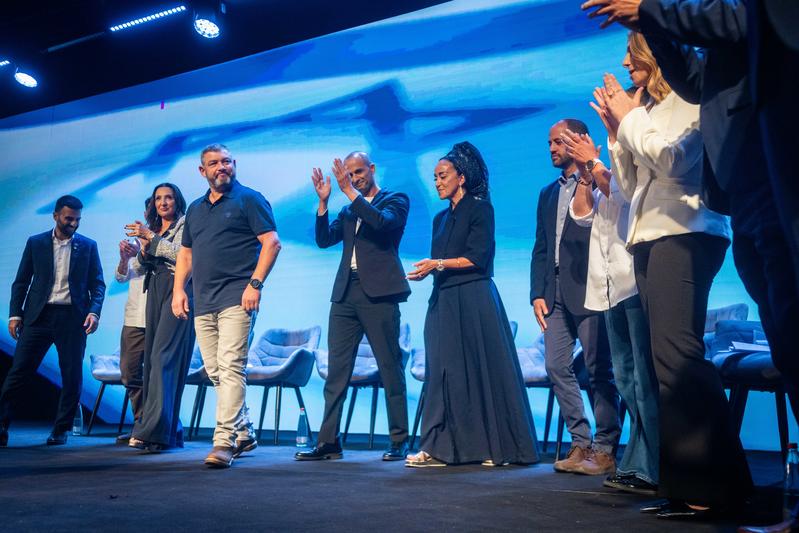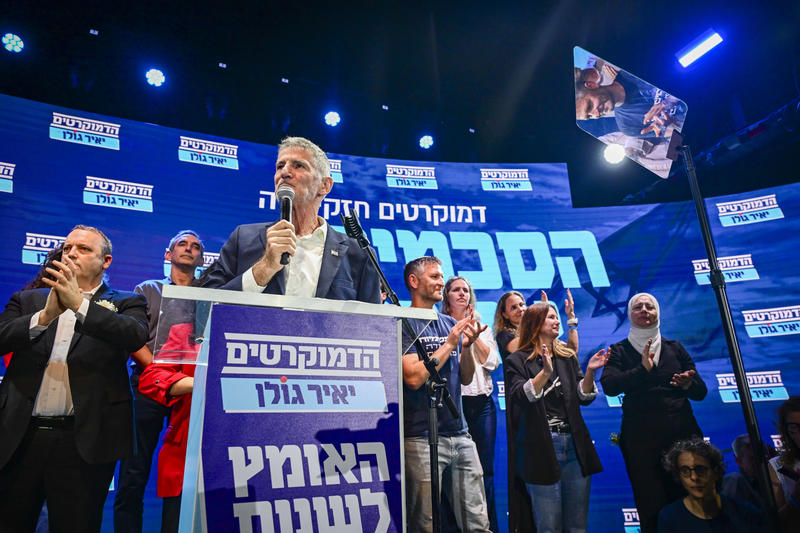
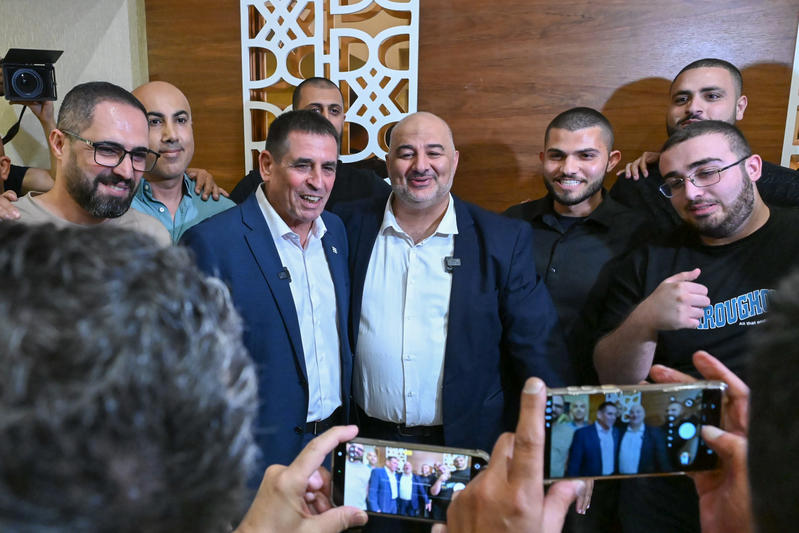
What’s happened: Leader of the Ra’am Mansour Abbas and former Yesh Atid MK Yoav Segalovitz formally announced on Sunday night that Segalovitz would run on the Ra’am’s Knesset slate. (Ra’am is now also as the UAL – United Arab List.)
- Segalovitz will take second place on the list, immediately behind Abbas.
- Abbas said, “Arabs and Jews together, with a professional who will spearhead the action. Every generation has a moment when fear and hope stand in the same room. Tonight, in this room, hope has prevailed. Yoav, welcome. We have shared work to do.”
- Segalovitz said, “I do not intend to change either Mansour Abbas or Ra’am, and the Ra’am won’t change me either. But we can cooperate based on trust, recognising differences on the one hand, and enlisting to work together on the other.”
- Segalovitz explained his decision in a lengthy post on X, where he wrote:
- “I am a Jew, a Zionist, secular, an IDF officer, and a superintendent in the Israel Police. Mansour is an Arab, a religious Muslim, and a conservative. The thing that connects the two of us is that all of us are Israelis, and that is the shared identity. The brilliant radiance of that term, Israeli, has been dulled, and we are perpetually preoccupied with ethnic facets that divide, instead of our common ground.”
- “The Arab population in Israel is 21 per cent; it is active and creative in industry, the economy, culture, education, and medicine. It is an engine of economic and social growth. Yes, there are differences between us. Jews and Arabs in this country have a fraught history, but we have a shared future. That shared future is in all aspects of life.”
- “The Arab citizens of Israel experienced the war, and in the course of the horrific assault on October 7, more than 34 members of Arab society were killed, and Arab citizens were kidnapped into Gaza — six members of Bedouin society from the Negev. As the war unfolded, all of us, Arabs and Jews, sat in bomb shelters under missile attacks by Iran and Hezbollah; residents were evacuated from their homes, and Arab citizens were killed and wounded too.”
- “The time for repairing the country is also a time for internal, societal repair. Twenty-one per cent of the citizens are also part of that repair. Arab society, with all its various shades and differences, is an economic, social, and cultural engine of growth for the State of Israel. It isn’t a threat; it is an opportunity for the State of Israel, and it is also a bridge to its neighbours.”
- “We are in an election period, but my intention in joining Ra’am goes far beyond the election. Politics is a means for producing change. I want to build a genuine political bridge, even if there are problems — and there will be. There will be difficulties, and even if that bridge is rickety and wobbles, it will be laid, and it will be the basis for further political action that I hope a good many others, Jews and Arabs, will join.”
Context: Jews and Arabs have run on joint lists before, but these have generally been non-Zionist Jews as part of Hadash, which, although overwhelmingly Arab, positions itself as an Arab–Jewish communist party.
- There is also the rare example from last week when Yossef Hadad, an Arab Israeli, joined Ofer Winter’s new right-wing party as number two.
- However, this is the first time a prominent mainstream Jewish Israeli has joined a purely Arab (and Islamic) party list.
- During the brief government of change, 2021–22, Segalovitz (then a member of Yesh Atid) served as Deputy Minister for National Security. In that role, he spearheaded efforts to reduce violent crime in Arab communities.
- Segalovitz comes from the heart of the Israeli consensus. Born in Tel Aviv, he enlisted in the Paratroopers Brigade. Before entering politics with Yesh Atid in 2019, he served in several senior positions in the police, including founding the Lahav 433 Unit (fighting organised crime and corruption) and serving as head of the Investigations and Intelligence Division.
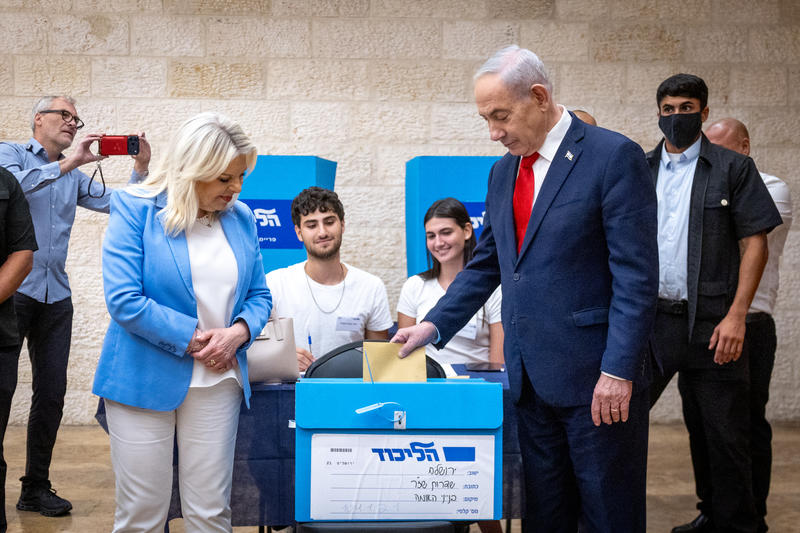
- As leader of Ra’am, Mansour Abbas has long taken a pragmatic approach. During the period of political stalemate and paralysis five years ago, he held negotiations with Likud before eventually becoming the first Arab party to join a governing coalition, under Bennett and Lapid.
- Ra’am represents the more moderate Southern Branch of Israel’s Islamic Movement. It justifies its participation in Israeli politics as part of its top agenda item to improve the socioeconomic conditions of Arab citizens, rather than remaining primarily focused on the Palestinian issue. Abbas recently moved to detach the party from the Islamic Shura council.
- In the past Abbas has said he accepts that Israel is a Jewish state and seeks Arab-Jewish partnership within Israel, while simultaneously identifying as Palestinian and supporting Palestinian self-determination and a two-state solution. He argues that Palestinians and Jews should acknowledge each other’s national narratives.
- This move was preceded last week when the other Arab parties agreed to reform the Joint List (without Ra’am). Hadash-Ta’al will run together with the more extreme Balad party (which alone failed to cross the threshold last time). The new Hadash Party leader, Yousef Jabareen, will head the list, and MK Ahmad Tibi will rank second.
- In the 2022 Knesset election, Ra’am secured five seats and is currently polling to retain the same number of MKs. The Joint List, meanwhile, appears to be capitalising on the momentum generated by its reformation, with polls projecting that it will win between six and ten seats—an improvement on the five secured by the Hadash–Ta’al alliance in the last election.
- With both Netanyahu and the opposition bloc struggling in the polls to secure an overall majority, the Arab parties, particularly Ra’am, could emerge as kingmakers after the election, potentially providing the opposition with the seats needed to cross the majority threshold.
Looking ahead: If Ra’am are successful, and if they were to join the next government formed after the election, Segalovitz would be their ministerial candidate. Depending on coalition dynamics and negotiations, he would ideally like to replace Ben Gvir as the Minister for National Security.
- On the other side of the political spectrum, the leaders of several small right-wing parties will meet later today to explore merging together ahead of the deadline next week. The meeting, which the participants tried to keep secret, will be held at the home of Nissim Louk, father of Shani Louk, who was murdered at the festival in Reim. The invitees include Zehut Party leader Moshe Feiglin, Economic Party leader Yaron Zelekha, The Reservists—Generation Victory Party’s Gilad Ach, El Hadegel Party’s Matan Yafe, Dedi Simchi, and Yair Ansbacher, and former MK and Beit Yisrael Party leader Gadi Yevarkan.