What’s happened: Egypt has presented its latest proposal for a comprehensive ceasefire agreement to Hamas.
- The deal would see a release of all Israeli hostages in exchange for Palestinian prisoners held by Israel, a permanent end to the war in Gaza, a provision for the demilitarisation of Gaza, and a “symbolic exile” of surviving Hamas leaders in Gaza.
- Khalil al-Hayya of Hamas’ five man ruling committee based in Doha, arrived in the Egyptian capital earlier this week to discuss the Egyptian proposal. Earlier reports of the Egyptian proposal indicated that it had a provision for the “freezing” of Hamas weapons stores, though it was unclear if the proposed “freeze” aligned with Israel’s demand for Hamas to be disarmed.
- Amid ongoing tensions between the IDF’s Chief of General Staff Eyal Zamir and senior cabinet figures surrounding the planned Israeli offensive into Gaza City, Zamir this morning approved tactical plans for the upcoming operation earlier this morning at a meeting of the General Staff, representatives of the Shin Bet, and other officers directly involved in the planned offensive.
- The Israeli Ministry of Health published a report on the condition of released hostages detailing both the inhumane conditions of their captivity and the long-term physical and psychological damage which they are still dealing with.
- Hostages were held underground in the dark with at most one meal a day, consisting of food unfit for consumption. Haaretz reports that hostages suffered from “infectious diseases, respiratory diseases, hallucinations and severe pains, dehydration that caused them to lose consciousness, serious respiratory disturbances and skin conditions that usually continued after their release. Many of them still suffer from irreversible nerve damage, sometimes due to damage from improperly treated gunshot wounds incurred during the abduction.”
- The report also describes the physical and sexual torture the hostages endured, as well as the psychological trauma they still carry with them. Released hostages did not get to mourn family members who were murdered alongside them on October 7 when they were abducted, some not knowing until their release what the fate of their family members was.
- The report was delivered to the International Committee of the Red Cross (ICRC) in Geneva.
- The ICRC President Mirjana Spoljaric met with a delegation of mothers of Israeli hostages earlier this week. Israeli officials indicate that the following the meeting, the ICRC seems to actually be making an effort to convince Hamas to allow it provide food and medicine for the hostages who have been held now for 677 days.
- Israel’s COGAT (Coordinator of Government Activities in the Territories) published a report yesterday strongly pushing back against claims of widespread starvation and famine in Gaza. Hamas authorities had reported a sudden increase of malnutrition related deaths in July without releasing any identifying information.
- COGAT was able to identify only a few of the reported deaths, and of the ones it identified, the fatalities were people with genetic disorders, degenerative muscular disorders, or other longstanding health problems. Many of those were actually people who had, prior to the war, been treated in Israel for their ailments.
- From October 2023 until June 2025, Hamas had reported 66 deaths related to malnutrition. In the month of July alone, it reported it reported 133 malnutrition related deaths.
- COGAT also reported that 320 aid trucks entered Gaza yesterday for distribution by the UN and international aid organisation, along with three fuel tankers for the operation of essential humanitarian systems.
Context: Following the failure of talks in Doha, the centre of gravity for hostage negotiations has now moved to Cairo.
- While the Doha talks focused on the Witkoff plan for a 60-day ceasefire with a partial hostage release during which a permanent end to the war would be agreed on, the Cairo talks are said to focus on a comprehensive deal.
- Such a deal would see all hostages released and an immediate end to the war, without a ceasefire on the way. The implication of this would be that the two sides agree now on final redeployments rather than on partial withdrawals as a form of down payment. It would also mean the sides, under pressure from the US and Arab governments, agree now on a framework for the governance of Gaza at war’s end.
- The renewed urgency from Egypt emerges as governments in the region and elsewhere seek to prevent a large Israeli military offensive into Gaza City, as the Israeli Government has committed to carrying out in the coming weeks if no deal is reached.
- Yedioth Ahronoth quotes a senior Arab official as saying, “Everyone in the international community understands that it is impossible without the presence of the Palestinian Authority in Gaza. Hamas also understands that they will not be able to remain in Gaza. Some want to leave Gaza and go build a new life, which is why they are interested in exile.”
- The Egyptians and Qataris have not closed the door on partial deal entirely, according to Egyptian Foreign Minister Badr Abdelatty. Speaking at a press conference in Cairo, he said “We are working very hard now in full cooperation with the Qataris and Americans.”
- Prime Minister Netanyahu told an Israeli interviewer that Israel had despaired of reaching an agreement along the lines of the Witkoff proposal, and that the idea of a partial deal was “behind us.” Netanyahu now wants “to return everyone within a framework that ends the war, but an end to the war on our terms.”
- Since the beginning of efforts to reach a ceasefire there has a been competition between Egypt and Qatar, with Israel traditionally preferring the Egyptians due to historical security cooperation and shared hostility towards the Muslim Brotherhood.
- However, Egypt’s role is somewhat contradictory. For decades the porous Egyptian – Gaza border allowed goods, including weapons to be smuggled into the enclave. In addition Egypt has refused to allow Gazan refugee’s to even temporarily escape the combat zone making them partly complicit in the humanitarian crisis that has ensued.
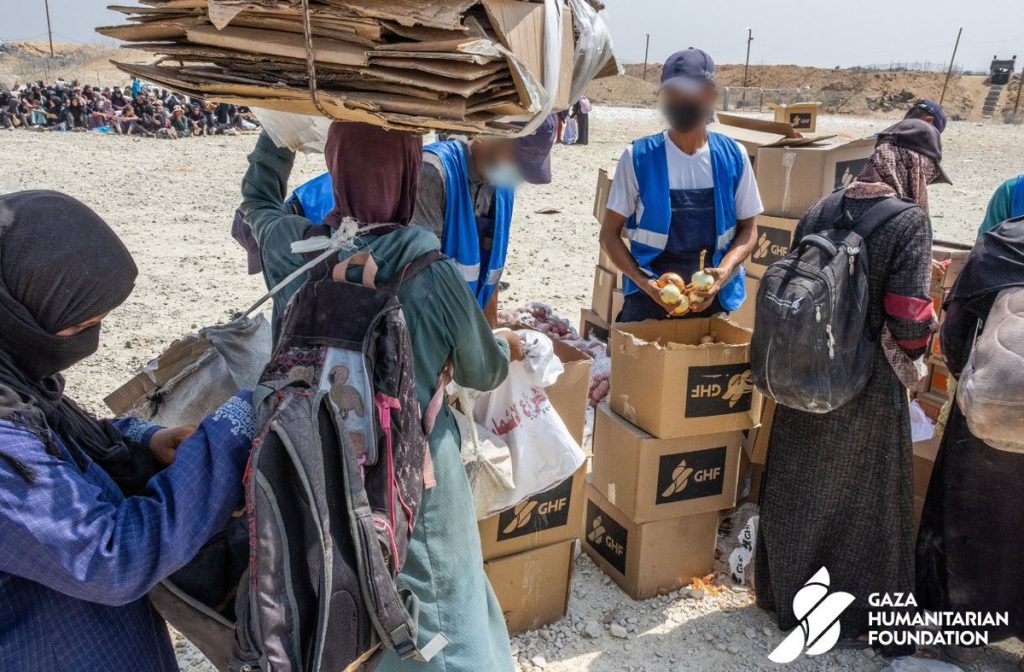
Looking ahead: The US plans on expanding its alternative aid mechanism, known as the Gaza Humanitarian Foundation, in the coming weeks. US Ambassador to Israel Mike Huckabee said yesterday that the initiative would grow from four sites to sixteen in total.
- The UN will add Hamas to its “blacklist” of organisations and countries that have sexual violence as an act of war, in line with a draft distributed to UNSC members by UN Secretary-General António Guterres of a report to be approved on August 19. In a letter to Israel’s UN Ambassador Danny Danon, Guterres warned that Israel might also be included on a future blacklist due to reports of sexual abuse of prisoners unless Israel implemented measures stronger enforcement and disciplinary measures. Guterres’ letter and the implied threat to include Israel on a future blacklist sparked an outraged response from the Ambassador, who called it “absurd.”
- If Hamas accept the outlines of the latest proposal an Israeli delegation is expected to travel to Cairo in the days ahead.