What’s happened: On Monday, the British Court of Appeal overturned the High Court’s February ruling that then Home Secretary’s designation of Palestine Action had been unlawful, meaning that the group’s proscription still stands.
- Responding to the announcement, the Home Secretary said that “The Court has found that Palestine Action has carried out acts of terrorism, celebrated those who have taken part in those acts and promoted the use of violence. It is not an ordinary protest or civil disobedience group, and its actions are not consistent with democratic values and the rule of law.”
- She added that “This decision does not affect lawful protest in support of the Palestinian cause, which remains a fundamental democratic right. There is a difference between supporting Palestine and supporting a proscribed terrorist group.”
- In a summary of the case, the Lady Chief Justice, Baroness Carr of Walton-on-the-Hill, said that it was “not sustainable” for Palestine Action to be portrayed as a non-violent organisation or a normal protest group given its continued intent to use violence. “It is not – as claimed – a direct action civil disobedience protest group like the suffragettes, operating transparently in the open,” she said, adding that the group “is a covert organisation which operates with secret cells to avoid the detection and prosecution of those using violence to destroy property and cause injury.”
- The court concluded that the original judgement had been lawful, striking a fair balance between protecting national security and the right to protest.
Context: The government’s intent to proscribe Palestine Action was announced in June 2025 by the then Home Secretary, Yvette Cooper. That decision was taken days after the group raided and vandalised two Airbus A330 MRTT planes at RAF Brize Norton in Oxfordshire. Palestine Action subsequently claimed that this was an attempt to interrupt “Britain’s direct participation in the commission of genocide and war crimes across the Middle East”.
- The planes were sprayed with red paint using repurposed fire extinguishers, and no other damage was caused. Two Palestine Action members infiltrated the airfield using scooters, and do not appear to have been challenged by base security. The damage caused was estimated by the authorities at £7 million.
- Addressing the Commons on 23rd June, Cooper stated that, since its founding in 2020, the group had “orchestrated a nationwide campaign of direct criminal action against businesses and institutions.” Increasing the frequency of its operations since 2024, Cooper argued that its “methods have become more aggressive, with its members demonstrating a willingness to use violence”. Apart from defence industry and infrastructure, other targets have included financial firms, charities, universities and Government buildings.
- Cooper also emphasised that these activities had since reached the “threshold set out in the statutory tests established under the Terrorism Act 2000”, and that the group had “provided practical advice to assist its members with conducting attacks that have resulted in serious damage to property.”
- In November 2024, Palestine Action claimed responsibility for an attack against the building which housed BICOM’s offices, as well as other Jewish community charities and Jewish-owned businesses. The accompanying Palestine Action specifically identified BICOM as having been the attack’s target.
- In October 2025, Palestine Action’s founder, Huda Ammori, was granted permission to judicially appeal against the Home Secretary’s decision. She was initially successful in doing so, with the High Court ruling that proscription was both “unlawful” and disproportionate in how it interfered with the rights to freedom of expression and assembly, both of which are protected under Articles 10 and 11 of the European Convention of Human Rights in February 2026.
- Immediately after the High Court’s ruling, the Home Secretary, Shabana Mahmood, announced her intent to contest it in the Court of Appeal. Her appeal began in April of this year, and concluded on Monday with a finding in her favour.
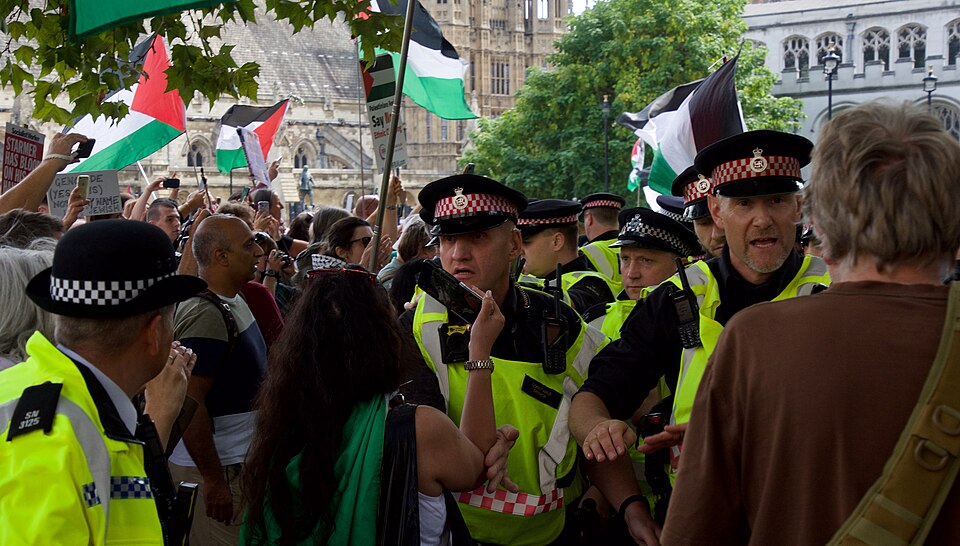
- As a proscribed group, belonging to or supporting Palestine Action is punishable by sentences of up to 14 years. Since its initial banning, its supporters have deliberately risked arrest by holding signs in public reading “I oppose genocide. I support Palestine Action.”
- Over 3000 individuals have been arrested on suspicion of Terrorism Act breaches in support of Palestine Action since July 2025, mostly at large demonstrations. Of these, just over 700 have been charged.
- 117 individuals were arrested on suspicion of showing support for a proscribed organisation, namely Palestine Action at protests outside of the Court of Appeal. Of these, it is a realistic possibility that a significant proportion will be charged and face criminal proceedings for their alleged support of Palestine Action.
- Last week, Four Palestine Action activists were jailed after causing £1.2m of damage and inflicting grievous bodily harm on a police sergeant.
Looking ahead: In an interview with the Guardian, Huda Ammori has confirmed her intent to have the Court of Appeal’s decision overturned and that the battle to do so will be won in the courts “or on the streets.”
- No timeframe for has been given for when this legal action may be initiated, but Ammori has specifically cited a willingness to escalate to the UK Supreme Court and European Court of Human Rights if necessary.
- It is highly likely that the Home Office will continue to challenge any further legal attempts to override Palestine Action’s proscription.
- Even in the event that Monday’s decision is appealed to the Supreme Court or European Court of Human Rights, it is highly unlikely that any ongoing prosecutions against alleged Palestine Action members and supporters will be discontinued.