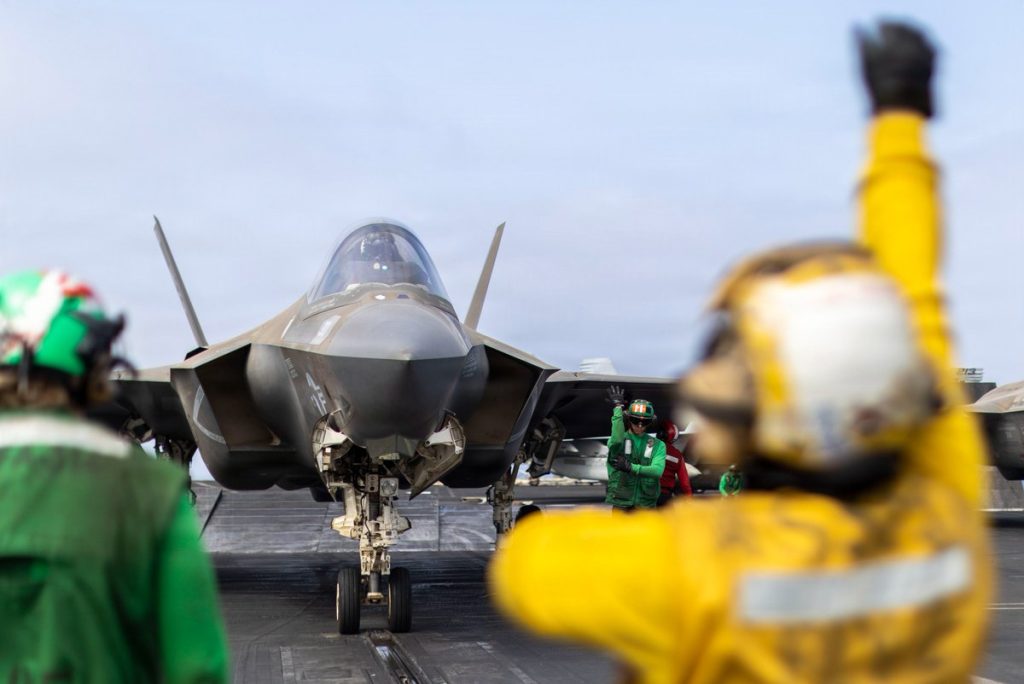
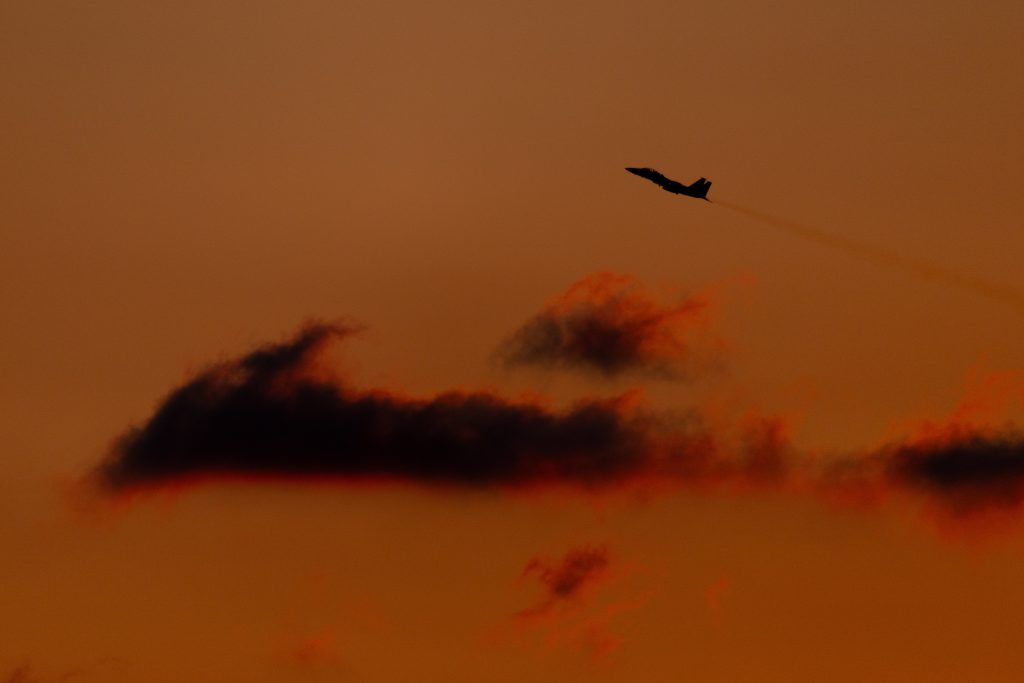
What’s happened: The US has responded to what CENTCOM called a “surprise” wave of missile attacks against military bases in Jordan yesterday with its own “powerful” retaliatory airstrikes on IRGC targets in the southwest of the country.
- American targets include command centres, missile and drone facilities, and coastal surveillance infrastructure.
- Ahead of the strikes, President Trump asserted that Iran was “going to get a beating” and that the US would be “hitting hard.”
- Saudi and US jets also launched waves of airstrikes against Iranian proxy Shia militias in Iraq late on Tuesday night. These strikes followed what the US has described as “over 30 IRGC-directed aerial drone attacks” on oil facilities in the Saudi Eastern and Riyadh regions on Monday and Tuesday emanating from Iraq.
- The American-Saudi attacks killed approximately 20 Iranian proxy militiamen who were also members of the Popular Mobilisation Forces.
- Commenting on the strikes, Major General Turki al-Maliki of the Saudi Ministry of Defence said that the Kingdom “reiterates that it does not seek escalation but will respond decisively to any aggression directed against it”, referring to the originators as “Iran-backed terrorist militias.”
- Iraq’s recently appointed Prime Minister, Ali al-Zaidi, responded by cancelling a scheduled meeting with Saudi Arabia’s Crown Prince, Mohammed bin Salman. Its President, Nizar Amidi, was similarly condemnatory, branding the attacks “as an unacceptable act, a flagrant violation of Iraqi sovereignty, and entirely contrary to international law and the United Nations Charter.”
- The Popular Mobilisation Forces, an umbrella formation of predominantly Iranian-sponsored Shia militias established after the Islamic State’s invasion of Iraq in 2014, responded with a statement condemning “the treacherous terrorist attacks”, branding them “an extremely serious escalation and a violation of Iraq’s sovereignty, targeting its official security institutions.”
- A drone also struck a US liquid natural gas storage tanker at the northern Egyptian port of Damietta, causing an explosion and fire. No group or country has claimed responsibility yet. To date, Egypt has not been attacked by any Iranian or proxy projectiles since Israel and the US launched the current war with Iran on 28th February.
- The IRGC also fired a salvo of ballistic missiles at American bases in Jordan on Wednesday morning, with the US confirming that it had intercepted what was described as a “surprise attack.”
Context: The American geographically limited targeting of Iran likely indicates a prioritisation of weakening Iran’s military assets around the Strait of Hormuz rather than escalating and causing damage elsewhere in the country.
- This is the first time that Saudi Arabia has acknowledged participating in strikes against Iran or its proxies despite being extensively targeted up until now. The UAE, Bahrain, and Kuwait are all reported to have launched direct airstrikes on Iran, but covertly and have never released statements admitting to doing so.
- Since 28th February 2026, the Islamic Resistance in Iraq have launched a significant number of drone attacks against US bases in the Middle East and energy infrastructure in the Gulf, especially Kuwait and Saudi Arabia.
- While mostly ineffective, three US troops were killed when an IRI-launched drone struck a military base in Jordan in February 2024. Two Israeli soldiers were also killed by a drone launched from Iraq which impacted their Golan Heights base in October 2024.
- The Islamic Resistance in Iraq is understood to primarily be an exercise in branding providing some deniability for the more Iran-aligned factions operating in the Popular Mobilisation Forces, especially Kataib Hezbollah and Asa’ib Ahl al-Haq.
- In March and May, the UAE, Kuwait, Bahrain, Saudi Arabia, Qatar, and Jordan issued joint statements condemning “the attacks carried out by armed factions loyal to Iran from the Republic of Iraq against a number of countries in the region, as well as their facilities and infrastructure.”
- These statements also reiterated how the signatories valued their “fraternal relations with the Republic of Iraq”, while calling on Baghdad to “take the necessary measures to immediately halt the attacks launched by factions, militias, and armed groups from Iraqi territory toward neighbouring countries, in order to preserve brotherly relations and avoid further escalation” as well as their right to self-defence.
- Iraqi Shia militias are Iran’s most enduring proxies in the Arab world, pre-dating Hezbollah’s official manifesto proclamation and establishment in 1985. Its oldest proxy militia, the Badr Group, was founded in 1982 and fought against Saddam Hussein in the Iran-Iraq War.
- In the aftermath of the US-led invasion of 2003, pre-existing groups returned to Iraq while new ones were established with Iranian patronage. Broadly referred to as “Special Groups” and supported by the IRGC-Quds Force and Hezbollah, they would go on to spawn factions including Kataib Hezbollah, Asaib Ahl al-Haq, the Promised Day Brigades, and Mahdi Army.
- After the Islamic State invasion of Iraq in the summer of 2014, these groups reconstituted as the Popular Mobilisation Forces and formally integrated into the government’s structures, arguably playing a more decisive role in combat operations than the Iraqi Armed Forces. Post-Islamic State, the Popular Mobilisation Forces remained an important part of the Iraqi state’s security apparatus and never disbanded. They were also subject to occasional US air strikes, with their then Chief of Staff, Abu Mahdi Al-Muhandis of Kataib Hezbollah, being assassinated alongside the IRGC-QF’s commander, Major General Qassem Soleimani, in January 2020.
- Shortly after Hamas’s invasion of southern Israel on 7th October 2023, a new grouping of Iraqi Shia militias emerged on Telegram branding themselves as the “Islamic Resistance in Iraq”, claiming missile and drone attacks against Israel and US bases in the Middle East. Some of these were branded as “joint operations” with the Houthis.
Looking ahead: Despite overnight strikes on IRGC targets, President Trump appears to remain open to negotiating a diplomatic solution with Iran, telling reporters: “We’ll see if we get there with an agreement at some point.”
- Pakistan has confirmed that negotiations between the US and Iran are “ongoing”, and that it is doing all it can “to bring all parties back to the Islamabad MOU.”
- Negotiations are understood to be focusing on a broader de-escalation and the Strait of Hormuz.