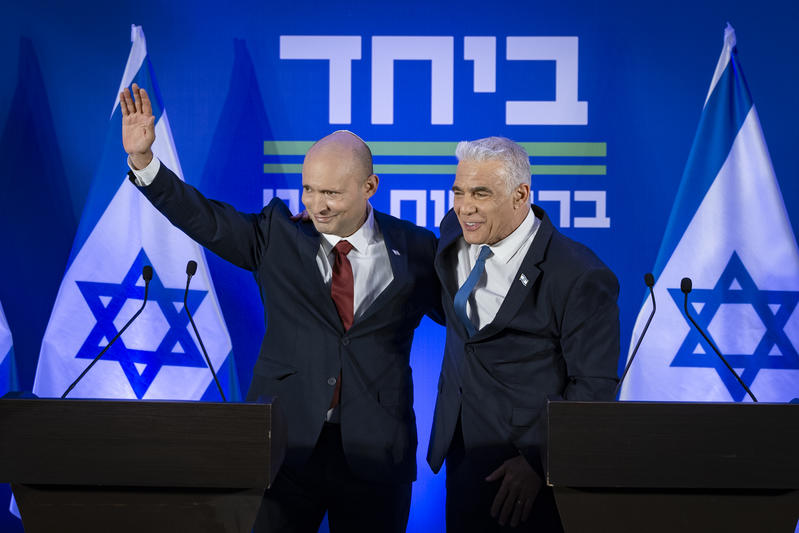
What’s happened: Politics: Former prime ministers Naftali Bennett and Yair Lapid will run together in the upcoming elections under a new united political party. On Sunday evening they announced the new list named “Together, Led by Bennett.”
- Bennett said, “I am taking the most Zionist and most patriotic step we have ever taken, for our country… Our unity sends a message to all the people of Israel: the era of division is over. The era of repair has arrived.”
- He re-committed to his three pledges:
- “On the first day of the new government under my leadership, we will establish a state commission of inquiry into the October 7 massacre to bring truth to the families and answers to all the people of Israel,”
- Initiate a universal conscription law, and stop funding ultra-Orthodox draft evasion.
- Introduce the term limit of a prime minister to eight years.
- Bennett added that he will:
- “Safeguard the lands of our country and will not hand over a single centimetre to the enemy,”
- Work to “strengthen an inclusive, welcoming Judaism without coercion.”
- Bennett also said that a government led by him would advance same-sex marriage, along with civil marriage. The current status quo is under exclusive domain of respective religious authorities.
- Lapid explained his thinking behind the move, “The State of Israel needs to change direction. This is a test of our leadership, and we will meet it. What you have seen today is the first step. We are here because this country needs unity like air to breathe. We are here for everyone who believes in democracy, believes in the deep Jewish foundation of the country, believes in the values of Zionism and our right to this land.”
- In his view, “to win the elections, the entire Israeli centre must stand behind Naftali Bennett. Bennett is a clear right-winger, but he is a liberal, decent, law-abiding right-winger who did not sell his values – neither to Haredi extortion nor to corruption – he was an excellent prime minister, and he will be an excellent prime minister. This is what we need now.”
Context: Whilst no real surprise, the move cements the opposition bloc under Bennett’s leadership.
- Lapid and Bennett first formed a political friendship and alliance when they both joined Netanyahu’s third government in 2013, and doing so blocked the entry of the ultra-Orthodox parties. That government survived less than two years after Netanyahu sacked Lapid as his finance minister. Since 2015 every Netanyahu government has included the ultra-Orthodox parties.
- The only break in the Netanyahu monopoly was the brief 2021-22 broad coalition government that saw Bennett and Lapid serve as (short-lived) rotating prime ministers. There is no suggestion that rotation is on the agenda this time.
- Bennett and Lapid’s broad coalition was the first in Israel’s history to include an Arab party, with the Islamic Raam Party and its leader Mansour Abbas part of the coalition.
- The timing of the announcement, amid a fragile ceasefire and in the week following Israel’s Independence Day, also symbolises the first significant consolidation ahead of the election that must be held within six months, and must be announced in the next three months.
- One of remaining issues to be determined is whether Gadi Eisenkot, who had initially recommended the three of them unite, will also join them. Both Bennett and Lapid are on good personal terms with Eisenkot, and the possibility remains open for him to join them at some point.
- Eisenkot who formed his Yashar party after serving as Benny Gantz’s deputy welcomed Bennett and Lapid’s decision to unite, saying that he had spoken to Bennett on the phone half an hour before the announcement. He said, “I see Naftali Bennett and Yair Lapid as partners and will continue to do, with responsibility and wisdom, what is right to achieve the victory and the change needed for the State of Israel.”
- The move was also welcomed by other members of the anti-Netanyahu bloc.
- However the decision came under fierce criticism by the Likud and the right-wing parties accusing them of once more preparing to form a coalition with Raam, and by extension with the Muslim Brotherhood. Whist technically accurate, Mansour Abbas the leader of Raam is also seen as brave moderate leader, who in the past has acknowledged his place as a Muslim minority in the Jewish State.
- There is a general feeling in Israeli society that after the trauma of October 7 and the ensuing 2.5 years of war, the possibility of Jewish-Arab political cooperation – as represented in the previous Bennett-Lapid government of which Mansour Abbas was a member – has been weakened.
- In a press conference in June 2024, Lapid said that “I have explained and we studied and I think that Mansour Abbas has also understood this, that they can’t be the 61st coalition member. It is impossible to establish a government that is dependent on them, without Israeli society and also Arab society not being able to deal with that. The Jewish and the Arab public are not ripe for a government in which the Arab parties will be the deciding voice.”
- The polling has remained relatively static for some time, with Bennett’s party neck and neck with the Likud around mid-20 seats. It is Eisenkot’s party that has some momentum polling in the mid- teens, at the expense of Lapid’s Yesh Atid that has fallen into single digits.
- The other advantage Bennett received by uniting with Lapid is significant financial backing. Although trailing in the polls, Yesh Atid is still the second largest party in the current Knesset and will therefore receive a substantial proportion of the state funding for the upcoming campaign.
- It remains unclear how the merger will affect the opposition bloc’s overall success, but the other opposition parties are all confident they represent a specific sector, so Yair Golan’s Democrat Party are the representatives of the Israeli left, having combined the Labour and Meretz parties, (with their separate runs in the 2022 elections seen as an error). Meanwhile Avigdor Lieberman’s Yisrael Beteinu, with a right-wing but anti ultra-Orthodox sentiment has the sectoral backing of Russian-speaking immigrants. It is expected that the three or four competing Arab parties will also reunite their Joint List, that could increase their electoral power significantly.
Looking ahead: The election is scheduled for no later than October, and a formal 90 day campaign beforehand will begin after the Knesset has been dissolved.