LATEST

Israel, the UK and the world

Key background
  • The UK and Israel share a strong relationship, built on historical, economic, and diplomatic ties. Both nations collaborate closely in trade, science, technology, and defence, with the UK being a key partner to Israel. The UK supports Israel’s right to exist as a Jewish state. Scientific progress, academic partnerships, and shared values of democracy further strengthen the bond.
  • Israel maintains diplomatic ties with 165 of the other 192 UN member states.
  • Israel maintains full diplomatic relations with two of its Arab neighbours, Egypt and Jordan, after signing peace treaties with the former in 1979, and the latter, 1994.
  • In 2020, supported by the US, Israel signed the Abraham Accords agreements establishing diplomatic relations with Bahrain, the UAE and Morocco.
People light candles in memory of the victims of the mass shooting attack in Sydney targeting the Jewish community during Hanukkah celebrations, in Tel Aviv, on December 14, 2025.
People light candles in memory of the victims of the terrorist attack in Sydney targeting the Jewish community during Hanukkah celebrations, in Tel Aviv, on December 14, 2025. Photo by Erik Marmor/Flash90

Updated December 15, 2025

Heightened concerns following the Sydney terror attack

What’s happened: As of this morning the number of people who were murdered in the Sydney terror attack stands at 15. Another 40 people were wounded.

  • The attack targeted Australian Jews celebrating a Chabad Chanukah party on Bondi Beach.
  • Following the attack, President Herzog sent his “deepest condolences” to the Jewish community of Australia. He added, “These vile terrorists deliberately targeted innocent Jewish families celebrating the first night of Chanukkah… our message is clear: the Chanukah lights must go on and will be lit all over the world, especially in Bondi Beach in Sydney and all over Australia. In Australia, in Israel, and around the world, the Jewish people — the eternal people — will continue to bring light into the world and overcome this terrible darkness.”
  • Prime Minister Starmer noted, “Chanukah should be a time of celebration and joy. The news that the Bondi beach attack was an antisemitic terrorist attack against Jewish families at a Chanukah event is sickening….The United Kingdom will always stand with Australia and the Jewish community.” He added that his government was working with the CST (Community Security Trust) on the policing of Chanukah events.
  • The prime minister later posted a photo lighting the Chanukah candles alongside his wife with his message: “As we light the Chanukiah, our thoughts and prayers are with those murdered in the terrorist attack on Bondi beach today, their loved ones and the whole Jewish community. Light will always win over darkness.” He further noted, “Antisemitism has no place in our society. We stand in solidarity with the Jewish community, today and every day.”
  • Later in Jerusalem President Herzog lit the first night candle alongside the family of Staff Sgt. Ran Gvili at the President’s Residence in Jerusalem. The President stated, “Ran is a police officer who fell heroically in battle on October 7th. 800 days later, Ran is now the last hostage still being held by murderous terrorists in Gaza. We renew our call for Ran to be released immediately and returned home to his dear family for dignified burial!”

Context: For many Jews around the world a deadly attack of this nature has felt inevitable following the increased levels of antisemitism, particularly since the October 7 massacre.  

  • Jewish community organisations in both Australia and the UK have been warning politicians for two years that the violent rhetoric on weekly marches in our cities, would escalate to physical violence.
  • Following the Heaton Park Synagogue murders in Manchester, the UK government made commitments to changes in the law, to protect places of worship and assess cumulative impact of marches. Neither have been implemented.
  • The terrorist attackers have been identified as Sajid and Navid Akram, a father and son aged 24 and 50 of Pakistani origin. It remains unclear if they acted independently or if they received training and support.  
  • Pakistani nationals have carried out attacks in the past, such as in the 2008 terror attack in Mumbai that – like in Sydney – also targeted a Chabad event. Similarly Pakistani nationals, serving as Iranian proxies were involved in a foiled terrorist attack at a Chabad House in Athens in October 2024.
  • Over the last few months the Mossad had warned the Australian government that Iran and other malign groups were planning attacks.
  • There is some speculation that Iran carried out a revenge attack against Jews at an iconic Australian tourist site following recent Australian action against the Islamic Republic. Other reports have suggested the terrorists may have identified with ISIS.    
  • This deadly attack followed months of anti-Israel public protests, including chants to “globalise the intifada.” This attack is viewed as a sadly predictable result of inaction against those protests.
  • Despite the welcome words of Prime Minister Starmer there is heightened concern that not enough is being done to counter the growing spread of antisemitic rhetoric and there are ongoing concerns for the safety of the Jewish community.
  • In Australia this attack followed a huge increase in antisemitic attacks that included a firebomb attack on a Melbourne synagogue a year ago.
  • Yesterday Prime Minister Netanyahu noted his previous warnings to the Australian government that its policy was “promoting and encouraging antisemitism in Australia,” adding that its call for a Palestinian state ” pours fuel on the antisemitic fire…rewards Hamas terrorists [and] emboldens those who menace Australian Jews and encourages the Jew hatred now stalking your streets.” Netanyahu emphasised that “Antisemitism is a cancer. It spreads when leaders stay silent; it retreats when leaders act. I call upon you to replace weakness with action, appeasement with resolve.”
  • The prime minister also noted that it was a brave Muslim man that heroically disarmed one of the terrorists.      
  • The festival of Chanukah, meaning “dedication” in Hebrew, commemorates both the 164 BCE rededication of the Second Temple in Jerusalem after its desecration by the ruling Seleucid (Syrian Greek) Kingdom, under Antiochus IV, and the re-establishment of religious freedom for the Jewish people after a period of harsh repression.
  • The success of the popular revolt led by Judah Maccabee and his brothers has ever since symbolised the fight for liberty and freedom against overwhelming odds.
  • Chabad is a religious Jewish movement synonymous with outreach programmes for Jews of all backgrounds.

Looking ahead: Israel’s National Security Council has issued warning over the possibility that terror supporters will be inspired by this event and try to carry out copy-cat attacks.

  • As a result, the NSC have issued a set of recommendations that include avoiding “unsecured public events, including events at synagogues, Chabad houses, Chanukah parties… Be vigilant when near Jewish/Israeli locations, and report to the security forces if anything out of the ordinary is detected (a suspicious person or object).”
  • As the UK prepares for its public Chanukah celebrations this week, the Jewish community is on heightened alert. 

November 20, 2025

Mossad foils Hamas plot in Europe

Mossad operation infographic
Mossad operation infographic. Photo credit: Israel in the UK/X

What’s happened: The Prime Minister’s Office announced yesterday the conclusion of a complex antiterrorist operation conducted by the Mossad in cooperation with law enforcing authorities across Europe that led to the disruption of a massive Hamas network that was preparing terrorist attacks in Europe.

  • According to the announcement, arrests were made in Germany, Austria, and the UK, and large weapons caches were discovered in Austria and possibly elsewhere as well.
  • The terrorists involved coordinated with Hamas operatives in Turkey and Qatar. The announcement sparked some media interest in Israel yesterday, but was little noted abroad, though the discovery of a weapons cache in Austria was reported abroad two weeks ago.
  • According to the PMO, Hamas operative Mahmoud Nayim was arrested in the UK in November 2025.
  • In its statement the Austrian Directorate for State Security and Intelligence (DSN) specified that “Among the seized items were tens of thousands of euros in cash, numerous data storage devices and mobile phones, gas pistols, firearms, ammunition, knives, and related literature.”
  • The Prime Minister’‘s office warned that: “Since the October 7 massacre, the Hamas terrorist organisation has been working with renewed vigour to build infrastructure and recruit terrorist cells in Europe and other arenas, similar to the Iranian regime and its proxies.” Reiterating Mossad’s commitment  to countering terrorism “The Mossad, together with its partners in the Israeli and global intelligence and security communities, is leading extensive efforts to thwart terrorism against Israeli, Jewish, and innocent targets worldwide.”

November 20, 2025

UNRWA’s mandate extended despite growing criticism

A wide view of the 44th plenary meeting of the UN General Assembly, November 18, 2025.
A wide view of the 44th plenary meeting of the UN General Assembly, November 18, 2025. Photo credit: UN Photo/Loey Felipe

What’s happened: The United Nations General Assembly voted to extend the mandate of UNRWA, the controversial agency which handles aid for Palestinian refugees and their descendants and which has been accused by Israel of complicity in Hamas operations against Israel.

  • Voting in favour of extending the mandate were 149 countries, a significant drop from 165 previously. The United States and nine other countries voted against the measure. In a dramatic departure from precedent and a minor moral blow to UNRWA, five European countries abstained: Germany, Italy, Czechia, Bulgaria, and Latvia.
  • Israeli Foreign Minister Saar said the number of countries that refrained from supporting the extension of UNRWA’s mandate “reflects the beginning of a recognition within the international community of UNRWA’s negative role, which was infiltrated by Hamas, and whose employees participated in the Oct. 7 massacre.”
  • US Ambassador to Israel Mike Huckabee condemned settler violence in the West Bank, saying “Israelis can carry out terrorism as well,” while also noting that there were only “a very small number” of people involved and that Israel was acting to contain the problem.

November 18, 2025

Netanyahu welcomes UN vote on Gaza

Israeli Prime Minister Benjamin Netanyahu at a 40 signatures debate, at the plenum hall of the Knesset
Israeli Prime Minister Benjamin Netanyahu at a 40 signatures debate, at the plenum hall of the Knesset, the Israeli parliament in Jerusalem, on November 10, 2025. Photo by Yonatan Sindel/Flash90 *** Local Caption *** 40 חתימות כנסת מליאה ראש הממשלה בנימין נתניהו

What’s happened: The United Nations Security Council approved Resolution 2803, endorsing President Trump’s Comprehensive Plan and granting an international mandate for the creation of an International Stabilisation Force to operate in Gaza for the next two years.

  • The resolution explicitly references both the Board of Peace, a body to be managed by the Trump Administration and a “path to a Palestinian state.”
  • The UNSC resolution authorises Trump’s Board of Peace to oversee governance of the strip until December 31, 2027. The Board of Peace will be empowered to appoint a “technocratic, apolitical committee of competent Palestinians from the Strip” to manage the day-to-day affairs of the Gaza Strip.
  • The resolution also authorises the World Bank to allocate financial resources for the reconstruction of Gaza and calls for the establishment of an international trust fund for Gaza reconstruction.
  • The Board of Peace will oversee the International Stabilisation Force, a multination armed force operating with a UN mandate that will “coordinate” with Israel and Egypt for security missions in the Gaza Strip, including training and support Palestinian police personnel, securing humanitarian corridors, and securing border areas.
  • PM Netanyahu reacted to the vote by praising the Trump plan. In a post on X, he wrote that “The State of Israel and PM Netanyahu applaud President @realDonaldTrump and his tireless and devoted team. The courage and sacrifice of our brave soldiers, along with President Trump’s diplomatic efforts, helped bring home all of the living hostages and most of the deceased ones. and saying it “will lead to peace.”
  • Before the vote, at the start of the Government meeting on Sunday, Netanyahu reiterated that his “opposition to a Palestinian state in any territory has not changed one bit.”
  • Israel’s UN Ambassador Danny Danon also praised the adoption of the resolution, emphasising that Israel would not compromise on the implementation of the resolution’s demands for full Hamas disarmament. “As we are determined to bring back all the hostages, we will display the same determination and ensure that Hamas is disarmed,” he said. “We will not stop and will not rest until Hamas is not a threat to the State of Israel.”
  • The Palestinian Authority’s Foreign Minister Varsen Aghabekian Shahin also praised the resolution’s adoption, calling it a “first step in a long road towards peace.” Speaking to reporters in the Philippines, she said that “we could not embark on anything else before we had a ceasefire.”
  • Hamas issued a statement rejecting the UN Security Council resolution, saying that it did not address the Palestinians’ rights and demands. It further indicated that it would not cooperate with any attempt to disarm the organisation.
  • UN Secretary General Antonio Guterres hailed the resolution’s adoption and said that it was “essential now to translate the diplomatic momentum into concrete and urgently needed steps on the ground.”

Context: Despite reservations about some of the language – specifically relating to a pathway to a Palestinian state – Israel accepted the resolution as it sees it as a natural progression towards the next stage of the Trump 20 Point Plan.  

  • According to Israel Hayom, Israel was opposed to the changes in the text’s wording, but later dropped its opposition after receiving private commitments from the Trump administration that the state envisioned in the resolution, as far as the US administration is concerned, is in line with the 2020 “Deal of the Century” proposal of the first Trump administration, and not one that see the entirety of the West Bank and Gaza handed over to a fully sovereign Palestinian state.
  • China and Russia abstained in the vote on the resolution’s adoption. Either country could have vetoed the resolution had they been so inclined. Both expressed serious reservations about the outsized role of the US, particularly the implied mandate of President Trump’s Board of Peace to govern Gaza.
  • In an earlier Russian draft, the Board of Peace was unmentioned entirely. The Chinese and Russians were concerned that the ISF would essentially be reporting to the Board of Peace and through it to Washington. Ultimately, in the approved text, the Board of Peace retains the powers Trump had sought for it, but the ISF has to report back to the Security Council every six months.
  • Algeria, the only member of the UN Arab Group currently on the Security Council voted in favour of the resolution, but only after securing language on Palestinian statehood that went beyond the wording in Trump’s 20-point plan or the original American draft of the resolution.
  • Algeria’s ambassador told the Council that “genuine peace in the Middle East cannot be achieved without justice, justice for the Palestinian people, who have waited for decades for the creation of their independent state.”
  • Algeria was not alone on insisting on these changes to the resolution’s text. The New York Times reports that other countries on the Security Council, including France, Guyana, Pakistan, Slovenia, and Somalia, pushed for more forceful language on Palestinian statehood.
  • The resolution stipulates that after the Palestinian Authority reforms itself and reconstruction of Gaza progresses, “conditions may finally be in place for a credible pathway to Palestinian self-determination and statehood.”

Looking ahead: The mandate of the ISF goes far beyond mere peacekeeping and includes disarmament.

  • The question of when the ISF could begin operating remains open.
  • Though the Security Council resolution gives it a mandate to disarm Hamas, no country presently seems willing to take on the task.
  • It can’t be effective in the parts of Gaza under Hamas control while Hamas forces still operate there as quasi-sovereign military and police force. It could conceivably operate in areas the IDF vacates, but Israel won’t vacate these areas until some kind of Hamas disarmament is achieved.
  • President Trump is due to meet with Saudi Crown Prince Mohammed bin Salman today in the White House. Their discussions could have far-reaching implications for the entire regional alliance structure following both the Gaza War and the Twelve Day War with Iran.
  • Trump announced yesterday his intention to sell the Saudis F-35 fighter jets, a move that could put Israel’s qualitative military edge at risk.
  • Previous US administration’s (including Trump’s) had conditioned any such sale on Saudi commitments to scale back relations with China and to normalise relations with Israel. It is not yet clear what Trump will be expecting from the Saudis in return for the sale announced yesterday.

November 17, 2025

UN Security Council set to vote on Gaza resolution

United Nations Security Council, November 14, 2025
United Nations Security Council, November 14, 2025. Photo credit: UN Photo/Loey Felipe

What’s happening: The UN Security Council is scheduled to vote tonight on the US proposal for the day after the war in Gaza.

  • On Friday evening the US announced a consensual text reached alongside Qatar, Egypt, UAE, Saudi Arabia, Indonesia, Pakistan, Jordan and Turkey. Their joint statement endorsed “a pathway to Palestinian self-determination and statehood” emphasising that “the Plan provides a viable path towards peace and stability, not only between the Israelis and the Palestinians, but for the entire region.”
  • The resolution which will endorse the twenty point Trump plan is also expected to outline the mandate of the International Stabilisation Force.
  • In anticipation of the approval of the resolution, Indonesia’s Defence Minister confirmed that 20,000 troops have been trained to take on health and construction-related tasks for a peacekeeping operation in Gaza.
  • Speaking at the start of the Government meeting on Sunday, Prime Minister Netanyahu reiterated that “Hamas will be disarmed. Either this will happen the easy way or it will happen the hard way.”
  • Regarding a Palestinian state, Netanyahu said, “Our opposition to a Palestinian state in any territory west of the Jordan [River], this opposition is existing, valid, and has not changed one bit.”
  • He also addressed the recent spike in settler violence saying, it was carried out by “a minority that enters Judea and Samaria, and does not represent the large public of settlers, who are law-abiding and loyal to the state.” Netanyahu added that the government would take action against these disturbances.  

Context: Israel’s top priority will be for the disarming of Hamas and the demilitarisation of the Strip.

  • Israel had hoped it would be given veto power to prevent the deployment of troops from Turkey or Qatar, but according to the draft text, only “close consultations” will be held with Israel.
  • There is also concern that any presence of international forces will restrict the IDF’s freedom of action.
  • However, even with the approval of a UN resolution it seems unlikely that any force composition will be able to disarm Hamas. Moreover, most countries have refused to send troops to Gaza as long as Hamas remains armed.
  • Hamas continues to reject any efforts to disarm.
  • A disturbing report on Kan News revealed that Hamas has in recent weeks begun to stockpile advanced weapons in Africa, Yemen and other supportive countries for it to use in a time of need in the Gaza Strip and elsewhere.
  • The UN Security Council’s endorsement of a Palestinian state – via its approved wording of ‘pathway to Palestinian self-determination and statehood’ at this moment is also a cause of great concern for the Israeli government, which believes that in the aftermath of the October 7 massacre it would be perceived as a reward for terrorism. The UN move follows unilateral recognition by UK, France, Canada and others, (but this time is being led by the US).    
  • Some in Israel highlight that the resolution will reference Trump’s 2020 peace plan, which includes many favourable conditions for Israel, but the text could also reference other initiatives (perceived as less favourable to Israel) like the French-Saudi plan too.
  • There appears to be no reference to the key reforms incumbent on the Palestinians, for example refraining and condemning terrorism, incitement, and the pay-to-slay incentivised payments programme.  
  • Meanwhile, on Friday the body of hostage Meny Godard was returned to Israel. Godard was 73 years old when he was murdered on October 7 along with this wife, with his body taken from his home in Kibbutz Beeri to Gaza. Three deceased hostages remain in Gaza: Ran Gvili, Dror Or and Sudthisak Rinthalak with their fate currently unknown.  

Looking ahead: The UN Security Council is expected to convene and vote on the resolution this evening.

  • On Tuesday President Trump is due to host Saudi Crown Prince Mohammed bin Salman in Washington. The proposed security agreement they are expected to agree includes concerning for Israeli security, chiefly the potential sale of F-35 fighter jets, that could significantly degrade Israel’s qualitative military edge in the region.
  • Separately, US envoy Witkoff, is set to meet once more with the head of Hamas’ politburo, Khalil al-Hayya.

November 12, 2025

Standoff in Gaza continues as al-Sharaa visits Washington

A yellow concrete block placed by the Israeli army is seen in the buffer zone east of Jabalia in the northern Gaza Strip
A yellow concrete block placed by the Israeli army is seen in the buffer zone east of Jabalia in the northern Gaza Strip, November 2, 2025. Photo by Fathi Ibrahim/Flash90

What’s happened: Israel and the US are staking out positions on the future of Gaza, as concerns mount in the US that the first stage of the ceasefire might be turning into a stable status quo, rather than a temporary measure leading to a more comprehensive political agreement.

  • According to reports, both Israel and the US are examining various modes of cooperation with informal militias in Gaza that are not aligned with Hamas.
  • The standoff over the one hundred or so Hamas fighters holed up in tunnels on the Israeli side of the Yellow Line near Rafah also continues.
  • Syria too has emerged as an issue where Israel and the US have partially overlapping positions and priorities. This week, Syrian President Ahmed al-Sharaa became the first Syrian President to be hosted at the White House since 1946. The US announced a partial suspension of sanctions against Syria.
  • While in Washington, al-Sharaa said to the US media that Syria was “engaged in direct negotiations with Israel, and we have gone a good distance on the way to reach an agreement.” But he stressed that “to reach a final agreement, Israel should withdraw to their pre-December 8 borders.” Al-Sharaa added that “Mr. Trump supports our perspective as well, and he will push as quickly as possible in order to reach a solution for this.”
  • By referencing the pre-December 8 borders, al-Sharaa is referring to the situation prior to the fall of Assad’s regime in Syria. Following that, Israel expanded the Golan perimeter and intervened to protect Syrian Druze, particularly in the al-Suwayda region. Al-Sharaa’s phrasing, however, may imply an acceptance of Israel’s control over the Golan Heights.
  • Israel’s Minister of Strategic Affairs Ron Dermer, who served as the main point man in Israel’s relationship with the Trump administration, has resigned his post in Cabinet. Dermer had long indicated his desire to quit, but stayed in his post in order to see through the completion of the ceasefire deal which ended the war in Gaza. In his resignation letter, he wrote, “This government will be remembered both for the October 7 attack and for its management of the two-year, seven-front war that followed.”

Context: While US officials are also those most enthusiastically pushing for an expansion of the Abraham Accords to include the new Syrian regime. The Syrian President himself is much less enthusiastic. In an interview with the Washington Post, he rejected the possibility of a full normalisation of relations with Israel in the near future, though he indicated that his country is in direct contact with Israel on a number of issues.

  • Al-Sharaa claimed in the interview that the Trump administration supported his position that Israel should withdraw to the positions it held on December 8, 2024, the day the Assad regime fell. He also rejected Israel’s demand for the demilitarisation of the region of Syria south of Damascus, something Israel has been de facto enforcing since a spate of violence targeted the Druze minority in the region earlier this year.
  • Regarding the Hamas terrorists trapped in the tunels behind the Yellow line, there were conflicting media reports about Israel’s position on the issue amidst the US efforts to resolve the crisis as quickly as possible. The US is keen for the fighters to receive safe passage on condition that they surrender their weapons. Israel reportedly objects to this arrangement, as some of the besieged terrorists are believed to be members of Hamas Nukhba forces that carried out the October 7 massacre. An unnamed Israeli official quoted on Kan, the Israeli public broadcaster, called the proposal to have them leave the tunnels without their weapons “naïve,” since, according to the same official, “weapons will be waiting for them at home.”
  • One option reportedly being considered according the Israel’s Channel 12 News was exile to a third country.
  • Advancing to the next phase of the agreement requires the full handover of the remaining deceased hostages as well as the establishment of an International Stabilisation Force (ISF). But four deceased hostages remain in Gaza, and few countries have expressed any interest in joining the ISF without a clear mandate from the UN. Of the countries that have indicated that they could join, most are only willing to take on peacekeeping roles and do not wish to be a part of any effort to actively disarm Hamas or remove it from power. A report in Reuters datelined in Manama, Bahrain cited “ten diplomats” as saying that governments “remain hesitant to commit troops.”
  • The result for now is that the status quo of the first phase, rather than leading to the next phases, appears to be settling into something longer and more stable. The Yellow Line is clearly demarcated by the IDF with yellow concrete blocks. Moreover, a resolution of the tunnel standoff in Rafah will only further the distinction between the two zones – on one side of the line will be only Israeli forces, and on the other Hamas will have nearly completely reasserted its control.
  • The Reuters report also cited “six European officials with direct knowledge of the efforts to implement the next phase” of the Gaza ceasefire, as well as a Jordanian Minister details growing concerns that the Gaza Strip is being partitioned for the long term into two roughly equally sized zones, one under Israel’s control and under Hamas’s. According to the ceasefire agreement, Israel withdrew its forces to the so-called Yellow Line, leaving the IDF in control of 53% of the Strip. Most of Gaza’s population is in the remaining 47%.
  • The de facto partition casts a shadow over reconstruction efforts too. A report in Maariv claims that US reconstruction efforts could, in the immediate term, be focused only on the Israeli-controlled sector of the Strip. The pledges of Arab money for reconstruction in the rest of the Strip are on hold as long as Hamas’s role remains unclear.

Looking ahead: The US continues its efforts to get a UN Security Council resolution that would authorise an international force to implement the agreement. But the text won’t change the basic conundrum:

  • there is a consensus that Hamas should disarm and a willingness to contribute to Gaza’s reconstruction and governance once Hamas is disarmed;
  • the international community does not want the IDF to do the disarming;
  • no other countries want to do it either.

October 27, 2025

Efforts continue to recovery hostages bodies

US Secretary of State Marco Rubio and Israeli PM Benjamin Netanyahu at PM Netanyahu's office in Jerusalem, October 23, 2025.
US Secretary of State Marco Rubio and Israeli PM Benjamin Netanyahu at PM Netanyahu's office in Jerusalem, October 23, 2025. Photo by Oren Ben Hakoon/Flash90 *** Local Caption *** רוביו שר החוץ ביבי ראש הממשלה בנימין נתניהו

What’s happening: In close coordination with Israel, an Egyptian team entered Gaza with heavy diggers to try to locate and retrieve hostage bodies.

  • Israel gave consent for Egypt to bring in the heavy equipment and gave the Egyptians the geolocations where it believes some of the bodies are buried.
  • In addition, Israel has allowed Hamas representatives to cross the Yellow Line in the Israeli held part of Gaza in order to try and locate hostages’ bodies together with the Red Cross.
  • The searches follow the latest comments by President Trump over the weekend that, “Hamas is going to have to start returning the bodies of the hostages…quickly, or the other countries involved…will take action.”
  • President Trump also related to the two bodies of American citizens, Itay Chen and Omer Neutra, still held by Hamas. During his visit at the end of last week US Secretary of State Rubio said that, “the remains are going to be released. That’s going to happen. And if it doesn’t, then the deal got broken. But it’s going to happen.”
  • Rubio also met with the families of the American-Israeli hostages and later wrote on X that “We will not rest until their—and all—remains are returned.”
  • Defence Minister Katz also released a statement noting, “The most urgent moral mission is, of course, the return of all the hostages and the fallen to their homes, and we will do everything to fulfil this sacred and critical mission.”
  • Katz revealed that 60 per cent of Hamas’s underground tunnels network still remains, saying, “I have instructed the IDF to prioritise the destruction of the tunnels as the central task in the yellow zone currently under our control.” Katz added that this would be coordinated with the US to, “find a way to thoroughly address the dismantling and destruction of all terror tunnels in the remaining territory under their responsibility, alongside disarming Hamas.”
  • On Saturday the Israeli Air Force struck the Nuseirat area in the central Gaza Strip, west of the yellow line. The IDF Spokesperson’s Office confirmed, “The IDF targeted an Islamic Jihad terrorist who planned to carry out a terror attack against IDF forces in the immediate future. The troops in the Southern Command are deployed in the area in accordance with the terms of the ceasefire agreement and will continue to act to eliminate any immediate threat.”

Context: According to point four of the Trump plan, Hamas should have returned all hostages, the living and dead, within 72 hours, so they are already in clear violation.

  • It has now been six days since the last remains of hostages, Arie Zalmanowicz and Tamir Adar, were returned to Israel.
  • Thirteen bodies remain in Gaza. According to Israeli intelligence, Hamas know the location of at least eight bodies of hostages.
  • The entry of Egyptians marks the first time since the ceasefire that Israel has allowed a foreign team to enter Gaza. Last week Israel refused entry to dozens of Turkish rescue workers. 
  • Egyptian President Sisi made a personal commitment at the peace summit he hosted in Sharm el-Sheikh that the Israeli bodies will be returned.
  • The entry of the Egyptian team was agreed upon during talks in Israel with Egyptian General Intelligence Director Hassan Rashad. An additional Israeli security team visited Cairo over the weekend to coordinate it.
  • The latest Trump post once more underscores how the president remains personally committed to the return of all the bodies. On the one hand he backs the Israeli position, whilst he also continues to carry favour with the Qataris. The latest example was his fawning praise heaped on the Qatari emir when they met on board Air Force One, whilst it refuelled in Doha.  
  • The general assessment in Israel is that Hamas is lying and deliberately refusing to return the bodies it has in its possession. This is partly in order to prolong the current ceasefire and hold off the next stage that includes the demand for them to disarm. In addition, they are keenly aware of Israeli society’s sensibilities on this matter.
  • Israel is keen to add further pressure on Hamas including the threat of resuming the fighting. Israel could also re-arrest prisoners recently released  to the West Bank, or impose restrictions on the humanitarian aid.
  • Following a train of senior US officials visiting last week, the Israeli government pushed back at the notion that it is a US ‘protectorate’. Nevertheless Israel is increasingly reliant on the US, as there are divergent opinions on would-be regional allies.
  • Saudi Arabia is keen to play a dominant role in rebuilding Gaza, but will not fund anything until a new Palestinian led government of technocrats is formed in Gaza.  
  • Turkey is thought to be trying to rebrand Hamas, and maintain its influence in Gaza, however the US has so far backed the Israeli position vetoing an entry of the Turkish troops as part of the International Stabilisation Force.
  • Egypt continues its longstanding efforts to bring about reconciliation between Fatah and Hamas.
  • In the meantime, Hamas continues to reassert control, killing off rivals and reorganising their forces.

Looking ahead: In his weekend social media post, Trump gave Hamas a 48 hour deadline – which expires today – but left in unclear what the consequences of failure to deliver would be.  

  • It remains unclear which countries will deploy troops into Gaza while Hamas maintain their weapons. Egypt for example has refused to send in soldiers and is only willing to send military advisors and prefers a Palestinian entity to take control. Similarly, the UAE and Saudi Arabia also oppose sending forces in while Hamas continues to retain military command there. The other countries involved, Indonesia, Azerbaijan, Jordan and Morocco have reportedly taken a similar stance.
  • Ahead of his 90th birthday, the Chairman of the Palestinian Authority Mahmoud Abbas announced that the Deputy Chairman of the PLO Executive Committee, Hussein al-Sheikh will take over if the position becomes vacant.

October 23, 2025

Israel rejects ICJ’s advisory opinion on UNRWA

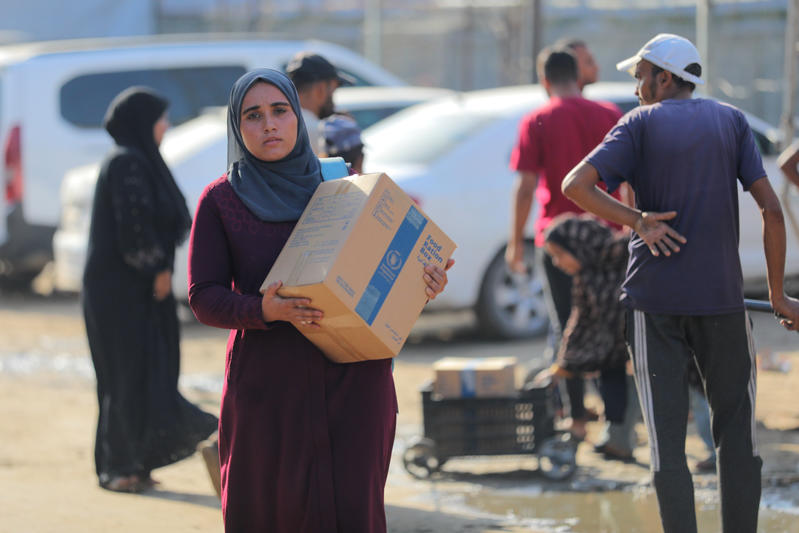
World Food Programme (WFP) provides food parcels to displaced people in Gaza City, October 23, 2025.
World Food Programme (WFP) provides food parcels to displaced people in Gaza City, October 23, 2025. Photo by Ali Hassan/Flash90

What’s happened: The International Court of Justice in the Hague issued an advisory opinion asserting that Israel is legally obligated to allow UN agencies to provide aid to Palestinians in Gaza, the West Bank, and East Jerusalem.

  • The Court said that Israel “is under the obligation to agree to and facilitate relief schemes provided by the United Nations and its entities, including Unrwa.”
  • The Israeli Ministry for Foreign Affairs called the decision “entirely predictable from the outset” and “yet another political attempt to impose political measures against Israel under the guise of ‘International Law.’”
  • The Knesset yesterday voted on two preliminary readings of bills which would apply Israel “sovereignty” on part or all of the West Bank. The Government opposed both bills, but an unusual mixed-motive alliance of right-wing rebels from within the governing coalition and opposition MKs seeking to embarrass the Government saw both preliminary readings pass.
  • US Secretary of State Marco Rubio, due to arrive in Israel today, told reporters just before boarding his flight that any move on West Bank annexation would be “threatening for the peace deal.” Regarding yesterday’s Knesset vote, he said, “They’re a democracy, they’re going to have their votes, and people are going to take these positions. But at this time, it’s something that we … think might be counterproductive.”
  • Rubio’s visit continues an uninterrupted chain of high-profile American officials in Israel coming to monitor and assist implementation of the ceasefire, which has now been in effect for two weeks. Yesterday, Vice President JD Vance arrived in Israel, joining Trump envoys Steve Witkoff and Jared Kushner.

Context: The ICJ, also called the World Court, is a body of the United Nations tasked with setting disputes between states. It is the same court that will rule on South Africa’s case against Israel, which alleges that Israel is committing “genocide.” It is a separate court from the International Criminal Court (ICC), which has issued arrest warrants for Prime Minister Netanyahu and former Defence Minister Yoav Gallant.

  • Israel vehemently denies the “genocide” charge, pointing out that the numbers of deaths include over 20,000 Hamas combatants. In addition, Israel argues that the nature of the fight against Hamas – which began after the massacres on October 7 – which is embedded in a densely populated civilian population and uses hospitals, schools, and mosques – in addition to hundreds of kilometres of tunnels – is inherently complicated and difficult.
  • The case regarding Israel’s obligations to facilitate aid was referred to the Court by a vote of the United Nations General Assembly in December 2024 at the instigation of the Norwegian delegation. This followed the passing of a new law in Israel in October 2024 which banned UNRWA in Israel limiting greatly Israel’s cooperation with it in Gaza and the West Bank.
  • According to Israeli law, East Jerusalem is part of Israel and not part of the West Bank, so the law has already led to the closure of UNRWA facilities there.
  • Israel has not objected to aid coming into Gaza, especially not during the ceasefire. It objects to the role of UNRWA, an organisation it charges with fueling the conflict rather than mitigating it.
  • Besides the Gaza Humanitarian Foundation, which Israel has been heavily involved with, Israel also facilitates aid coming in through the World Food Program, World Central Kitchen, and other humanitarian organisations. COGAT reports nearly 6,000 tons of aid entering Gaza since the ceasefire went into effect on October 10.
  • The Court’s decision stated that Israel had not substantiated its charge that UNRWA violated its neutrality obligations. The rejection of the Israeli claim came in two parts.
    • First, the Court argued that neutrality applies to UNRWA’s obligations to the population it was serving and, implicitly, not to its stance on the conflict.
    • Second, the Court said that Israel had not provided sufficient evidence that a significant number of UNRWA employees were members of terrorist organisations.
  • Israel’s Court submission documented widespread Hamas infiltration of UNRWA, including Hamas use of at least 32 of its facilities. It also provided evidence of UNRWA employees taking part in the October 7 massacre and alleged that some 1400 of UNRWA’s 13,000 Gaza employees were members of Hamas.
  • The advisory opinion is non-binding, and Israel has made clear that it will not be changing its stance on UNRWA. A report on Israel’s Kan radio quotes an unnamed Israeli official saying that UNRWA “will not set foot in Gaza again.”
  • The US State Department condemned “this so-called ‘court’” for issuing “a nakedly politicised non-binding ‘advisory opinion’ [that] unfairly bashes Israel and gives UNRWA a free pass for its deep entanglement with and material support for Hamas terrorism.”
  • One of the Knesset bills that was passed yesterday was tabled by Avigdor Liberman, and would see the effective annexation of Maaleh Adumim, a West Bank city adjacent to Jerusalem which has been slated for annexation in every peace proposal since 2000. Thirty one members voted in favour, and nine voted against. The other bill, tabled by far-right MK Avi Maoz, would effectively annex the entire West Bank.
  • Neither measure has a realistic path to passing into law. 25 members voted in favour and 24 against. The timing is not coincidental – opponents of the government are looking to embarrass it during the visits of senior US officials. The government has made assurances to both the US and some of the moderate Arab states backing the ceasefire that annexation is not presently on the agenda.  

Looking ahead: Conflicting media reports give various hints as to American plans for Gaza reconstruction.

  • From the new Civil-Military Coordination Centre in Kiryat Gat, where a multinational team led by 200 American officers, with contributions from Britain, Denmark, Jordan, the UAE and others, is operating, there are reports of a technocratic government for Gaza being established, composed of Palestinian and international experts.
  • Yediot Ahronot reports that Hamas will select some of its members, though Israel says it will not allow any Hamas involvement.
  • A report in the Wall Street Journal suggests American officials are considering a de facto partition of Gaza, at least as a temporary measure, until Hamas is disarmed.
  • According to this idea, investment and reconstruction would be focused on areas of the Strip that are free of Hamas control. For now, that would mean the 53% of the territory on the Israeli side of the so-called “yellow line.”
October 22, 2025

Israel and US coordinate next phase of Trump plan

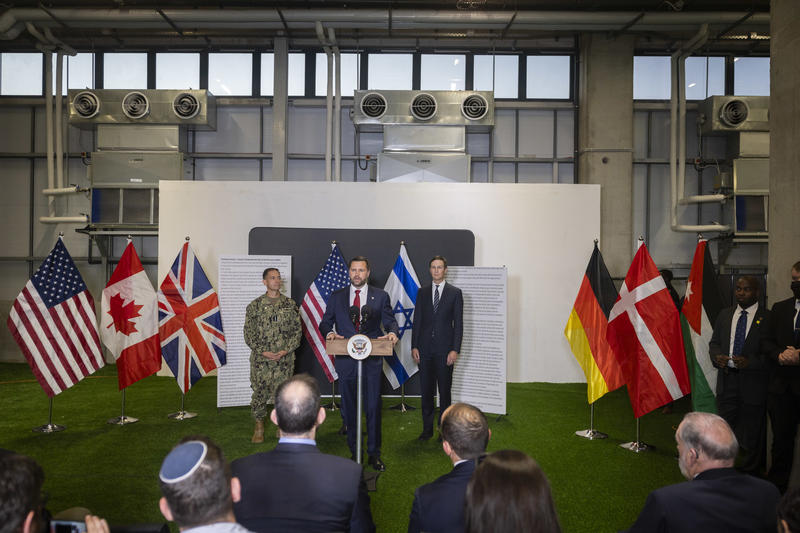
US Vice President JD Vance delivers a statement to the media alongside US Middle East Envoy Steve Witkoff and Jared Kushner, near Kiryat Gat, on October 21, 2025.
US Vice President JD Vance delivers a statement to the media alongside US Middle East Envoy Steve Witkoff and Jared Kushner, near Kiryat Gat, on October 21, 2025. Photo by Chaim Goldberg/Flash90 *** Local Caption *** ישראל מסיבת עיתונאים ארצות הברית ביקור עזה מלחמה הפסקת אש סגן נשיא ארה"ב ג'יי די ואנס ג'ארד קושנר סטיב ויטקוף

What’s happened: US Vice President JD Vance arrived in Israel yesterday. Echoing President Trump’s threat of a “fast, furious and brutal force” if Hamas does not abide by terms of the ceasefire. He said “If Hamas doesn’t cooperate, as the president of the United States has said, Hamas is going to be obliterated.”

  • He is due to meet with Prime Minister Netanyahu today to discuss next steps in the ceasefire.
  • According to Arab media reports, Hamas has indicated to the US administration that it would halt public executions of its rivals. Videos of Hamas firing squads reasserting control over Gaza had been circulating on social media, provoking outrage, but also seen as an indicator that Hamas remained firmly in control of whatever territory lay beyond the presence of the IDF. Currently, the IDF holds about 53% of the Strip’s territory.
  • Hamas handed over two more bodies of Israeli hostages. They were identified by the Israeli Institute for Forensic Medicine as Tamir Adar and Arie Zalmanowicz, both of Kibbutz Nir Oz.
  • Adar was 38 when he was killed on October 7, 2023, while battling the terrorists who invaded the kibbutz, and his body was taken into Gaza. It was not at the time known that he had fallen defending the kibbutz, and for months his family held out hope that he might be alive. His 85-year-old grandmother, Yaffa Adar, was also abducted that morning. She was released in the first ceasefire.
  • Arie Zalmanovicz was 85 years old when he was kidnapped alive during the October 7 attack. He was one of the founders of the kibbutz, along with Amiram Cooper and Oded Lifshitz who were also kidnapped that morning and murdered in captivity. Zalmanovicz is believed to have died in November 2023 due to malnutrition and a lack of treatment for his diabetes.
  • The bodies of 13 hostages remain in Gaza.
  • Prime Minister Netanyahu dismissed the National Security Council Director Tzachi Hanegbi following months of longstanding disagreements between the two. Hanegbi was known to have opposed the expanded military offensive in Gaza that began just before a ceasefire agreement was reached. In his announcement regarding his departure, Hanegbi wrote “The terrible failure of October 7, to which I was party, must be investigated thoroughly to ensure that the correct lessons are learned and in order to help restore the trust that cracked.”

Context: With Vance’s arrival in Israel, he joins Trump envoys Steve Witkoff and Jared Kushner who arrived earlier this week.

  • The talks in Israel are focused on two issues. The first is stabilising the ceasefire and efforts to prevent it from collapsing, which emerged following the Hamas attack in southern Gaza on Sunday. The second is laying the groundwork for the second stage of the agreement.
  • The Director of the General Intelligence Directorate of Egypt Hassan Rashad was also in Jerusalem yesterday, meeting Netanyahu in his office in Jerusalem. Rashad, who has been Egypt’s intelligence chief since 2024, played a key role in mediating the talks which led to a ceasefire. The meeting reportedly focused on the next stages of the ceasefire, with particular focus on the reopening of the Rafah crossing. Rashad’s visit marks the first visit of any senior Egyptian official in Israel since the war began on October 7, 2023.
  • A crucial component of phase two will be deployment of a multinational force. There is grave concern that as signatories of the agreement Turkish soldiers could be deployed into Gaza, a move that Israel vehemently opposes.
  • Similarly, both the UAE and Saudi Arabia are concerned about the outsized role that Qatar has been given in the future rehabilitation of the Strip.        
  • The two US envoys visited the Civil-Military Coordination Centre for implementing the ceasefire in Kiryat Gat in southern Israel. Israeli media  noted the presence of flags from Denmark, German, and Jordan there, but not those of Turkey and Qatar.
  • Military personnel at the site reportedly included soldiers from the US, UK, Jordan and the UAE. Regarding the participation of a “small number of British officers,” the a UK Ministry of Defence spokesperson said, “The UK continues to work with international partners to support the ceasefire in Gaza and identify where it can best contribute to the peace process.”
  • The Coordination Centre is seen as testament to the seriousness of the US administration’s commitment to the implementation of Trump’s plan.
  • It is still unclear when and how the International Stabilisation Force called for in the 20-point plan which ended the war in Gaza will be deployed. The New York Times reports that countries that were expected to contribute troops to the ISF are skittish about entering Gaza and being seen there as fighting Hamas or as a kind of foreign occupying force. Unnamed diplomatic sources refer to discussions involving Indonesia, Egypt, Turkey and Azerbaijan.
  • Israeli security officials have also expressed misgivings about the international forces that are to be deployed in Gaza, whose presence will severely limit the IDF’s freedom of action. Far from disarming Hamas, they could, unwittingly or not, serve as a shield for the terrorist organisation.
  • During his meeting with Netanyahu, Vance is expected to also discuss the expansion of the Abraham Accords, the anticipated economic impact of the expanded accords and policies regarding Iran.

Looking forward: Secretary of State Marco Rubio is also due to visit Israel in the next few days  to oversee next steps in the implementation of the ceasefire.

  • It was announced yesterday that Saudi Crown Prince Mohammed bin Salman will visit the White House on November 18. The agenda will likely include new US security guarantees for Saudi Arabia.
  • The US is keen to advance an agreement that would lead a normalisation of ties between Israel and Saudi Arabia, something the Biden administration was pushing for in the months preceding the October 7 attack and which has been on hold as the ensuing war raged for the two years since.

October 20, 2025

Israel urges UK action on antisemitism

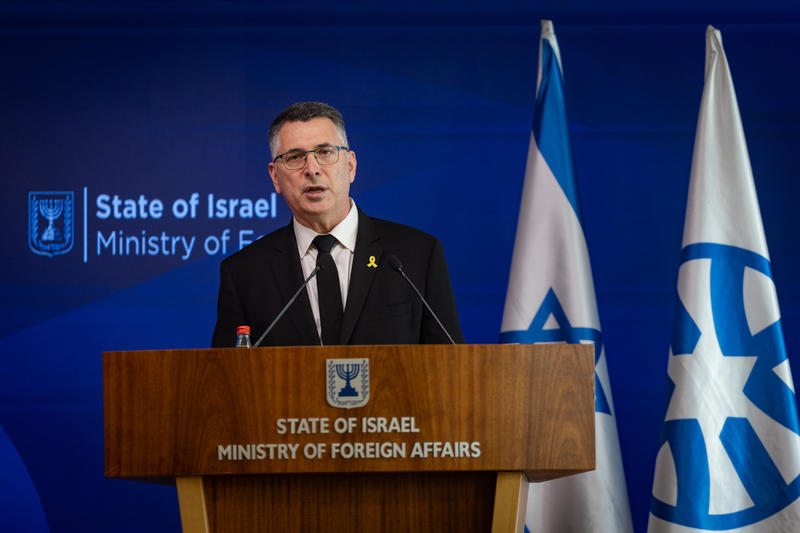
Israeli Minister of foreign affairs Gideon Saar at the Ministry of foreign affairs in Jerusalem
Israeli Minister of foreign affairs Gideon Saar hold a press conference at the Ministry of foreign affairs in Jerusalem, May 22, 2025. Photo by Yonatan Sindel/Flash90 *** Local Caption *** מסיבת עיתונאים משרד החוץ ישראל שר החוץ גדעון סער פיגוע ארצות הברית

Over the weekend, Foreign Minister Saar spoke with Foreign Secretary Cooper. According to the Saar they discussed, “the Trump Plan, its implementation and the situation in Gaza. I raised the issue of the dead hostages and Hamas’s violation of the agreement in this regard. I also described Hamas’s efforts to consolidate its control over Gaza, as well as its mass and public executions without trial.”

  • Saar added, “I also raised the need to take practical measures against the use of the slogan “From the river to the sea – Palestine will be free” in public spaces in the UK. This follows PM Starmer’s statement last week that the phrase constitutes an antisemitic expression. I added that the slogan is, in fact, a call for the elimination of Israel. A line must be drawn between freedom of expression and hate speech. I said that PM Starmer’s remarks should be part of a historic turning point in the UK’s fight against antisemitism. I added that legislation is needed to enforce a ban on the use of this slogan, as several federal states in Germany have already done.”
  • “We also discussed the outrageous ban imposed by Birmingham police preventing Maccabi Tel Aviv fans from attending the Europe League match against Aston Villa at Villa Park on November 6. I expressed our clear and unequivocal expectation that this disgraceful decision be revoked and that Maccabi Tel Aviv fans be allowed to attend the game. The Foreign Secretary expressed the British government’s reservation about the decision and said that staff work, involving the Home Secretary and the Secretary of State for Culture, Media and Sport would resume on Monday to find an appropriate solution.”
  • Following Prime Minister’s welcome comments on Friday regarding the categorisation of inciting anti-Israel chants, it is hoped that this latest call starts a reset in UK-Israel ties  damaged following the UK’s recognition of a Palestinian state.
  • On Sunday, Saar commented on the arrest of Jewish person allegedly for wearing the Star of David. He emphasised it’s “a symbol of Jewish identity, not provocation. The fact that Jews are warned in central London not to display it publicly shows how rampant antisemitism spread through hateful “pro-Palestinian” marches in Britain has poisoned the streets. This is a moral disgrace. British Authorities must act: ban antisemitic slogans and conduct a full institutional review.”

Newsletter sign-up

Please enter your information below to subscribe to our daily newsletter and stay updated and informed.

Donate to BICOM

At BICOM, we rely on the generosity of people like you to keep our website and services running. Your donation, no matter the size, makes a real difference. Please consider supporting us today. For further information please email: [email protected]