LATEST

Iran and their Proxies

Key background
  • The Islamic Revolutionary Guard Corps is a branch of the Iranian Armed Forces with a constitutional mandate for guaranteeing the Islamic Republic’s integrity and projecting its influence abroad. In practice, this manifests as supporting Iranian allies and proxies with funds, weapons, and training.
  • Many of its allies and proxies are terrorist groups and human rights abusers including: Hamas, PIJ, Hezbollah, the Islamic Resistance in Iraq, the Houthis, Syrian Arab Republic, and Russia.
  • Iran is the world’s leading enabler and facilitator of terrorism, especially targeting the US and its allies. It has also targeted diplomatic missions and diaspora Jews.
Iran on a map
Iran on a map. Photo credit: Canva

Updated January 14, 2026

Monitoring the Iranian protests

What’s happened: Violence continues to engulf Iran as the Islamic Republic’s forces crack down on protests throughout the country.

  • Official regime sources put the death toll of protesters at around 2000, with unofficial and unverified reports placing the real figure at 12,000 and even higher. The higher estimates are based on reports coming from Iranian hospitals treating thousands of victims with bullet wounds.
  • There were also reports that regime forces themselves have sustained casualties, possibly as high as 500 killed. If these reports are true, it would indicate a much more violent encounter between protesters and security forces, and it would constitute another bit of evidence that the official death toll of 2,000 is extremely low.
  • President Trump gave further hints that the US are poised to take military action against the Iranian regime, posting yesterday on his social media account that “help is on its way.” At a speech in Michigan later in the day, Trump called on “Iranian patriots” to “keep protesting and take over your institutions if you can,” adding, “Save the names of the killers and abusers that are abusing you. You are being very badly abused.” At the speech, he repeated again that “help is on its way.”
  • In the meantime, Trump announced an immediate 25% tariff on goods from countries with commercial ties with Iran. There has not yet been any announcement on its implementation. Countries that have both commercial ties with Iran and a significant trade portfolio with the US include China, Turkey, India, the UAE, and Pakistan.

Context: In recent days, as the violent uprising in Iran escalated, Iranian officials sought to reopen negotiations with the Trump administration on an agreement regarding Iran’s nuclear programme.

  • Initially, some US officials expressed a tentative openness to proceeding. Israeli officials quoted anonymously in local media described the Iranian move as a “trap” designed to prevent the US from taking military action against regime targets in support of the protesters. Whatever openness there might have been by administration officials was shut down yesterday by Trump’s post on social media that “I have cancelled all meetings with Iranian Officials until the senseless killing of protesters STOPS.”
  • Current Israeli assessments are that Trump will make good on his threat to attack Iran. The initial threat was that the US would attack if the Iranians violently cracked down on protesters with deadly force, something which has since happened.
  • Trump has twice ordered military operations against Iran, first in 2020 in the assassination of Qasem Soleimani and second in 2025 when he sent B-2 bombers with bunker busters to destroy three Iranian nuclear facilities. In both cases, a very limited operation was launched at a precise target in conditions where success was nearly assured. An American operation that is longer, broader, and less likely to have a decisive impact on the course of events will not appeal to the President. A clear target timed and executed in a way that might actually bring the regime down, on the other hand, might — if such a target exists.
  • The clearest targets in this case would be the Islamic Revolutionary Guard Corps (IRGC) and the various security agencies most directly implicated in the violent repression of the current uprising, most notably the IRGC’s Basij (internal repression militia). The US would also like to both disrupt the communications capacities of the regime and at the same time restore those of the protesters. Even here, in the best case scenario, the protesters would still need to be able to marshal enough manpower to overcome regime forces.
  • Latest reports suggest that Israel and US-aligned Arab states were urging the US to hold off on an attack for the time being and wait until the regime was further weakened by the uprising. In the meantime, those states urged the US to assist protesters to get around the communications blackout imposed by the regime, as well as target it with cyberattacks and possibly assassinations as well.
  • American interest in a possible military action in Iran comes at a time of reduced US naval presence in the Gulf. In October, a carrier group was moved from the Gulf to the Caribbean in anticipation of military action in Venezuela. The US maintains six Navy warships in the Gulf, as opposed to twelve in the Caribbean. In the US attack on Iran in June, long range bombers took off from a base in Missouri, however that was for a radically different mission than the one under consideration now.
  • Israeli and US defence officials remain in close dialogue. In addition, US CENTCOM has now opened a new coordination office at Al Udeid Air Base in Qatar to enhance regional integrated air and missile defence.

Looking ahead: Israel remains on alert for a possible Iranian attack in response to any US move — or even a surprise attack.

  • For now, Home Front Command has not issued any special instructions and schools and businesses are operating as usual.
  • Israeli officials have also speculated that Iran-backed terrorist organisations might mount an attack on an Israeli or Jewish target outside the region.
  • The US administration has indicated that it would like to convene the first meeting of the Board of Peace, the advisory board for overseeing postwar Gaza governance, sometime next week in Switzerland. Membership of the Board has not been announced beyond its designated High Representative, the Bulgarian diplomat Nikolay Mladenov who is broadly trusted and well regarded by all sides in the conflict. However, reports have suggested Prime Minister Starmer could be involved too.
  • The Board sent officials letters of invitation to participate in the technocratic committee that is supposed to actually govern Gaza in place of Hamas, according to the ceasefire agreement which went into effect last October. The committee, known as the National Committee for the Administration of Gaza (NCACG) includes a former Deputy Transportation Minister from the Palestinian Authority and the Chair of the Gaza Chamber of Commerce.

January 12, 2026

Israel stands with the people of Iran

The Lion and Sun Flag of Iran.
The Lion and Sun Flag of Iran. Photo Credit: Nevin Thompson, Creative Commons licence

What’s happening: Israel’s political and security leadership are carrying out regular situation assessments, multiple times a day, to review the ongoing protests in Iran.

  • Ahead of the government’s weekly meeting, Prime Minister Netanyahu said, “Israel is closely monitoring the events unfolding in Iran. The protests for freedom have spread throughout the country. The people of Israel, and the entire world, stand in awe of the immense bravery of Iran’s citizens.”
  • He added, “Israel supports their struggle for freedom and firmly condemns the mass killings of innocent civilians. We all hope that the Persian nation will soon be liberated from the yoke of tyranny, and when that day comes, Israel and Iran will once again be faithful partners in building a future of prosperity and peace for both nations.”
  • Anti-regime groups assess that over 2,000 people have been killed over the weekend, since the Basij  paramilitaries have begun opening fire on protestors.
  • Speaking from his home in the US, the son of the exiled Iranian monarch, Reza Pahlavi, yesterday declared that the transition from civil protest to national uprising to liberate Iran had begun. He urged demonstrators to take over the main streets and declared all the regime’s propaganda institutions a legitimate targets. He called on the security forces to join and help topple the regime. He also expressed support for peace with Israel.
  • Iranian leaders have threatened that if they are attacked by the US, they will target Israel in response. In light of this, Israel has deployed its array of anti-missile defence systems and is confident its intelligence will track any direct threat.

Context: As the protests enter their third week, there is growing concern over the level of violence now being deployed by the regime against the protestors.

  • Some analysts believe the current events are on a different scale and volume than in the past, and the barrier of fear appears to have been broken. Others caution that that there hasn’t been a substantial growth or further spreading of the campaign and that it is limited to pockets of support, the majority in east Tehran.
  • Israel assesses that until last Thursday, the Iranian leadership was confident that the protests could be contained, but since then they have become more concerned.
  • One sign the Iranian regime views the current protests as particularly dangerous is their decision on Thursday evening to completely shut down internet access across the country. Growing evidence that the regime is now shooting protestors suggests that the regime’s fears for survival are palpable.    
  • According to Israeli analysts the current strength of the regime includes:
    • 150,000 – 200,000 members of the IRGC who are ideologically committed and to a degree insulated from the financial instability.
    • 2 million active members of the Basij paramilitary enforcers, who number a further 3 million affiliates. Although they generally come from working class backgrounds, whose families are most likely seriously harmed by the economic crisis, they too have not shown any significant signs of rebellion.
    • Approximately 420,000 members of the army, considered the weak underbelly of the regime (and not involved in clamping down on the protests). They have not yet shown signs of significant changes in allegiance.      
  • One critical factor will be if policemen and soldiers defect to join the protests. This happened in the overhaul of the regimes in Egypt and Tunisia, but has not yet occurred in Iran.
  • Israel’s defence establishment assesses a low to very low possibility that Israel will be attacked. Former National Security Council director Maj. Gen. (res.) Yaakov Amidror told Kan News, “The odds of them opening fire on the State of Israel—and giving the United States and Israel the legitimacy to use their full power against Iran—are extremely slim. It behoves us to be modest: whatever can be done under the radar should be done under the radar, and whatever requires publicity should not be done, which includes not talking. Let’s hope that this opposition succeeds.”
  • Since the Israeli Operation Rising Lion last July, Iran remains exposed to air strikes.  
  • Netanyahu is insisting on coalition communications discipline, that only he will speak on the matter. This followed more provocative statements from ministers last week.
  • Donald Trump, who warned that the US might get involved if the regime killed protestors, has said that the “military is looking at” “very strong options.” These might include:
    • An advanced military posture as an initial step, moving more naval assets and aircraft to the region, particularly in order to augment the defence of US bases.  
    • Cyber-attacks against the Iranian tools of repression, command and control centres.
    • Running psych-ops, exposing and embarrassing the regime to encourage the protestors.                            
    • Military strikes on Iranian military or government targets, which at this point seems less likely, although continued regime repression could trigger an intervention, especially as some opposition voices inside Iran are calling for US military assistance.
  • Trump  feels emboldened following the audacious operation in Venezuela and his ability to deliver regime change. However most of the US’s regional allies including Saudi Arabia, Turkey, Qatar  and UAE are opposed to a military intervention.    
  • Israel enjoys intimate security coordination and intelligence sharing with the US, but any decision to strike or intervene will be made in Washington.              

Looking ahead: Israel is concerned the Iranian regime will become even more violent in clamping down on the protests.  

  • The more the regime begins to fear for its own survival, the greater the risk becomes that it might make a miscalculation. Consequently, Israel will be very cautious about public statements.
  • President Trump has said that Iran reached out to the US regarding potential negotiations on its nuclear programme, and that the US may agree to meet. He also added that he is in contact with Iranian opposition leaders.
  • Reza Pahlavi, the crown prince, is positioning himself as a leader in waiting, with some of the protesting crowds calling to restore the monarchy.

January 5, 2026

Post Trump meeting, Netanyahu declares support for the Iranian people

President Donald Trump hosts a bilateral meeting with Israeli Prime Minister Benjamin Netanyahu
President Donald Trump hosts a bilateral meeting with Israeli Prime Minister Benjamin Netanyahu at Mar-a-Lago. December 29, 2025. Photo credit: The White House.

What’s happened: At the start of Sunday’s weekly cabinet meeting, Prime Minister Netanyahu expressed support for the Iranian people.

  • Netanyahu told his ministers, “we identify with the struggle of the Iranian people, with their aspirations for freedom, liberty, and justice. It is very possible that we are standing at the moment when the Iranian people are taking their fate into their own hands.”
  • Similarly, President Trump has also expressed support for the protesters in Iran and warned that if Iran, “starts killing people like they have in the past, I think they’re gonna get hit very hard by the United States.”
  • According to the New York Times, senior Iranian officials acknowledged that the Islamic Republic has entered “survival mode.”
  • During the cabinet meeting, Netanyahu also related to the Iranian issue that came up at last week’s meeting with President Trump saying, “We reiterated our joint position of zero enrichment on one hand, and the need to remove the 400 kilograms of enriched material from Iran and oversee the sites with tight and genuine supervision.”
  • Netanyahu also expressed support for the US “determined decision and action” in Venezuela, “to restore freedom and justice to that part of the world.”

Context: The Iranian issue was one of the top priorities for Netanyahu when he met Trump last week. Overall, the top objective for Netanyahu was to consolidate on the military achievements across several fronts including Iran, Gaza, Lebanon and Syria. The common thread was to reaffirm US support that if necessary Israel will act to prevent Iran and their proxies from rearming and to ensure Israeli military freedom of action to counter any developing threats.

  • Although details of the private meeting between Trump and Netanyahu remain vague, Netanyahu also told ministers on Sunday that Trump was “unequivocal” on Gaza.
  • Netanyahu said, “He repeated this both in our private conversations and to public opinion at the press conference there. He said it: ‘The essential condition is that Hamas disarms.’ There is no other option. This is an essential and fundamental condition for the implementation of his 20-point plan. He made no concessions and showed no flexibility on this issue.”
  • Without continued Israeli action Israeli officials are concerned that the achievements of the last year will be eroded. To ensure the achievements are consolidated Israel is banking on continued close coordination with US defence officials.    
  • In the wake of the October 7th attack Israel is pursuing a new security doctrine, that includes forward and pre-emptive defence. It is further understood Israel’s new defence posture includes:
    • Disarming terrorist armies.
    • Disarming and destroying military infrastructure above and below ground in a way that will make it impossible to renew the fighting, or to carry out surprise attacks on Israel’s borders and civilian communities adjacent to them.
    • Preventing terror groups from restoring their military capabilities.
    • Establishing effective international enforcement mechanisms that will ensure and enforce precise implementation of the disarmament.
    • Secure US support to operate independently, without having to coordinate with the US every time Israel detects violations of the arrangements.
  • Specifically on Gaza, Netanyahu reiterated the Israeli position to secure the return of the body of Ran Gvili, the last remaining hostage who has not been buried in Israel before transitioning to the second phase.
  • When it comes to disarming Hamas the priorities include decommissioning RPG launchers, other rockets, missiles, mortars, anti-tank weapons, and heavy drones.
  • Thirdly, the destruction of the remaining underground infrastructure, especially attack tunnels, as well as  command and control centres and weapons manufacturing sites. Israel is also demanding a complete ban on military training in the Strip.
  • At this point Israel remains insistent on remaining on the Yellow Line to ensure the protection of communities on the Gaza periphery.
  • Similarly in the north, Israel is demanding that Hezbollah be fully stripped of its heavy and long-range arms, including rockets and missiles and drones
  • Regarding Iran, Israel will support an international agreement that removes Iran’s ability to develop its military nuclear programme. In addition, Netanyahu seems to have secured support from Trump that also recognises Iran’s efforts to rebuild its array of conventional military threat of ballistic missiles as another red line.      
  • It appears that Trump was accommodating to most of Israel’s demands. The main area of disagreement appears to be the role of Turkey, both in Gaza and their ambitions to extend their sphere of influence in Syria.
  • According to Nahum Barnea writing in Yediot Ahronot, “There will probably not be Turkish soldiers in the international force whose establishment is unlikely, but Turkish contractors will be included in the [Gaza reconstruction] work, and F-35 jets will be sold to the Turkish air force. Netanyahu was unable to persuade Trump that Erdogan is bad; Erdogan was unable to persuade Trump that Netanyahu is bad. Trump enjoys both of their displays of sycophancy.”    
  • On Venezuela, Israel has been concerned for several years of their alliance and connection to both Iran and Hezbollah.    

Looking ahead: Later today Israeli – Syrian negotiations over a security agreements in southern Syria are expected to be resumed in Paris. The talks have been on hold for the last two months.

  • Israeli defence establishment remains on high alert over concern that the Iranian regime could try and divert domestic attention by launching an attack on Israel.
  • On Sunday, Iran International, a Persian language opposition channel broadcasting from London, reported that the Islamic Revolutionary Guards Corps (IRGC) has conducting further missile launching exercises. The exercise includes tests of air defence systems and is being conducted in several cities including Tehran and Shiraz.
  • The Israeli assessment remains that the Iran remains exposed, and that their air defences have not been reconstituted since the 12 Day War last summer. Nevertheless, there is concern that if the regime fears it will be deposed then an attack on Israel could be its only move left.
December 23, 2025

Concern over missile production as Iran conducts tests

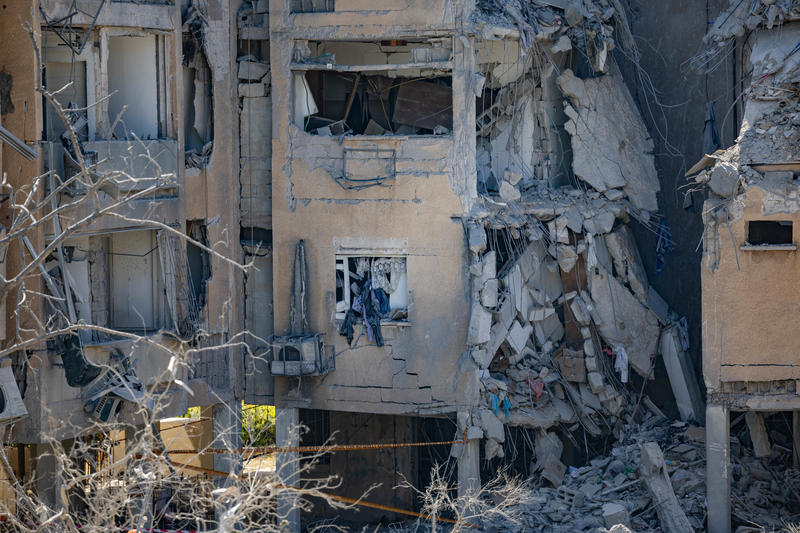
Scene from the city of Holon, where a ballistic missile fired from Iran hit civilian infrastructure, June 19, 2025.
Scene from the city of Holon, where a ballistic missile fired from Iran hit civilian infrastructure, June 19, 2025. Photo by Oren Ben Hakoon/Flash90

What’s happened: A large military exercise in Iran over recent days has heightened alert levels in the region and brought to the fore discussions in Israel, US, and elsewhere regarding the possible resumption of hostilities following the last June’s Twelve Day War.

  • Iranian state media reported missile tests in several regions of the country, including Khoramabad, Mahabad, Isfahan, Mashhad, and Tehran. Israeli intelligence assessments were that, although war was unlikely, Iran could use a broad missile test such as the one it carried out this week as a cover for launching a surprise attack on Israel. These concerns were conveyed by Israeli officials to their US counterparts, including by IDF Chief of Staff Zamir to Admiral Brad Cooper, the head of CENTCOM, in a call on Saturday.
  • The Iranian Foreign Ministry characterised the Iranian missile programme as purely defensive and non-negotiable. “Iran’s missile programme has been developed solely for the defence of the country and is fundamentally not a matter for negotiation,” the ministry’s spokesman, Esmaeil Baghaei, told reporters.  “The media hype is also part of a hybrid war that the Zionist regime, with the help of the United States and affiliated media networks, has long designed and pursued against the Islamic Republic of Iran,” he added.
  • In the days leading up to the missile tests, multiple western intelligence agencies reported “suspicious movements” of Iran’s Revolutionary Guards, heightening concern that war might break out, either by design or by miscalculation by one of the sides. These movements were connected not just to the missile test, but also to drone activity and air defence drills.
  • Prime Minister Netanyahu referred to the Iranian threat yesterday in remarks made after meeting the leaders of Cyprus and Greece, “We know that Iran has recently been conducting exercises. We have been following this, and we have been maintaining the necessary readiness. I want to make it clear to Iran: any action against Israel will be answered with very harsh retaliation.”
  • The consensus among observers is that Iran is actively seeking to restore and augment missile capabilities that were lost in the Twelve Day War in preparation for a future confrontation with Israel. US officials believe that, left unchecked, Iran could produce up to 3000 ballistic missiles per year.
  • The IDF has revealed that one of three Hezbollah operatives who were eliminated yesterday in southern Lebanon was serving simultaneously in the Lebanese Armed Forces (LAF). The Israeli Air Force struck a vehicle in the Sidon area, killing the three men that were, “engaged in efforts to repair terrorist infrastructure.” The IDF revealed that one of the Hezbollah terrorists had a dual role, serving simultaneously in a LAF intelligence unit. This disclosure comes amid numerous complaints that the LAF is not doing enough to enforce  the ceasefire mechanism and some of its personnel are affiliated with Hezbollah.

Context: The Iranian threat to Israel over the years leading up to the October 7 War and since has been understood in Israel as ranging over three categories: the nuclear programme, proxies, and missiles.

  • Current Israeli assessments are that Iran suffered major setbacks on all three, and that it has struggled to restore its capacities on the first two. On missiles, however, the picture is more daunting. Only 36 Iranian ballistic missiles made impact in Israel during the Twelve Day War, but these killed 32 Israelis and caused extensive property damage. Moreover, the threat of missiles during those days shut the Israeli economy down completely.
  • Besides ramping up missile production, the Iranians are also fortifying and modernising launch sites. They retain up to 75% of the mobile launchers they had at the beginning of the war, and are manufacturing new ones. And as for fixed sites, Iran is reportedly working to build hardened silos that are more resistant to Israeli and US attacks.
  • All this is happening on the backdrop of a severe domestic crisis in Iran. Tehran, the capital city and home to ten million people, is unable to supply its population with water. Local reservoirs operate at only ten percent capacity. Electricity throughout the country is limited to a few hours a day, and petrol is severely rationed. The Iranian rial is trading at historic lows, and emigration of educated Iranians continues despite the governments efforts to stop it.
  • The regime’s censorship and restrictions of internet access have not succeeded in dampening public dissent. Iran’s second-largest city, Mashad, was the scene of wide scale protests against the regime. Israeli officials are concerned that the Iranian leadership may see a new war with Israel as a way of distracting the public and shoring up support.
  • In addition to the domestic political crisis in Iran, the renewed Iranian armament project takes place in an evolving geostrategic environment. Western countries have long complained about Iranian-Russian cooperation on drone production, particularly as it impacts the war in Ukraine.
  • China is widely believed to be helping Iran on ballistic missile production, both in supplying raw materials and in providing technology transfers. Turkey’s role is murkier. Iranian proxies planning terror attacks on Israeli targets were believed to be operating in Turkey. Attacks on Israeli targets in Latin America were recently foiled by local police and intelligence forces. These are believed to have been planned by Hamas and Hezbollah command centres located in Turkey.

Looking ahead: Prime Minister Netanyahu is due to meet President Trump in Florida on December 29. He is expected to present the President with an Israeli dossier on Iran’s efforts to restore its ballistic missile arsenal as well as renew its nuclear programme and fund its network of terrorist proxies, including Hezbollah, Hamas, and the Houthis.

  • The two leaders are also expected to discuss the further implementation of ceasefire agreements in both Lebanon and Gaza, with the US side expected to exert pressure on Israel to move forward on promised territorial withdrawals in spite of the fact that other commitments — return of the last deceased hostage in Gaza and disarmament in both Gaza and Lebanon — have not yet been achieved.
  • Gaps exist as well between the Israeli and American positions regarding both Syria and Turkey, and these are expected to be discussed and possibly resolved during the leaders’ meeting.

November 27, 2025

Iran’s belligerence as its water crisis deepens

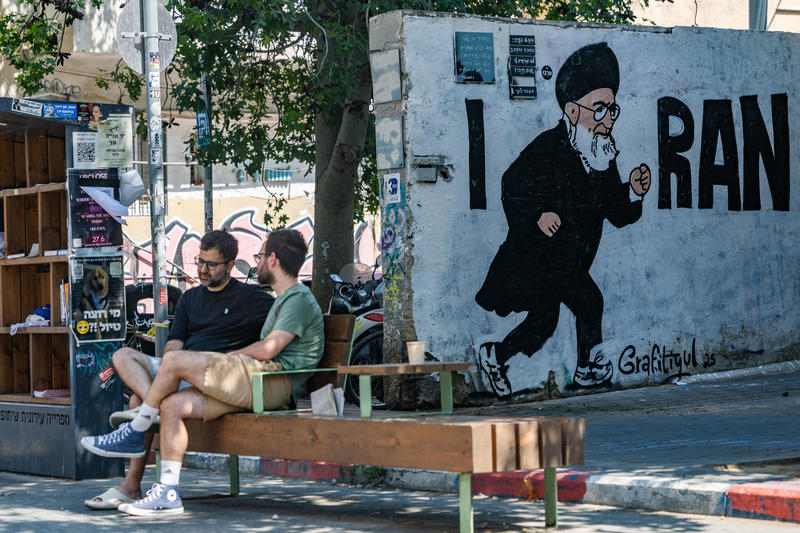
A mural depicting Iran’s Supreme Leader Ayatollah Ali Khamenei running, alongside the phrase “I RAN,” is seen on a street wall in Tel Aviv, July 21, 2025.
A mural depicting Iran’s Supreme Leader Ayatollah Ali Khamenei running, alongside the phrase “I RAN,” is seen on a street wall in Tel Aviv, July 21, 2025. Photo by Chaim Goldberg/Flash90 *** Local Caption *** איראן אירן ישראל עלי ח'אמנאי גרפיטי תל אביב קיר אנשים הולכים

What’s happened: Over the past few days, Iranian officials have issued several bellicose statements alongside occasional conciliatory backtracks about negotiations for a new nuclear agreement.

  • All this is happening on a backdrop of a severe domestic crisis and fallout from Iran’s performance in the Twelve-Day War it fought with Israel in June.
  • Iran’s Supreme Leader Ali Khamenei has largely avoided public appearances since then, but last week he was back calling Israel a “cancerous growth.” His line on both Israel and the US has been consistently aggressive, while the regime’s Foreign Minister Abbas Araghchi has been left to follow his remarks with renewed offers of negotiations.
  • Various media reports indicate that Iran is rushing to rebuild its air defences and its offensive missile capabilities in preparation for another confrontation with Israel. The New York Times reported that Iran aims to be able to fire 2000 missiles at Israel at a time, though there was no indication it was anywhere near such a capability.
  • While all this is going on, Iran’s two standing proxies, Hezbollah in Lebanon and the Houthi militias in Yemen, have largely refrained from using any firepower against Israel, despite absorbing blows from the IDF.
  • The Islamic Republic’s domestic hold continues to fray as its water crisis deepens. Six consecutive years of drought and massive neglect of basic infrastructure as Iranian public expenditures went to funding proxy armies and foreign propaganda efforts have left entire cities with limited water supplies.
  • Earlier this week Beni Sabti from the Institute for National Security Studies claimed over the last four months Iran has sent around one billion dollars to Hezbollah through smuggling routes in northern Iraq, Syria, and Turkey, despite the unprecedented domestic water crisis, rolling blackouts, and heavy air pollution.
  • Last week, the IAEA passed a new resolution demanding access to Iranian nuclear sites, as well as information regarding the stocks of uranium which Iran was holding in sites targeted by the US and Israel.
  • Iran has given no indication of what happened to this stockpile. IAEA Director-General Rafael Grossi stated publicly that the agency was ready to resume inspections and re-engage with Iran, but for now the Iranians are uninterested in any kind of cooperation.

Looking ahead: The most volatile front in the Israel-Iran conflict remains the Lebanese one. The United States are insisting on December 31 as the deadline for Lebanon to fully disarm Hezbollah, in keeping with the ceasefire agreement in Lebanon which went into effect one year ago following Israel’s decisive victory over Hezbollah.

  • Israeli policy makers expect Trump to blame Lebanon if his deadline is not met. At the same time, there is concern that US tolerance for offensive Israeli military action in Lebanon during a ceasefire might end or become more limited. This would mirror the situation in Gaza, where Israeli firepower has largely been restricted to immediate responses to armed actions by Hamas fighters against Israeli positions, rather than the pre-emptive operations Israel has been conducting almost nonstop since the Lebanese ceasefire went into effect.
  • Military analyst Yoav Limor, writing in Israel Hayom, posits that an all-out effort by the Lebanese Armed Forces to disarm Hezbollah by the deadline may be the only way to “save Lebanon from itself.” The odds of this happening, in his assessment, are extremely low, comparable to those of Lebanon joining President Trump’s Abraham Accords.

September 29, 2025

Snapback sanctions re-imposed on Iran

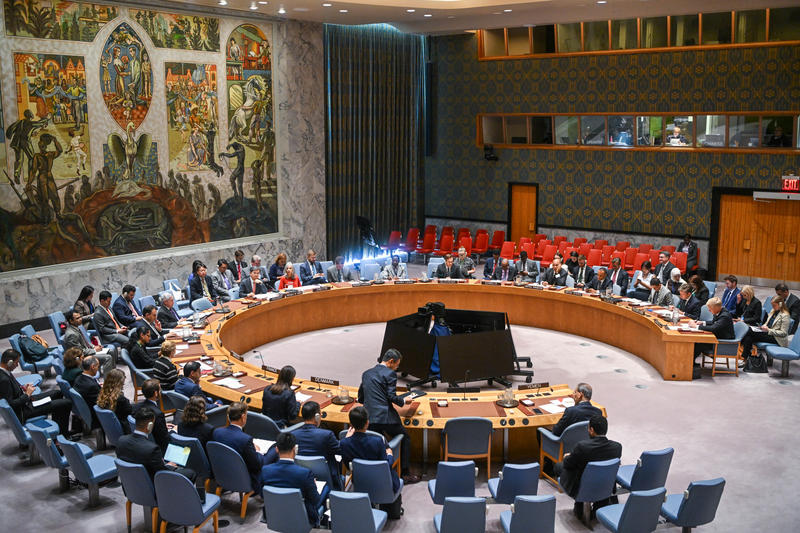
Ambassadors to the United Nations are seen during a session at the UN headquarters
Ambassadors to the United Nations are seen during a session at the UN headquarters in New York, USA, on September 15, 2025. Photo by Arie Leib Abrams/Flash90 *** Local Caption *** או"ם אום העצרת הכללית ניו יורק ארצות הברית

What’s happened: Over the weekend, the snapback sanctions mechanism against Iran was activated at the UN. 

  • The UK’s Ambassador to the UN Barbara Woodward explained the move noting, “Iran is defying the global non-proliferation regime. Iran’s nuclear escalation, as detailed in over 60 IAEA reports over the past six years, is a threat to international peace and security.”
  • She added, “Among the steps Iran has taken is the accumulation of a High Enriched Uranium stockpile which lacks any credible civilian justification and is unprecedented for a state without a nuclear weapons programme.”
  • The significant sanctions against Iran require compliance from all UN member states and reimpose sanctions that had been lifted ten years ago with the signing of the Joint Comprehensive Plan of Action (JCPOA) nuclear agreement. 
  • The sanctions include:
    • A ban on weapons sales to Iran.
    • Banning the sale or transfer of technology or components related to the Iranian nuclear programme and the ballistic missile project.
    • Freezing  state assets, company assets, and personal assets of individuals connected to the nuclear programme.
    • Travel bans for individuals connected to the nuclear programme.
    • Financial restrictions, including revoking access to the global SWIFT system for transferring funds for any entity or institution that supports Iran’s nuclear and missile programmes.
    • A ban on insuring Iranian merchant ships, including oil tankers.
    • Authority to stop for inspection and detain any Iranian vessel, including oil tankers, and to confiscate prohibited cargo. 
  • Scott Bessent, the US treasury secretary, noted that “Iran’s nuclear programme poses a threat to our peace and prosperity,” adding, “President Trump gave Tehran every opportunity to reach a deal, yet they remain unserious.” 
  • In a defiant message, Speaker of the Iranian Parliament Speaker, Mohammad Qalibaf, committed to continue to enrich uranium.
  • Overnight, Israel once more intercepted a missile that was fired from Yemen. Air raid sirens were activated in several places across central Israel.

Context: Provisions for snapback sanctions were part of UN Security Council Resolution 2231 which was passed at the same time that the JCPOA was signed. 

  • On 28 August, the E3 (UK, France, and Germany) triggered the snapback mechanism against Iran under the 2015 nuclear agreement, saying that there was “significant non-performance” by Iran of its commitments made under the deal. This started a 30-day period, where unless the trigger is withdrawn or a UN Security Council resolution is passed against it, all UN sanctions against Iran that have been lifted under the agreement will be reimposed. The E3 have called on Iran to resume talks.
  • Reimposing sanctions now was considered particularly urgent as clauses within the JCPOA restricting ballistic missile development were about to expire (one of the sunset clauses).
  • The snapback is considered a diplomatic success for Israel at the UN. Whilst the UK and France disappointed Israel last week with their unilateral recognition of a Palestinian state, Israel appreciates their stance on Iran.    
  • The snapback option was led by the E3, with the US unable to intervene after President Trump withdrew from the agreement during his first term in office in 2018.
  • The re-imposition of sanctions was partly possible due to Israel’s successful 12 day operation against Iran in the summer. Among Israel’s successes, they left Iran with:
    • No functioning enrichment site. 
    • No conversion capability of uranium gas into metal. 
    • Crippled missile manufacturing capability including the destruction of their missile assembly lines.
    • Bereft of key knowledge following the elimination of top tier nuclear scientists.
  • However, since the strikes Iran has already made an effort to rebuild some of this capacity. 
  • Most significantly Iran still has its stockpile of enriched uranium, estimated to be about 400 kg at 60 per cent enrichment. 
  • Last week Iran reportedly test fired an intercontinental ballistic missile and began to repair its missile array, allegedly with Chinese help.
  • Russia and China were unable to veto the move, as the mechanism had already removed that possibility. One of the key issues will now be if Russia and China will uphold these measures. According to the provisions of the sanctions any country that violates the terms will be liable for secondary sanctions.  
  • Whilst Israel is satisfied with the snapback sanctions, security officials remain wary that Iran is still a major power with the ability to covertly rush to build a nuclear bomb.   
  • Despite setting it back, Israel still views Iran’s ballistic missile programme as an existential threat. Israel continues to:
    • Carefully monitor Iran’s effort to repair and reconstruct their missiles.
    • Work alongside the US to persuade China and Russia not to assist Iran. 
    • Improve Israel’s anti-missile defence systems, including the development of lasers.   
    • Continue to strengthen Israeli deterrence, including implied threats that they could strike Iran again.
  • Internally Iran is weakened, their currency is at a new historic all time low and the country is also suffering from water and electricity shortages. 
  • In August Prime Minister Netanyahu delivered a message to the Iranian people telling them, “Israel is the no. 1 recycler of water in the world. We recycle 90 per cent of our waste-water. And we lead the world in desalination. We know exactly what to do so Iran can also have plentiful water. Almost a decade ago, I opened a Telegram channel in Farsi to teach water management to Iranians. 100,000 Iranians joined almost instantly. The thirst for water in Iran is only matched by the thirst for freedom…..The moment your country is free, Israel’s top water experts will flood into every Iranian city bringing cutting-edge technology and know-how. We will help Iran recycle water, we’ll help Iran desalinate water.”
  • During Netanyahu’s address to the UN last Friday he wore a sticker on his lapel with a QR code that documented the October 7 atrocities. According to his office this has been scanned over 1 million times, with approximately 30% of the scans originating in Iran or Gaza.

Looking ahead: Later today Prime Minister Netanyahu will meet President Trump in the White House, for a fourth time this year.    

  • The top item on the agenda is to reach an agreement over Trump’s 21 point plan to end the Gaza War and secure the release of all 48 remaining hostages, now held 724 days. 
  • There are a range of other regional issues also on the agenda including: Iran, a security arrangement in Syria, and the ongoing attacks on Israel from the Houthis in Yemen.

August 29, 2025

E3 initiates process for snapback sanctions on Iran

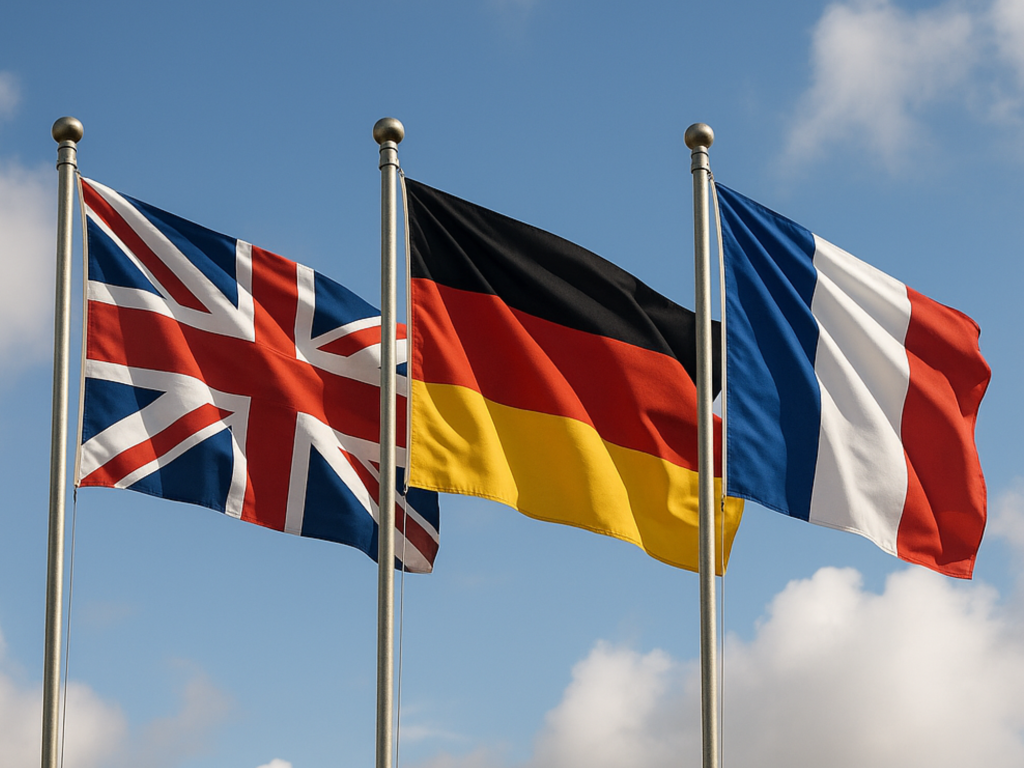
Hyperrealistic image of three flags — United Kingdom, Germany, and France — on tall flagpoles waving in the sky.
UK, Germany, and France flags waving side by side. AI-generated visual, OpenAI, 2025.

What’s happened: The foreign ministers of UK, France and Germany (E3) announced “snapback mechanism” at the UN Security Council, initiating a 30-day process to restore international restrictions and sanctions targeting Iran’s nuclear and missile programmes.

  • In their joint statement they declared  shared “fundamental objective that Iran shall never seek, acquire or develop a nuclear weapon.” 
  • They noted Iranian violations of the JCPOA nuclear agreement over the last six years including exceeded limits on enriched uranium, heavy water, and centrifuges, as well as restricted ability to conduct verification and monitoring activities.
  • Whist emphasising that despite the US withdrawal from the agreement the E3 “consistently undertook intensive diplomatic efforts to deescalate tensions and to bring Iran and the United States to the negotiating table for a comprehensive negotiated solution. We acted in good faith to preserve the JCPOA, in the sincere hope of finding a way to resolve the impasse through constructive diplomatic dialogue, while preserving the agreement and remaining within its framework.” Listing numerous efforts to reach understandings.  
  • However, “today, Iran’s non-compliance with the JCPOA is clear and deliberate, and sites of major proliferation concern in Iran are outside of IAEA monitoring. Iran has no civilian justification for its high enriched uranium stockpile – now over 9 Significant Quantities – which is also unaccounted for by the IAEA. Its nuclear programme therefore remains a clear threat to international peace and security.” The significant quantities of nuclear material are designed to produce nuclear bombs.  

Context: Alongside the threat posed by Iran’s nuclear programme. Israel continues to fight with Iranian proxies, particularly Hamas and the Houthis. 

  • The Israel Air Force carried out its latest strikes on the Houthis on Thursday. Instead of striking military and infrastructure (as they have in the past), this attack appears to have targeted several senior Houthi officials that had gathered in Sanaa to watch a speech from their leader, Abdul-Malik al Houthi. As yet unconfirmed, Arab media sources have reported that the Houthi prime minister, Ahmed al-Rahawi, was among those eliminated. 
  • The Houthis have launched close to 100 missiles and drones towards Israel since March 2025, the vast majority have been intercepted, whilst in May one landed within the perimeter of Ben Gurion Airport. 
  • For years, due to other operational priorities Israel did not carry out substantial intelligence gathering against the Houthis, relying instead on the US. In recent months Israel has sought to build up their intelligence picture, if these strikes are successful it would mark another significant achievement for both Israeli intelligence and air force capability. 
  • Also on Thursday, the UK government has imposed unilateral restrictions on Israel’s official participation at the Defence and Security Equipment International (DSEI) exhibition, scheduled to take place in London in September.
  • According to Israel’s MOD, “these restrictions amount to a deliberate and regrettable act of discrimination against Israel’s representatives.” Further noting, “At a time when Israel is engaged on multiple fronts against Islamist extremists and terrorist organisations – forces that also threaten the West and international shipping lanes – this decision by Britain plays into the hands of extremists, grants legitimacy to terrorism, and introduces political considerations wholly inappropriate for a professional defence industry exhibition.”
  • The UK’s decision is particularly disappointing in light of the two countries shared threats assessments and self-defeating as its denying a platform for presenting battle tested technology from a trusted ally.
  • In another UK connected regional development, it was recently revealed that former Prime Minister Sir Tony Blair has been working alongside the Trump administration, developing a detailed plan for the future of Gaza governance and reconstruction. Although not yet full announced the plans includes provisions for expanding the food supply, housing and education. The idea appears to begin with the implementation process in the southern Gaza Strip, which is under IDF control and is relatively stabilised. 
  • Following his stint as prime minister, Blair led the Quartet’s efforts to reinvigorate a peace process between Israel and the Palestinians. Under his leadership they declared three principles beholden on Hamas (that were never met):
    • Declare an end to terror attacks.
    • Recognise the State of Israel.
    • Respect previous agreements signed between Israel and Palestinian representatives.   
  • In the meantime the IDF announced two additional humanitarian aid distribution centres will be be established in the southern Gaza Strip. The IDF also declared, “since the end of May until now, more than 2.3 million weekly food packages have been distributed to families through the four existing centres.”
  • Despite continued protests inside Israel calling for the hostages to be released, there appears little prosect for a deal before the IDF’s planned incursion into Gaza City.  However, according to the latest comments by US Special Envoy Witkoff, Hamas has signalled that it would be receptive to reaching an arrangement, and that Israel also wants to negotiate an end to the war and the hostages’ release.
  • In preparation of the planned IDF operation into  Gaza City, IDF Arabic-language spokesperson Col. Avichay Adraee issued a statement to residents telling them, “There is no alternative to evacuating Gaza City. Every family that moves south will get the most humanitarian aid possible, which the IDF is working to expand at this time. We have already begun the work of setting up tents, preparing areas where aid centres can be established and laying water infrastructure.” Hamas has continued to warn citizens to ignore the IDF and remain in situ.   

Looking ahead: The snapback process now opens a 30-day period before reimposing sanctions “and other restrictive measures” via the UN Security Council resolutions. 

  • The statement concludes, “if the UNSC does not adopt within 30 days a resolution to continue the lifting of UNSC resolutions on Iran, six Security Council resolutions, including on sanctions, will be restored.”
  • The IDF continues the preparations for an assault on the Hamas strongholds in Gaza City. 
  • The security cabinet is scheduled to meet on Sunday to discuss plans for conquering Gaza City and to authorise the operational plans that were presented to the defence minister and the prime minister.

July 16, 2025

Deadline set for snapback sanctions on Iran

Flags of the United States, the United Kingdom, France, and Germany, blowing in the wind.

What’s happened: The US, UK, France, and Germany have agreed on a joint deadline of August 31 for snapback sanctions to come into effect against Iran if no new nuclear agreement is reached by then.

  • US Secretary of State Rubio held a phone call with the three European countries’ Foreign Ministers yesterday, and all four agreed on the ultimatum.
  • The so-called “snapback” would restore the sanctions that were on Iran prior to the 2015 nuclear agreement known as the JCPOA. It would take a full month for the sanctions to come into force.
  • A deadline of August 31 for reaching a deal creates a very tight space for negotiations, which have not yet formally begun, on a range of complex issues. On the other hand, the Europeans were keen for an early deadline so that the sanctions, if implemented, could be carried out before Russia assume the presidency of the UN Security Council on October 1.
  • Also related to Iran, a new report on ballistic missile strikes on Israel during the Twelve Day War in June show that the Iranians were able to recalibrate their attacks on Israel to exploit gaps in Israel’s missile defence. According the Wall Street Journal, by the war’s final days, Israel’s interception rate was less than half what it was at the beginning. Thus the Iranians were landing more missiles on Israeli cities at the end of the war despite launching significantly fewer.

July 11, 2025

Parliamentary report highlights the Iranian threat in the UK

View of Elizabeth Tower
View of Elizabeth Tower, on the South Bank of the Thames, in London. September 20, 2022. Photo by Nati Shohat/Flash90 *** Local Caption *** לונדון אנגליה ביג בן

What’s happened: The British Parliament’s Intelligence and Security Committee (ISC) published its long awaited report on Iran and the threats it poses to UK national security. 

  • One of its key findings is that the threat posed by Iran is major, and now equal to that of Russia.
  • Its contents primarily take the form of declassified intelligence and interviews with senior officials from MI6, MI5, GCHQ, the Cabinet Office, and Home Office.
  • According to the report, Tehran strategic priorities include:
    • Reducing British military presence in the Middle East.
    • Undermining its relationship and alliance with the US and Israel.
    • Suppressing criticism of the Islamic Republic, especially among UK-based dissident exiles and journalists. An increased threat to Jewish and Israeli interests is also noted.
  • One key finding is that Iran views the UK as one of its most significant adversaries, only behind the US, Israel, and Saudi Arabia. The report also found that the threat of assassination and violence by Iran and its proxies had reached the same level as Russia, and is accompanied by a “significant espionage threat” involving multiple intelligence agencies, including the Ministry of Intelligence and Security (MOIS), IRGC Intelligence Organisation, and IRGC Quds Force. According to the report, both the MOIS and various arms of the IRGC “pose a significant threat to UK national security.”
  • While describing the Iranian threat as “more narrowly focused and opportunistic than the more strategic, all-encompassing and well resourced threats from Russia and China,” the report emphasised that “it should not be underestimated given its persistence” highlighting its “ferociously well resourced” intelligence services and “a high appetite for risk when conducting offensive activity, which means it poses a dynamic and erratic threat.”
  • The following areas were also identified as specific threat elements against the UK and its interests:
    • Physical attacks, i.e. “assassination as an instrument of state policy – targeting dissidents is a high priority for both the Ministry of Intelligence and Security (MOIS) and the IRGC”.
    • Irans’ nuclear weapons programme.
    • Espionage – utilising cyber capabilities and human agents. Iran’s cyber threat is described as manifesting itself “acutely”, being significantly easier to deploy than human agents given a difficult operating environment.
    • Offensive cyber operations, such as attacks on critical national infrastructure.
    • Political interference activity.

Context: Iran has long been understood to pose a major threat to the UK’s national security, but this report is the first time intelligence about its activities and operations has been declassified and made public.

  • In September 2024, GCHQ issued a joint statement with the FBI and US Treasury warning of “the ongoing threat from spear-phishing attacks carried out by cyber actors working on behalf of the Iranian government”, with targeting prioritising “individuals with a nexus to Iranian and Middle Eastern affairs, such as current and former senior government officials, senior think tank personnel, journalists, activists and lobbyists.”
  • In October 2024, MI5’s Director General, Ken McCallum, disclosed that the service had “responded to twenty Iran-backed plots presenting potentially lethal threats to British citizens and UK residents”. These plots are understood to have primarily targeted prominent dissident activists, journalists, Israelis, and members of the Jewish community.
  • In November 2024, a former British Army soldier, Daniel Khalife, was found guilty of having spied for Iran and sentenced to over 14 years in prison for espionage and terrorism offences, including breaches of the Official Secrets Act and eliciting or attempted to elicit information of a kind likely to be useful to a person committing or preparing an act of terrorism.
  • In May 2025, three Iranian men were charged with assisting a foreign intelligence service under the National Security Act following their arrest on suspicion of plotting an attack on the Israeli Embassy in London. Their plea hearing has been scheduled for September 26, and in the event they plead not guilty their trial will take place in October 2026.
  • Iran International, the dissident TV channel, has faced a significant number of attempted attacks by the regime in Tehran. In February 2023, it was forced to temporarily relocated to Washington, DC, due to credible and increased threats. In December of the same year, Magomed-Husejn Dovtaev was found guilty of one charge of attempting to collect information useful for terrorism after surveilling the station’s West London premises.
  • This report marks the culmination of years of research and testimony. While it finished taking evidence in August 2023 and therefore did not respond to the Iranian threat post-7th October, the ISC advised that its findings are still relevant despite a changed and changing regional landscape.

Looking ahead: While the ISC welcomed and praised some of the British government’s recent policy measures against Iran, it was nevertheless critical of the overall approach taken, which it said “suffered from a focus on crisis management and has been primarily driven by concerns over Iran’s nuclear programme – to the exclusion of other issues” and that “fire-fighting has prevented the Government from developing a real understanding of Iran, with a lack of Iran-specific expertise across Government”.

  • From 1 October, enforcement of the Foreign Influence Registration Scheme (FIRS) will begin, with individuals acting under Iran’s direction required to register or face up to five years in prison. The Home Office launched the scheme on 1 July, with a three-month grace period for compliance.
  • The Government is expected to introduce new legislation to close the legal gap preventing the proscription of the IRGC, as confirmed earlier this week by the Minister for the Middle East, Hamish Falconer. However, details of the proposed solution and its timeline remain unclear.
  • Powers to ban state-backed groups that threaten UK national security – outside the framework of existing counter-terror laws – are expected to be developed, after the Home Secretary committed in May to drafting new legislation to that effect.
  • According to the Guardian, “the report will feed into the full government response to the review conducted by Jonathan Hall KC, the independent reviewer of terrorism legislation, into a new proscription mechanism surrounding state-sponsored terrorism.”

July 9, 2025

Trump and Netanyahu meet for a second time

Prime Minister Netanyahu and President Trump
Prime Minister Netanyahu and President Trump. Photo credit: Prime Minister of Israel / X

What’s happened: Prime Minister Netanyahu met President Trump in the Oval Office last night. It was the second meeting of the two leaders in as many days. 

  • Although there was no media event before the meeting, and no joint statement was released when it ended, reports indicated that the discussion centred around negotiations to bring about a new ceasefire and hostage deal, and that President Trump exerted “heavy pressure” on Netanyahu to come to an agreement.
  • After the meeting was over, Netanyahu said in Hebrew, “We focused on the efforts to free our hostages. We haven’t relented from that for a moment, and this has become possible because of the military pressure that is being exerted by our heroic soldiers. Regrettably, that effort has exacted from us painful prices, the fall of the best of our sons, but we are determined to achieve all of our objectives: The release of all of our hostages, the living and the deceased alike; the elimination of Hamas’s military and governmental capabilities; and, by so doing, to ensure that Gaza does not pose a threat to Israel anymore.”
  • Also at the White House yesterday, a Qatari delegation arrived to discuss the hostage deal. It is not known if they met with any Israeli officials.
  • Israel allowed 22 trucks loaded with aid from the international community to enter the northern Gaza Strip, where Israel’s preferred aid distribution mechanism, the Gaza Humanitarian Foundation, does not operate.
  • The UK maritime security firm Ambrey confirmed yesterday that the bulk carrier Magic Seas had sunk in the Red Sea. It had earlier come under a combined attack by Houthi forces using rockets and explosive-laden remote control boats. Another bulk carrier, Eternity C, was also attacked in a similar manner yesterday with four people killed.
  • Two senior terrorists were eliminated in separate IDF operations in Lebanon yesterday. In southern Lebanon, Israel targeted Hussein Ali Muzhir, the head of firepower for the Zahrani sector in Hezbollah’s Badr Unit. In Tripoli, in the north, an IAF air strike eliminated Maharan Mustafa B’ajur, a key Hamas commander in Lebanon.

Context: There has not yet been a breakthrough, but reports in Arab media indicated that Trump’s special envoy Steve Witkoff could be headed to Qatar in the coming days to announce the finalisation of an agreement on a ceasefire and hostage release

  • It is widely understood that he will not go to Qatar unless the sides have actually reached an agreement. According to Witkoff himself, most of the outstanding issues of contention have been resolved in the last few days. “We had four issues, and now we’re down to one after two days. I’m hopeful that by the end of this week, we will have an agreement that will bring us into a 60-day ceasefire.” 
  • Witkoff did not itemise the issues he was referring to, but they are largely believed to be related to aid and aid distribution, military redeployments, the conditions for ending the war, and the involvement of outside parties in postwar Gaza governance.
  • Among the issues that have ostensibly been resolved in the negotiations is the question of humanitarian aid deliveries. The sides have apparently agreed to some neutral mechanism for areas that the IDF vacates in the ceasefire. This arrangement will not cover areas still under Hamas control, nor will it cover areas that remain under IDF control, where the Gaza Humanitarian Foundation is expected to continue operating. But it will mean that the GHF cannot operate in areas currently under Israeli control, from which Israeli forces will withdraw during the 60-day ceasefire. For Israel, this is a recognition that the sheer amount of aid that is expected to enter Gaza during the ceasefire is beyond the operational capacity of the GHF.
  • Hamas has throughout insisted on guarantees that the ceasefire could lead to an end of the war. According to a report from Sky News, Trump conveyed a personal message to Hamas via Palestinian-American businessman Bishara Bahbah with his commitment to end the war. The contents of the message were not released, but, according to the report, they were sufficient to convince the Hamas leadership in Qatar. At the same time, Israeli officials have repeated their commitments not to end the war until Hamas is eliminated as a governing authority in Gaza and a military threat to southern Israel. 
  • The last issue under contention appears to be related to IDF redeployments during the ceasefire. Hamas demands that Israel withdraw down to the Philadelphi Corridor, the area along the border with Egypt, while Israel has agreed only to withdraw to the Morag Corridor, this would leave the city of Rafah under IDF control.

Looking ahead: If an agreement is indeed reached, Steve Witkoff is expected to arrive in Doha either Friday or Saturday to announce its immediate implementation.

  • When Netanyahu returns to Isreal, he will face a deepening coalition crisis over the Haredi draft exemption. A major ultra-orthodox newspaper, Yated Ne’eman, published an editorial this morning highly critical of Prime Minister Netanyahu for allegedly not fulfilling his promises to the ultra-orthodox public to protect them from the draft. It compared Netanyahu to Churchill, both as a “brilliant and talented” leader in war and one who was ousted from power once the war was successfully ended.
  • A compromise deal reached between the Prime Minister and the Attorney General will allow the Prime Minister to nominate a new appointee to head the Shin Bet in 60 days. By that time, the agency is expected to conclude its investigation into the so called Qatargate affair. With the investigation concluded, the possible conflict of interest which had, according to the Attorney General, rendered Netanyahu’s earlier appointment nomination illegal, will have been lifted. The nomination will then go to the Senior Appointments Advisory Committee.

Newsletter sign-up

Please enter your information below to subscribe to our daily newsletter and stay updated and informed.

Donate to BICOM

At BICOM, we rely on the generosity of people like you to keep our website and services running. Your donation, no matter the size, makes a real difference. Please consider supporting us today. For further information please email: [email protected]