LATEST

Hamas and the Muslim Brotherhood

Key background
  • Hamas is an Islamist Palestinian nationalist movement which currently governs the Gaza Strip. It is proscribed by the UK and in the majority of western countries.
  • Its primary state backers are Iran, Turkey, and Qatar. It is also active in the West Bank, East Jerusalem, Syria, and Lebanon.
  • Since seizing control of the Gaza Strip in 2007, it has continuously launched attacks against Israel and weaponised civilian infrastructure by embedding itself into schools, mosques, and hospitals.
  • Hamas’s 7th October attacks on southern Israel killed 1200, and over 250 hostages were subsequently taken to the Gaza Strip.
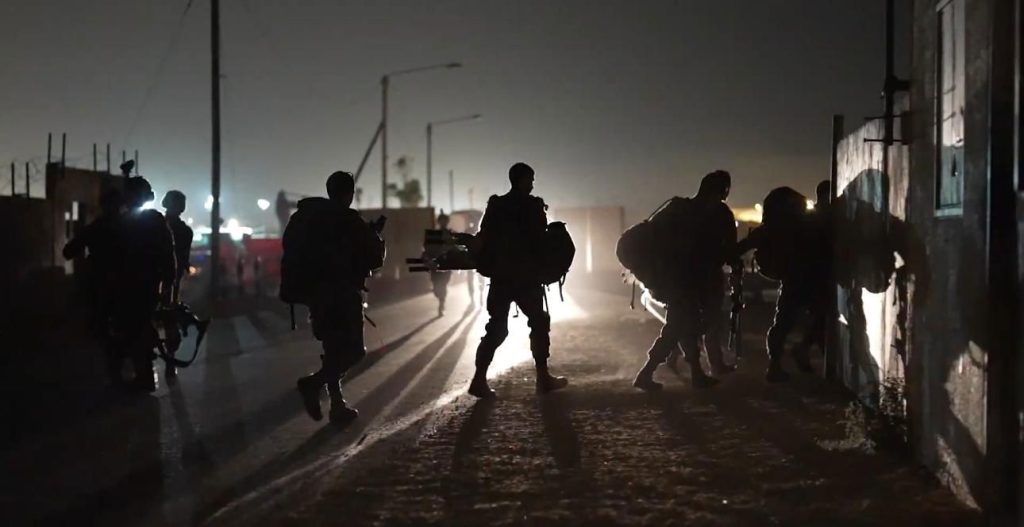
IDF forces expand ground maneuvers in Gaza City.
IDF forces expand ground maneuvers in Gaza City. Photo credit: IDF

Updated September 16, 2025

IDF mounts pressure on Hamas as Arab states meet in Qatar

What’s happened: The IDF has indicated that it has now “begun destroying Hamas infrastructure in Gaza City”, suggesting that its promised offensive has now begun earlier than anticipated. Israeli tanks were reported in Gaza City, and it is estimated that approximately 350,000 have evacuated to different parts of the Gaza Strip.

  • Objectives remain unchanged, namely dismantling Hamas and bringing the hostages home.
  • Two divisions are operating, and more will join them in due course. The IDF is working to set the conditions for civilians to distance themselves from combat zones and move into humanitarian areas.
  • Now that this offensive has begun, its priorities will be encircling and operating deeper within Gaza City. It follows close to two years of war since Hamas’s attacks on southern Israel on 7th October 2023, and is hoped to dismantle the terrorist group in its final bastion in the Gaza Strip.
  • Approximately 60,000 reservists were called up for this operation, augmenting the 70,000 already in reserve service.
  • Following Israel’s air strikes on Doha last week, Arab and Islamic leaders have met at an emergency summit convened in the Qatari capital. A joint Arab League and Organisation of Islamic Cooperation session, it included close to sixty countries including both Iran, all three Arab Abraham Accords signatories (the UAE, Bahrain, and Morocco), as well as Egypt and Jordan.
  • The summit was concluded with a joint statement calling for “all states to take all possible legal and effective measures to prevent Israel from continuing its actions against the Palestinian people…[including] reviewing diplomatic and economic relations with it, and initiating legal proceedings against it”, though it is unclear what practical steps will be taken in its aftermath, if any.
  • Commenting at the summit, the Iranian President, Masoud Pezeshkian, alleged that last week’s airstrike amounted to “pure terrorism”, and that no Arab or Muslim capital was safe from similar strikes. This condemnation comes despite Iran themselves also firing a ballistic missile at US bases in Qatar in June.
  • Qatar’s Emir, Sheikh Tamim bin Hamad Al Thani, accused Israel of having no genuine interest in peace, attempting “to thwart negotiations”, and pledged to “do whatever is necessary to preserve our sovereignty and confront Israeli aggression.”
  • It is unclear how Qatar may do this, especially given its post-strike statements that it will continue to mediate ceasefire and hostage release negotiations between Israel and Hamas.
  • Egypt has also reportedly called for the establishment of a Cairo-based joint Arab military command that would operate in a similar manner to NATO, providing assurances of mutual defence against external aggression and attacks.
  • Despite their attendance at the Doha summit and prior statements condemning Israel’s air strikes, none of the Abraham Accords signatory countries sent heads of state, instead being represented by senior officials.

Context: US Secretary of State Rubio is partway through a regional trip to visit both Israel and Qatar. He is now due to visit the UK for meetings with the Foreign Secretary, Yvette Cooper, and “to join President Trump’s delegation for his unprecedented second State Visit.”

  • While in Israel, Rubio reaffirmed that Washington’s priorities were the release of Israeli hostages and the destruction of Hamas, and refrained from directly criticising the Doha air strike in his public comments alongside Netanyahu.
  • Earlier this morning while travelling to Doha, Rubio also warned of a “short window” in which to secure a ceasefire in Gaza while praising Qatar for its ongoing mediation of negotiations between Israel and Hamas.
  • In a speech on Monday, Prime Minister Netanyahu also admitted that Israel was becoming increasingly isolated at a conference hosted by the Finance Ministry, specifically blaming Muslim immigration within the EU and online Qatari and Chinese propaganda.
  • Netanyahu said part of this isolation was economic, with Israel needing to become more self-reliant. The Prime Minister singled out the arms industry as one where Israel would come to rely more on domestic production than on trade, expressing out loud what has been a growing consensus in Israel since the war began nearly two years ago.
  • In the part of the speech that was most quoted, especially by critics of the Prime Minister, he said, “We are Athens and Sparta. But we’re going to be Athens and super-Sparta.”
  • Leader of the Opposition Yair Lapid responded that “isolation isn’t fate, it’s the product of the wrong and failing policies of Netanyahu and his government,” while former Prime Minister Ehud Barak said, “’Super Sparta’ is the end of the country: economically, politically and militarily.”

Looking ahead: Last night, Canada, France, Egypt, Jordan, Qatar and UK held a call to discuss “advancing peace”. Chaired by President Macron of France, a subsequent readout said that “all leaders agreed that the focus must remain on advancing peace and security, including reaching a lasting ceasefire, securing the release of all hostages and the disarmament of Hamas, and scaling up flows of life-saving assistance for Palestinian civilians.”

  • Ahead of President Trump and Secretary Rubio’s visit to London, it is likely that Prime Minister Starmer will raise these points, and attempt to further align the UK and US in calling for and advancing an immediate ceasefire and the release of hostages in Gaza, as well as increased aid provision.
September 15, 2025

US Secretary of State Rubio in Israel as Gaza offensive looms

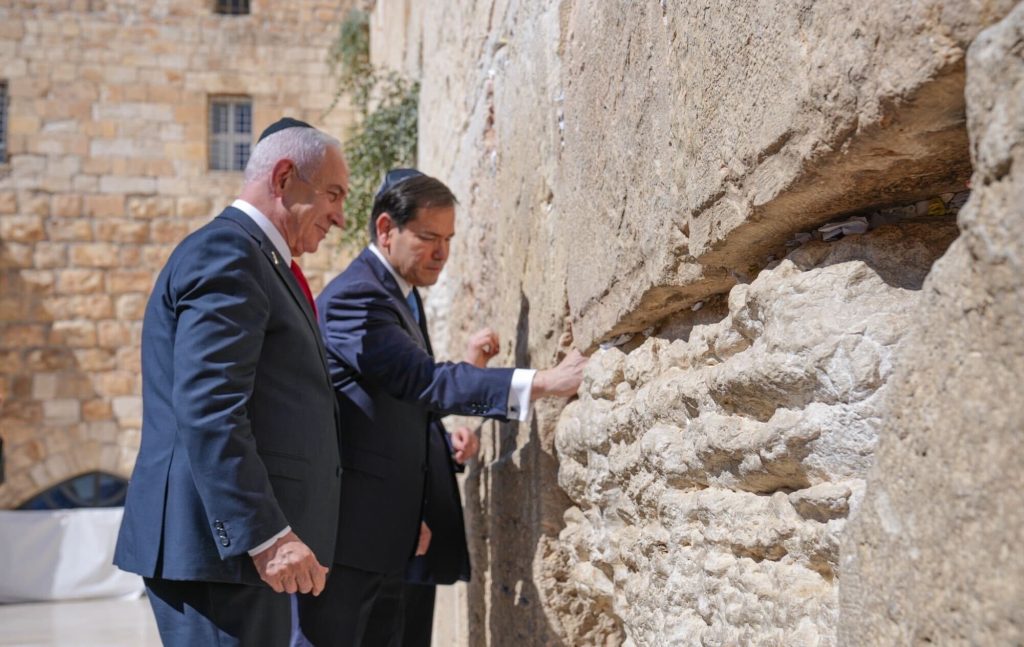
Secretary of State Marco Rubio and Prime Minister Benjamin Netanyahu at the Western Wall in Jerusalem
Secretary of State Marco Rubio and Prime Minister Benjamin Netanyahu at the Western Wall in Jerusalem. September 14, 2005. Photo credit: Secretary Marco Rubio / X

What’s happened: IDF preparations for a major ground offensive into Gaza City continue apace. Four high-rise towers in the city that the army claims were being used by Hamas were destroyed yesterday following evacuation orders. Similar tower strikes have been happening over the course of the last week as the IDF moves forces into the outskirts of the city.

  • According to IDF estimates, up to 300,000 people of the nearly one million who were sheltering in Gaza have already evacuated. The IDF believes that most of the rest will leave only when a major ground incursion begins. 
  • Haaretz reports that reconstruction work is underway on the European Hospital in Khan Yunis in the southern Gaza Strip, and that two additional field hospitals are being set up, also in the southern part of the Strip. A new water pipeline connecting the humanitarian zone in al-Muwasi was connected to Egypt, and another power line was connected to an existing desalination facility.
  • US Secretary of State Marco Rubio arrived in Israel yesterday and traveled to the Western Wall in Jerusalem, accompanied by Prime Minister Netanyahu. Today he is meeting with Prime Minster and other top officials to discuss the war in Gaza and other topics. He told journalists that the US was “not happy” with the Israeli air strike in Qatar last week.
  • Yesterday, Trump said Israel must “be very careful” and take action against Hamas, but emphasised Qatar’s importance. “Qatar has been a great ally to the U.S. A lot of people don’t know that. The emir is a wonderful person, actually.” Trump described Qatar as “a great ally.”
  • According to media reports, Israeli officials are expected to raise with Rubio the possibility of Israel annexing some of the West Bank in response to the planned recognition of a Palestinian state later this week by a number of countries, including France and the UK.
  • Foreign Minister Gideon Saar briefed diplomats in Jerusalem yesterday on Israel’s moves in Gaza and the West Bank.
    • Regarding the West Bank and the possibility of some kind of limited annexation, he said that no decision had been made yet.
    • Regarding a Palestinian state, he reiterated his opposition, and added that this was the overwhelming position of both Israeli officials and the Israeli public. Such a state, he said, would have as its “sole objective” the destruction of Israel.
    • On Gaza, he said that Israel had no interest in “controlling Palestinian’s lives there,” and spoke instead of a transitional period, possibly under an international mandate, as part of a comprehensive plan for the “day after” which was being worked out with the Americans.
  • It was reported yesterday the Royal College of Defence Studies had decided to exclude Israeli participants from its programs in the next academic year. Critics of the move compared this exclusion unfavourably with the open door the College maintains to non-allied non-democratic countries, such as China. Amir Baram, Director General of the Israeli Ministry of Defence and himself an alumnus of the Royal College, called the decision “a profoundly dishonourable act of disloyalty to an ally at war.”

Context: The Security Cabinet met last night to discuss the hostage crisis. Maariv reports that the meeting ran for more than three hours and covered a long list of scenarios, including that Hamas might harm the hostages as the IDF moved into  its last redoubts in Gaza City. The Israeli television station Channel 12 reported that Israel had formulated measures to be carried out in response to any Hamas move to harm the hostages, but did not specific what those measures might be.

  • IDF Chief of General Staff Eyal Zamir spoke with MKs in the Knesset Committee for Intelligence Affairs, a subcommittee of the Foreign Affairs and Defence Committee and a rare forum outside the Government where officials have access to highly classified briefings and intelligence. Multiple leaks from the committee meeting indicate Zamir’s dissatisfaction with the Government’s decisions on the Gaza offensive due to begin soon.
  • Zamir was quoted as not knowing what the Government’s goals in the operation were, including if the end result would be a full military administration of the territory, something the IDF has sought to avoid. Such direct military rule existed in Gaza from 1967 to 1994 and is expected to be a much more onerous task now than it was 31 years ago when it came to an end.
  • Zamir was widely quoted in the press as saying that even a successful operation in Gaza City would not defeat Hamas, and ultimately Israel would be pushed to mounting another offensive in the refugee camps in the central region of the Gaza Strip. 
  • Yedioth Ahronoth reports that Zamir specifically criticised the Gaza Humanitarian Foundation, the aid mechanism that was established to bypass the UN and Hamas. He also told the Knesset committee that even in a siege, the IDF would continue to allow humanitarian aid into Gaza.
  • Zamir told MKs that the Government’s plan put hostages at risk, put soldiers at risk, and did not have sufficient international legitimacy.
  • There are also reports that Hamas has moved living hostages above ground into homes and tents in Gaza in an effort to make them into human shields. A video released this week of one hostage, Guy Gilboa-Dalal, showed him in the back seat of a car above ground.

Looking ahead: Qatar will host an “emergency summit” today in Doha of Arab and Muslim countries to formulate a response to Israel’s attack on Hamas leaders in its capital last week. Despite reports of Egyptian attempts to create a formal military alliance, the draft resolution circulated before the summit includes strong condemnatory language but no practical measures. 

  • The Israeli public broadcaster’s Kan radio news bulletin reports that Israeli officials are bracing themselves for a wave of public condemnations once the IDF’s operation in Gaza City gets underway. 

September 10, 2025

Doha air strike triggers diplomatic storm and hostage concerns

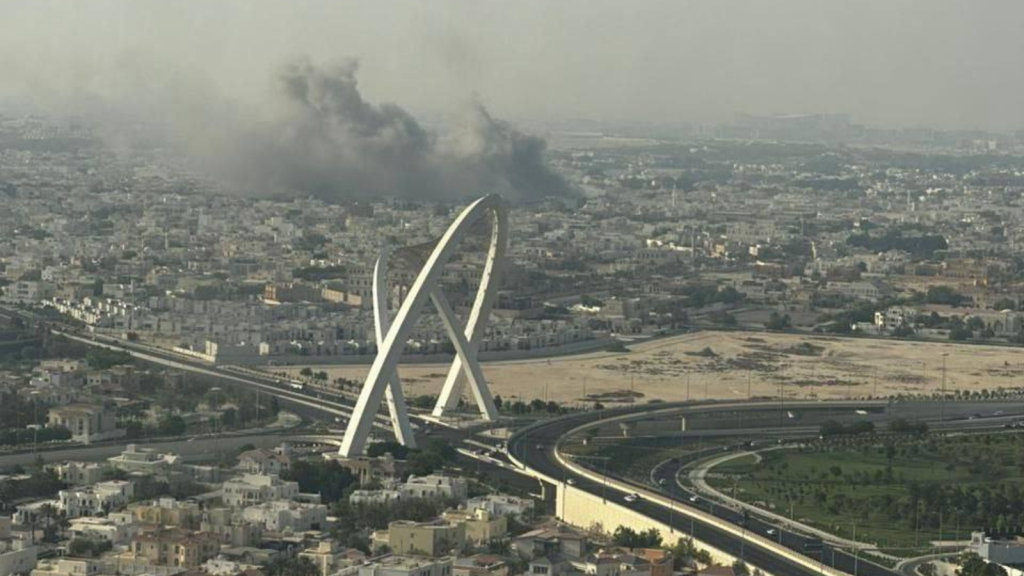
Smoke rises over Doha following the Israeli air strike targeting Hamas leadership on September 9, 2025.
Smoke rises over Doha following the Israeli air strike targeting Hamas leadership on September 9, 2025. Photo credit: X

What’s happened: The IDF and Shin Bet launched an attack on the Qatari capital of Doha yesterday in what is being described as “a precise strike targeting the senior leadership of the Hamas terrorist organisation.” The mission was led by the Israeli Air Force, with ten to fifteen jets participating and firing ten munitions at a single target. The US were informed of the operation as it was underway.

  • It is understood that the Hamas ceasefire negotiation delegation was targeted including the Hamas leader in Gaza, Khalil al-Hayya, Zaher Jabarin, who leads Hamas in the West Bank, Muhammad Darwish, head of Hamas’s Shura Council, and Khaled Mashaal, head of Hamas abroad.
  • While six individuals are reported to have been killed, five of those named were more junior Hamas members and one Qatari police officer. Thus far, there is no confirmation that the senior leaders have been killed while Hamas claims that they survived. Israeli defence officials are increasingly pessimistic that the intended targets were eliminated.
  • The international community has almost universally condemned the strike. Prime Minister Starmer said that it was a violation of Qatar’s sovereignty, and risked further escalation across the region while reiterating his calls for an “immediate ceasefire, the release of hostages, and a huge surge in aid into Gaza.”
  • President Trump said that “we are not thrilled about the way that went down today” while conceding that eliminating Hamas was a “worthy goal”, while the UAE condemned the attack “in the strongest terms,” while its Foreign Minister said the country was in “full solidarity with dear Qatar.” Saudi Arabia offered its “full support for the sisterly State of Qatar, and its condemnation of the blatant Israeli attack on the sisterly State of Qatar.”
  • The incoming UN General Assembly’s President, Annalena Baerbock, branded the strikes “concerning” adding that “sovereignty and territorial integrity of all member states must be respected and not violated.”
  • Prime Minister Netanyahu said yesterday of the operation in Doha that “the days are over when terror leaders will enjoy immunity in a particular place.”
  • The IDF has issued an evacuation order for the whole of Gaza City ahead of its anticipated offensive which will begin in approximately a month. Approximately a million Palestinians are impacted by this order, and are being encouraged to evacuate to a humanitarian zone in al-Mawasi in the southern Gaza Strip.
  • Elizabeth Tsurkov, a dual Israeli-Russian national who was being held hostage by Kataib Hezbollah in Iraq has been released to the US Embassy in Baghdad. An academic at Princeton University in the US, she was abducted while undertaking research in Iraq in 2023. While the circumstances surrounding her release are unclear, her cause was championed by the US and President Trump’s Special Envoy for Hostage Affairs, Adam Boehler.

Context: Israel’s strike on Doha follows the latest US ceasefire proposal. While Hamas indicated that it was willing to continue negotiations, it refused to accept the terms that were put to them. Shortly after, President Trump issued a “last warning” to the group, indicating there would be “consequences” unless they accepted a ceasefire.

  • For some Israeli analysts, the yesterday’s strike underscored the importance of ending perceptions of Qatar’s immunity given that it had long sheltered and supported Hamas.
  • One of the principal targets of the strike was Ghazi Hamad, who was quoted in the aftermath of the October 7 attack as saying, “Israel is a country that has no place on our land. We must remove it because it constitutes a security, military and political catastrophe to the Arab and Islamic nation… We must teach Israel a lesson, and we will do it twice and three times. The Al-Aqsa flood is just the first time, and there will be a second, a third, a fourth. Will we have to pay a price? Yes, and we are ready to pay it.”
  • Ahead of the operation, there was reportedly a concern in the defence establishment about the high stakes of the operation, particularly about its impact on the negotiations for the release of Israeli hostages.
  • Israel has not commented on its jets’ flight paths, with Israeli media reports indicating that the airplanes never entered Qatari airspace or, for that matter, the airspace of Saudi Arabia or the United Arab Emirates. Given Israel’s swiftness in issuing a statement after the strikes took place and before the jets would have been able to return to Israel, this suggests little concern on their part.
  • Since 7th October 2023, the Israeli Air Force has successfully operating in or over Lebanon, Syria, Iraq, Iran, Yemen, and Qatar with no losses.

Looking ahead: The Hostages and Missing Families Forum has issued a statement indicating serious concerns about the Doha strike saying that a “grave fear now hangs over the price that the hostages may pay…[and that] we know from the survivors who have returned that the revenge directed at the hostages is brutal.”

  • Despite attacking and criticising Netanyahu and Israel, the Qatari Prime Minister has indicated that Doha is still willing to continue mediating ceasefire talks.
  • Later today, the United Nations Security Council will hold an emergency meeting in response to Israel’s Doha air strike. It is expected that Israel will be strongly condemned against the background of UNGA which began yesterday.

September 9, 2025

UK rules out genocide as Israel braces for Gaza battle

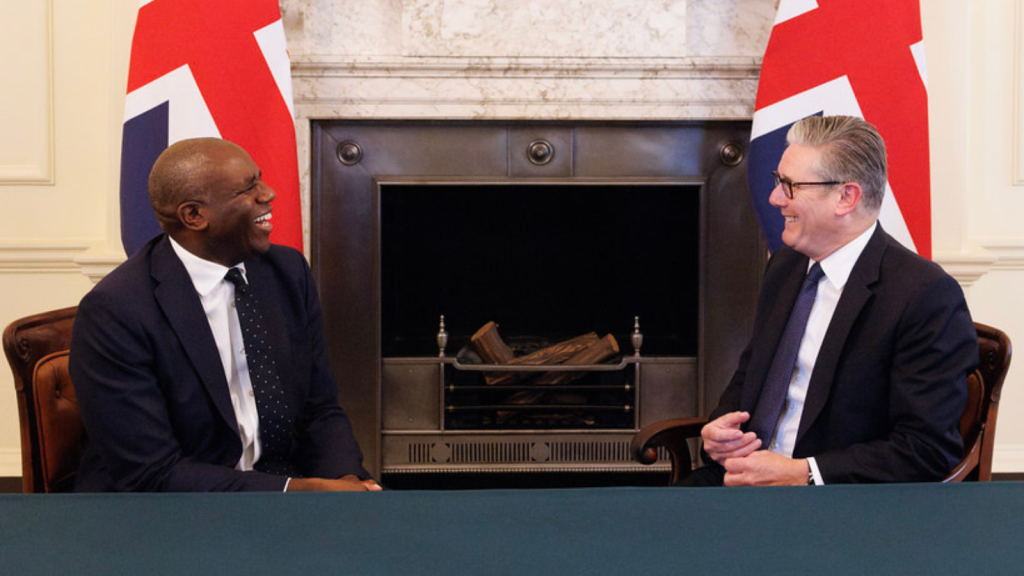
Keir Starmer and David Lammy.
Keir Starmer and David Lammy. Photo credit: Simon Dawson / No 10 Downing Street (CC BY-NC-ND 4.0)

What’s happened: Prime Minister Keir Starmer welcomed Palestinian Authority President Mahmoud Abbas to No 10 Downing yesterday, ahead of the Government’s anticipated recognition of a Palestinian state. Abbas was recently denied a US visa to attend the United Nations General Assembly. According to a statement released by the Prime Minister’s Office, Starmer and Abbas “both agreed there will be absolutely no role for Hamas in the future governance of Palestine.”

  • In a letter sent to Sarah Champion, chair of the international development committee, Foreign Secretary David Lammy wrote that the UK Government had determined that Israel was not committing genocide in Gaza.
  • The letter was sent by Lammy just before he left the position of Foreign Secretary. Previously, Lammy and other British officials had taken the position that the Government could not make such a determination absent a judicial ruling from the ICJ. But in the letter, Lammy asserted that “the crime of genocide occurs only where there is specific ‘intent to destroy, in whole or in part, a national, ethnic, racial or religious group’. The government has not concluded that Israel is acting with that intent.”
  • Six people were killed and at least seven others seriously wounded in yesterday’s shooting attack in Jerusalem. The dead were named as Levi Yitzhak Pash, 57, Yaakov Pinto, 25, Yisrael Matzner, 28, Rabbi Yosef David, 43, Rabbi Mordechai Steintzag, 79, and Sarah Mendelson, 60. The Palestinian gunmen, men in their twenties from an area of the West Bank just northwest of Jerusalem, were killed by an off-duty soldier, ending the shooting rampage.
  • Four IDF soldiers were killed yesterday when Hamas gunmen opened fire on an IDF Armored Corps position in Jabaliya in the northern Gaza Strip and hurled an explosive device into their tank. They were named as First Sgt. Uri Lamed, 20, Sgt. Gadi Kotal, 20, Lt. Matan Abramovitz, 21, and Sgt. Amit Aryeh Regev, 19. A fifth soldier was injured in the attack. 904 IDF soldiers have fallen since the war began on October 7, 2023, 54 of them since the last ceasefire ended in March of this year.
  • This morning, the IDF’s Arabic-language spokesperson announced a broad evacuation order for Gaza City. “The IDF is determined to defeat Hamas and will operate in the Gaza City area with great force, just as it has throughout the strip,” the announcement said. It also contained a phone number to report any Hamas roadblocks preventing people from evacuating.

Context: The Israeli offensive into Gaza City has focused over the last two days on high-rise buildings used by Hamas. At least five have been destroyed after specific evacuation warnings by the IDF. There were no reports of casualties from the strikes, images of which were widely posted and shared.

  • Referring to the downed towers yesterday, Prime Minister Netanyahu said, “All this is just the prelude for the main intensive operation and that is a ground maneuver by our troops, who are now organising, for inside Gaza City. And that is why I am telling Gaza’s residents: I am using this opportunity and listen to me well. You have been warned. Leave.”
  • Writing in Israel Hayom, Yoav Limor reports that thus far only about 10% of Gaza City’s residents have evacuated. He further notes that in the last major operation in Gaza City, in November 2023, the IDF lost 122 soldiers. This was in a less extensive battle than the one planned for now, and in a city that had been thoroughly evacuated in the first dramatic weeks of the war following the October 7 attacks.
  • With an Israeli ground offensive imminent, a last-ditch effort to reach a diplomatic agreement is also underway. The Trump administration’s new proposal would see an immediate release of all remaining Israeli hostages on the first day in exchange for thousands of Palestinian security prisoners held by Israel. A ceasefire would be guaranteed by the United States for as long as negotiations were ongoing for an end to the war.
  • President Trump posted on social media that “the Israelis have accepted my Terms. It is time for Hamas to accept as well.” He added,  “I have warned Hamas about the consequences of not accepting. This is my last warning, there will not be another one!”
  • Hamas has not given a definitive response to the Trump proposal. Sources close to Hamas report that the organisation believes it is logistically impossible to free all hostages on the first day of the ceasefire, though it appears that much of the apparent difficulty relates to the challenge of extricating the bodies of dead hostages more than to liberating the living ones.
  • Channel 12 news reports that Israel assesses that there will be internal disagreement among the Hamas leadership over the question of whether it can accept Trump’s conditions. Even if the answer is affirmative, the question is whether it can trust the American guarantees and to hold negotiations in practice on the basis of these principles.
  • According to a report on Kan radio, officials in Jerusalem believe Hamas will likely reject the American proposal, and that this will pave the way for Israel’s anticipated operation in Gaza City.

Looking ahead: President Isaac Herzog will be in London this week to “show solidarity with the Jewish community, which is under severe attack and facing a wave of antisemitism.” He is scheduled to meet with Prime Minister Starmer on Wednesday and likely to meet Foreign Secretary Yvette Cooper as well.

September 8, 2025

Donald Trump presents new hostage deal

Donald Trump in the White House.
Donald Trump in the White House. Photo credit: The White House

What’s happened: President Trump has reportedly passed a new proposal for a comprehensive hostage and ceasefire deal to Hamas’s leadership. 

  • Trump wrote on Truth Social, “Everyone wants the Hostages HOME. Everyone wants this War to end! The Israelis have accepted my Terms. It is time for Hamas to accept as well. I have warned Hamas about the consequences of not accepting. This is my last warning, there will not be another one!”
  • According to the new plan:
    • All 48 living and dead hostages are to be released on the first day of the deal, in return Israel will simultaneously release hundreds of terrorists and thousands of Palestinian detainees.
    • Israel will halt Operation Gideon’s Chariots II and the takeover over of Gaza City. 
    • Negotiations will begin immediately to end the war, personally overseen by President Trump. 
    • The fighting will not be renewed as long as the negotiations remain ongoing. 
  • While according to Trump, Israel has accepted his terms, Hamas released a statement saying it, “received, through mediators, some ideas from the American side to reach a ceasefire agreement. Accordingly, Hamas welcomes any move that will assist in the efforts to halt the aggression against our people. Hamas affirms its readiness to immediately sit at the negotiating table to discuss the release of all prisoners in exchange for a clear declaration of an end to the war, a full withdrawal from the Gaza Strip, and the formation of a committee to administer the Gaza Strip from independent Palestinians, which will assume its duties immediately.”
  • The Hostage and Missing Families Forum issued a statement noting, “The provision of the US president’s personal guarantee is an historic development of the utmost importance. We call on the Israeli government to announce its unreserved support for the emerging agreement.”

Context: The support from President Trump has been a crucial factor in Israel’s continued military campaign. His direct involvement in this latest proposal could force the hands of all parties and bring the war to an end. 

  • Meanwhile the fighting in Gaza City intensified over the weekend with preliminary bombings of high-rise buildings. The airstrikes focused on hundreds of surveillance cameras and anti-tank firing positions, and sniping positions on the upper floors of high-rises of buildings in the centre and west of the city.
  • As ever, the IDF highlighted, “Prior to the strike, steps were taken in order to mitigate harm to civilians, including advanced warnings to the population, the use of precise munitions, aerial surveillance, and additional intelligence.”
  • Despite almost two years of fighting, it is understood that Hamas still possesses a variety of military surveillance technologies.
  • A secondary objective of targeting the high rise buildings (deliberately in broad daylight), is to encourage the civilian population to leave the city. In line with this, according to the IDF they have now set up a new “displaced persons city” near Khan Yunis, with “water, food and medical infrastructure.” 
  • In the latest assessment, the takeover of the city itself will not take more than a couple of weeks. However, the IDF has continued to warn that the whole operation could take a year. This is primarily due to the large network of tunnels remaining underneath Gaza City, as well as the presence of hostages who are still alive in them. 
  • It is estimated that 10,000 armed operatives are currently inside Gaza City, but as in the past many or even most are expected to flee the area along with the civilian population.  Due to the scale, it is not feasible for the IDF to screen everyone leaving.
  • In light of these challenges, military analysts suggest that Hamas cannot be destroyed in this operation, and the goal is to degrade the terrorist infrastructure used by the Gaza City Brigade.
  • However, one of the IDF’s main targets will be Hamas’s current leader in Gaza City, Izz al-Din Haddad who commands the city’s brigade. According to military assessments, he has restored much of its command-and-control capabilities over the past year. Hamas’ centre of power consists of a network of tunnels is located in western Gaza City. It was partly damaged during the December 2023 ground operation, but has since been repaired.
  • Whilst the IDF prepares to operate with a massive force deployment in to the city, there is concern that Hamas may choose to attack troops manning static positions along the recently established corridors in southern Gaza, as happened during Hamas’s multi-pronged attack two weeks ago. Similarly there could be attacks along the buffer zone set up adjacent to Israeli communities as there are likely still tunnels in the proximity. 
  • According to reports out of Gaza, the terrorist Mahmoud Afana was eliminated in an IDF strike. Afana participated in the October 7 massacre and in a phone call he placed from Kibbutz Mefalsim boasted to his family that he had personally murdered ten Israelis. That call was recorded, and subsequently shared as evidence.    
  • Israel maintains residual concern that whilst Hamas might accept a new technocratic leadership of the Strip, a scenario in which it is allowed to maintain its weapons and military wing, they will seek a Hezbollah style model of operating a terrorist army under a weak political framework.     
  • Alongside the fighting, Israeli continues to facilitate aid into Gaza. According to the IDF, “Over the past week, close to 1,900 trucks were collected and distributed this week from the Gazan side of the Kerem Shalom and Zikim Crossings. Over 1,500 humanitarian aid trucks primarily containing food, entered through the crossings this week.” 

Looking ahead: President Herzog will arrive in London later this week to meet with senior representatives of the government. 

  • The timing, ahead of the UN General Assembly, and the UK’s anticipated announcement to recognise a Palestinian state, is aimed at maintaining the close Britain – Israel relationship at this sensitive time.
  • According to the President’s office, “The purpose of the visit is to show solidarity with the Jewish community, which is under severe attack and facing a wave of antisemitism.” 

September 5, 2025

Israel marks the 700th day since October 7th

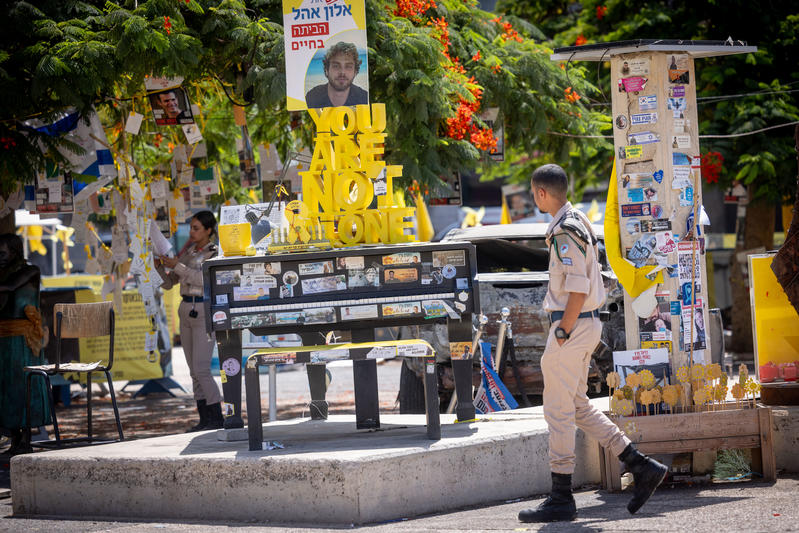
Hostage Square in Tel Aviv. September 04, 2025.
Visitors at Hostage Square in Tel Aviv. September 04, 2025. Photo by Miriam Alster/FLASH90 *** Local Caption *** כיכר החטופים תל אביב

700 days: There are forty-eight hostages still being held in the Gaza Strip, 20 of whom are thought to be alive as the IDF prepare to intensify their conquest of Gaza City.

  • The families of hostages and their supporters demonstrated outside the President’s Residence in Jerusalem on Thursday night. Viki Cohen, whose son Nimrod Cohen a soldier held hostage, said, “Mr. President, it’s not just the hostages. It’s the values that we were taught and that we raised our children on. Values of mutual responsibility, of leaving no one behind, and that we are a people that sanctifies life, not land.” The demonstrators chanted in response, “All of them, now!”
  • Yediot Ahronot quotes Liran Berman, the brother of twin captives Gali and Ziv, “We passed the 100 day-mark, we didn’t believe we’d make it to 200, we crossed the 300 day-mark. Now it’s 700. I feel numb to the symbolic numbers. It’s another day my brothers are in captivity. We’re but a step away from the second anniversary of October 7. And on the way there, we have another milestone that I’m even more afraid of, which is Gali and Ziv’s birthday on September 10, next Wednesday. I’m still there, stuck on October 7, 2023.” 
  • Silvia Cunio, the mother of Ariel and David, told the paper, “For me, the number 700 is a number. It’s the longest October 7 of my life.” Eight people were abducted from her home that day. Six of them have returned, but not her two sons. 
  • IDF Spokesperson Effie Defrin said last night that the IDF has already taken control of 40 per cent of Gaza City. He noted that infantry and armoured corps are operating in the Zeitoun neighbourhood,  and conducting manoeuvres on the outskirts of the Sheikh Radwan quarter, the northern neighbourhood of Gaza City. 
  • Once more a ballistic missile was fired from Yemen last night, but disintegrated en route. Nine missiles have been fired from Yemen towards Israel since Operation Lucky Drop killed a dozen senior Houthi officials. Six of the missiles disintegrated, three were intercepted.

Humanitarian aid: On Thursday BICOM was granted access to the Palestinian side of Keren Shalom border crossing.

  • BICOM saw large quantities of aid, mostly food including dried goods, fruit and vegetables as well as hygiene products awaiting distribution.
  • During the 42-day ceasefire earlier this year, Israel facilitated the delivery of 300,000 tonnes, calculated to be enough to feed the entire population of Gaza for 5 months
  • At present, aid is being provided through two main channels:
  • The Gaza Humanitarian Foundation (GHF) has so far delivered 2.5 million food packages, each sufficient to feed a family of five for one week.
  • In parallel, and in collaboration with the UN World Food Programme, international NGOs and donor nations, Israel enables the delivery of goods essential for kitchen cooking and bakeries across the Gaza Strip.
  • The process involves aid being brought to one of four designated border crossings, where Israeli officials conduct security inspections. Once cleared, consignments are returned to UN organisations, which are then responsible for collecting and distributing them inside Gaza. Currently, between 300 and 400 trucks are entering Gaza on daily basis, with many more awaiting collection by the UN at the crossings.
  • UN officials have stated that they face logistical challenges, citing limited transport capacity, insufficient time for collection, and too few crossings being open. In contrast, the Gaza Humanitarian Foundation and private contractors are widely considered more efficient in collecting aid at the crossings and ensuring its delivery.
  • For comparison, prior to the war an average of just 70 food trucks per day entered Gaza. At present, no aid is moving through the Rafah crossing between Gaza and Egypt.

War v hostages: It is a consensual view that this war would have been over long over had the hostages been released.

  • From the start, a profound dilemma has confronted decision-makers, amid concern that the dual goals of defeating Hamas and retrieving the hostages are contradictory. Nevertheless, the government has charged the IDF with creating the conditions to achieve both.    
  • At the onset of Operation Gideon’s Chariot II, the IDF has informed families of hostages who are still alive that the army plans to ensure that the hostages will not be harmed during the operation despite their assessment that at least some of them are being held in Gaza City. 
  • However, the IDF admits that it does not have precise information about where the hostages are. As part of the preparation commanders are trying to predict what Hamas will do with the hostages, whether they will try and move them (as they have in the past), or place them in the line of anticipated fire as human shields, or even kill them as happened with Hersh Goldberg-Pollen and five others, a year ago this week.  
  • There is continued speculation whether securing a temporary hostage deal to release half of the living hostages is still possible. Supporters of the deal among senior security officials have argued that a partial deal would make it easier later on for the army to operate where the hostages had been kept and to target Hamas in those areas. That would bring the actual defeat of the terror organisation closer. 

Looking ahead: IDF activity in the outskirts of Gaza City is expected to expand and intensify in the coming days.

  • Whilst there is no sign of an imminent breakthrough a partial, gradual deal based on the Witkoff proposal including a two-month ceasefire, redeployment of IDF troops and the release of ten living hostages and the bodies of 18 dead hostages is still possible. Neither Israel nor Hamas has ruled it out.

September 3, 2025

Preparations for Gaza City offensive, amid heightened anti-war protests

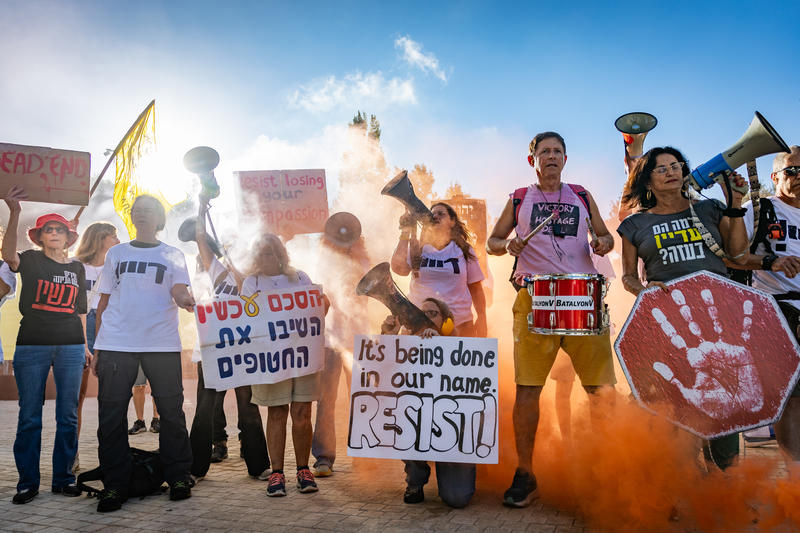
Israelis attend a protest calling for an end to the war with Gaza and the release of the Israeli hostages held captive by Hamas, outside the Israeli parliament in Jerusalem
Israelis attend a protest calling for an end to the war with Gaza and the release of the Israeli hostages held captive by Hamas, outside the Israeli parliament in Jerusalem, September 3, 2024. Photo by Yonatan Sindel/Flash90 *** Local Caption *** מלחמה חטופים משפחות כנסת חרבות ברזל מלחמה

What’s happened: Tuesday saw a major call-up of reserve soldiers in preparation for Israel’s expected offensive into Gaza City. 

  • Tens of thousands reported for duty as they are expected to relieve regular soldiers in the West Bank and along the northern border, who will prepare to enter Gaza in the coming weeks. 
  • Prime Minister Benjamin Netanyahu said about the upcoming operation, “Now we are facing the decisive stage.” Directing his comments to reservists, he said, “I know that you have paid a heavy price – at work, with studies and at home. We are fighting a stubborn and just war without peer. We do not forget for a moment what they did to us on October 7, the beheadings, the women who were raped, the babies who were burned and the hostages who were taken into the tunnels in Gaza. We are working to bring them all back.”
  • Speaking to reservists on emergency call-up orders, IDF Chief of Staff Zamir told them, “We are going to increase and enhance the strikes of our operation, and that is why we called you. The IDF does not offer anything less than decisive victory. We will not stop the war until we defeat this enemy.”
  • As call-ups increase, so too has opposition to the upcoming offensive. Protesters demanding a deal for the release of hostages converged on Jerusalem this morning, where some set fire to rubbish bins and at least one car and others mounted the rooftop of Israel’s National Library.
  • The IDF announced yesterday that it had successfully eliminated Hazem Awni Naeem in a joint operation with the Shin Bet on August 28. Naeem was a senior Hamas terrorist who had, among other acts, held in captivity the three female Israeli hostages Emily Damari, Romi Gonen, and Naama Levy.
  • A Houthi missile launch triggered sirens all over central Israel this morning. The missile was successfully intercepted by Israeli missile defence. Last Thursday, an Israeli operation in Sanaa eliminated several senior Houthi officials including the Houthi Prime Minister Ahmed al-Rahawi.
  • Also on Tuesday, Israel successfully launched a new satellite into space, Ofek 19. President Herzog, who attended the launch, hailed it as a significant Israeli technological accomplishment. “We are not only a Start-Up Nation, we are a Space Nation.” Israel’s space program effectively began with the launch of Ofek 1 in 1988. The new satellite, Ofek 19, will orbit the earth once every 90 minutes and is expected to be fully operational, providing high-resolution intelligence to the Israeli security services in both day and night, by sometime next week.

Context: With preparation for the ground offensive into Gaza City underway, the operation is expected to begin in mid-September. The operation will involve at least four divisions.

  • In the initial stage, the IDF hopes to prompt civilians to move out of Gaza City into the Al-Mawasi region on the southern beach area of the Strip, where temporary accommodation is to be provided. There are an estimated 800,000 people in the city at present.
  • The pace of operation will depend on the rate at which the civilian population vacates the area. 
  • According to reports in the Arab media, there is concern that Hamas might move living hostages and disperse them across Gaza City to serve as human shields for Hamas strongholds. 
  • Israel Hayom reports that the operational plan which was approved is different from the original one, which Chief of General Staff Eyal Zamir had warned was a “strategic trap.” The current plan was formulated by Southern Command and is reportedly much more sensitive to the challenges facing the IDF as it enters a densely populated area. According to the report, “the IDF believes Gaza City to be strewn with IEDs and underground networks that will pose a major threat to the troops. The top IDF brass said the mission could be accomplished, but in a bid to protect the troops the operation is planned to be slow and accompanied by intensive firepower.”
  • The latest estimates of the cost of the Gaza operation at around 25 billion shekels (about £5.5 billion). It is not clear if cuts will be made across government or if the deficit will be extended.   
  • The long time-scale for the launch of the operation leaves open the possibility of a ceasefire and hostage deal that might avert it. Israel’s position on a hostage deal remains ambiguous, with leading figures close to the Prime Minister insisting on a comprehensive deal that would release all hostages, while Minister for Strategic Affairs Dermer reportedly told mediators that Israel has not entirely ruled out a partial deal. A partial deal would reportedly include a time-limited ceasefire and the release of ten out of the twenty hostages believed to still be alive.
  • Amid military preparations the government continues to clash with the judiciary. A unanimous decision by the Supreme Court ordered the government to respond by September 14 whether it will convene the Appointments Committee in order to carry out its decision to dismiss the Attorney General Gali Baharav-Miara. The decision does not actually force the government to do so, though it still leaves that possibility open after September 14. In the meantime, Baharav-Miara remains in her post, though the Government only invites her to meetings where the presence of the Attorney General is a legal requirement.

Looking ahead: The French President Emmanuel Macron will host a high-level international conference in New York together with the Saudi Crown Prince Mohammed bin Salman to advance the cause of a two-state solution to the Israeli-Palestinian conflict. Macron called on the Trump administration to reverse its decision denying visas to senior officials from the Palestinian Authority, including the PA President Mahmoud Abbas. The conference was originally scheduled for June but was be postponed because of the Twelve Day War with Iran.

September 2, 2025

IDF call ups begin following stormy cabinet meeting

Recruiting of new IDF soldiers at the Tel haShomer army base in Ramat Gan
Recruiting of new IDF soldiers at the Tel haShomer army base in Ramat Gan. August 05, 2025. Photo by Miriam Alster/Flash90 *** Local Caption *** גיוס תל השומר חיילים לשכת הגיוס

What’s happened: Emergency call up orders began to go into effect yesterday with 40,000 reservist soldiers mobilised. This is taking place as the IDF prepares to embark on a broad offensive operation into Gaza City.

  • Most reservists are not likely to enter Gaza. They are, rather, relieving soldiers in the West Bank and on the northern border who are slated to be a part of the upcoming operation, which will involve five divisions.
  • The Israeli government’s public position remains that only a comprehensive deal that would release all hostages could avert the operation. A stormy cabinet session was held on Sunday regarding the war in Gaza. Ministers did not vote on the ceasefire deal on the table, though Hamas appears to have accepted it. This deal would include a 60-day ceasefire and a partial release of the remaining hostages.
  • Belgium announced that it would recognise a Palestinian state at the UN General Assembly later this month. Foreign Minister Maxime Prevot also announced 12 “firm sanctions” against Israel, including a ban on importing products from settlement. Prevot’s announcement stipulated that the “administrative formalisation of this recognition” would only take effect “when the last hostage is released.”
  • Foreign Secretary David Lammy reiterated his commitment to recognise a Palestinian state “unless the Israeli Government takes substantive steps to end the appalling situation in Gaza and commits to a long-term sustainable peace.” He added, “To those who say recognition rewards Hamas or threatens Israeli security – it does neither,” without explaining how this was the case. 
  • Alluding to the humanitarian crisis in Gaza, Lammy said that “words of condemnation… are not enough. But be in no doubt: we have acted, as a country, where we can.” He went on to list  actions taken by the Government: “We restored funding to UNRWA. We suspended arms exports that could be used in Gaza. We signed a landmark agreement with the Palestinian Authority. We stood up for the independence of international courts. We have delivered three sanctions packages, three, on violent settlers and far-right Israeli Ministers for incitement. We suspended trade negotiations with the Israeli Government. We are at the forefront of the international community’s work to plan for a stable, post-conflict peace. And we have provided nearly over £250m in development assistance over the past two years.”
  • None of this actions mentioned by Lammy is putting any  pressure on Hamas to release the hostages  or  exerting diplomatic pressure for the October 7 attacks. Nor did he mention any action relating to states, allied with Britain, that harbour leading Hamas figures, such as Qatar or Turkey.
  • Lammy also announced the triggering of the “snapback” procedure for sanctions against Iran. These will go into effect in 30 days barring some diplomatic breakthrough with Iran.
  • 320 trucks of humanitarian aid crossed from Israel into Gaza yesterday through crossings at Kerem Shalom in the southern Gaza Strip and Zikim in the north. COGAT reports that 350 trucks were collected and distributed by aid organisations yesterday, as opposed to 170 the day before, with hundreds more still waiting on the Gaza side of the border for collection. 

Cabinet leaks: Multiple Israeli media outlets gave detailed reports of a stormy cabinet meeting on Sunday evening, all based on anonymous leaks.

  • It is understood that the heads of the IDF, National Security Council, Mossad, and Shin Bet strongly support accepting the ceasefire deal which would see the release of 10 out of 20 living Israeli hostages and a 60 day pause in fighting. The Prime Minister and most of the cabinet oppose this. All four men are Netanyahu appointees. The security chiefs all expressed severe doubts about the planned military offensive into Gaza City.
  • The IDF estimates around 100 fatalities to its forces in an operation to conquer Gaza City in an operation that could take as long as a year to complete successfully. Chief of General Staff Eyal Zamir told the Government that such an operation would necessarily mean a military government in Gaza, with all the attendant legal and operational obligations that would entail. Israel would be directly responsible for the welfare of Gazans in territory its forces occupy in a way it has not been since 1994. And its soldiers would be constant targets of guerrilla attacks.
  • Mossad Director David Barnea spoke out more forcefully than in the past in favour of the current ceasefire deal. He was quoted in television reports as saying, “That’s the proposal that is on the table, and we need to take it.”
  • Most of the media attention, however, focused on Zamir, with many harsh and pointed statements attributed to him or to his critics. Orit Struck, one of the most far-right figures in the Cabinet, obliquely referred to Zamir with a Mishnaic reference to “the man who fears and is soft-hearted.” Zamir responded to her, “I came to carry out two of my life’s missions: to prevent nuclear [weapons] in Iran and to destroy Hamas. Every morning I approve attacks everywhere. No one is soft of heart. If you want blind obedience, get someone else.”
  • Confronted by the Cabinet Secretary with Ministers’ demands to defeat Hamas, Zamir responded with a sarcastic Hebrew phrase that can be translated as “you don’t say?” or “good morning sunshine!” and added, “you were the security cabinet on October 7. Now you’ve remembered to talk about defeating Hamas?”
  • Various reports in the Hebrew press referenced Cabinet ministers who dissented from the majority position and preferred taking the ceasefire deal and partial hostage release now rather than embarking on the new offensive into Gaza City. Most reports mentioned Foreign Minister Gidon Saar as one of the opponents of the new operation, with concerns about Israel’s diplomatic position at the upcoming UN General Assembly attributed to him. 

Looking ahead: In preparing a response to the upcoming announcements of recognition of a Palestinian state by France, Britain, Canada, and others, Prime Minister Netanyahu will convene a consultation on annexing parts of the West Bank.

  • The cabinet are expected to explore various proposals, including annexation of settlement blocs, of Areas C, or of the Jordan Valley. An initiative to annex the Jordan Valley was stopped in its tracks in 2020 by the announcement of normalisation agreements with Bahrain and the UAE.
  • The Jordan Valley stretches from the Sea of Galilee to the Dead Sea, forming a natural border between the West Bank and Jordan. It is sparsely populated and serves as a vital buffer zone and holds strategic significance for Israel’s security.

September 1, 2025

Two hostage bodies retrieved as plans for the conquest of Gaza City continue

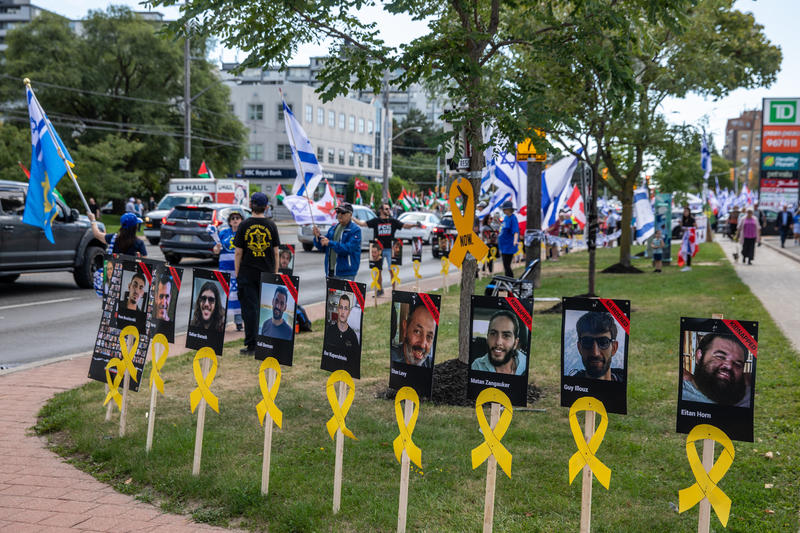
People protest in support of Israel and call for the release of hostages
People protest in support of Israel and call for the release of hostages held in Gaza, while across the road pro-Hamas demonstrators rally in their support, in Toronto, Canada, August 31, 2025. Photo by Doron Horowitz/Flash90 *** Local Caption *** חמאס מלחמה חטופים חרבות ברזל מלחמה הפגנה

Inside Gaza: Two more bodies of hostages have been retrieved by Israeli security forces in Gaza.      

  • Ilan Weiss, was killed on October 7th  while trying to defend his community, Kibbutz Beeri. His body was taken into Gaza. Separately, his wife, Shiri, and one of his daughters, Noga, were also taken hostage that morning. They were freed in November 2023.
  • Idan Shtivi, a resident of Ein Hayam was 28 at the time of his death. He was murdered while  trying to rescue people from the Nova music festival, and his body was taken by Hamas.
  • This now leaves 48 hostages, of whom 20 are believed to be alive and held by Hamas in horrific conditions for 696 days now. So far, 148 hostages have been brought back alive, along with the bodies of 59 others.
  • Also on Friday, Master Sergeant Ariel Lubliner, a 34-year-old reservist from Kiryat Bialik, was killed in action in the southern Gaza Strip. Master Sergeant Lubliner was killed by friendly fire.
  • He is the 900th soldier to have been killed so far in the war and the 75th to have been killed by friendly fire in an operational accident. A preliminary inquiry found that an IDF soldier in an outpost in the Khan Yunis area accidentally discharged a bullet. The bullet struck Lubliner, who was part of a logistical convoy and was roughly 200 meters away from the soldier who misfired.
  • Palestinian sources (but not yet Hamas) have confirmed that Abu Obaida, Hamas’s military wing spokesman, was eliminated in an IDF attack in Gaza City. The Israeli Air Force bombed two floors of a residential building in Gaza City’s western Rimal neighbourhood. The IDF Spokesperson’s Office statement noted, “Prior to the strike, numerous steps were taken to mitigate the risk of harming civilians, including the use of precise munitions, aerial surveillance, and additional intelligence.” According to reports out of Gaza, ten people were killed in the strike.
  • The IDF considered Obaida a key figure in Hamas not only because of his symbolic status and his high media profile, but also due to his close ties with senior Hamas officials. Chief of Staff Zamir commented, “In the Gaza Strip we attacked one of Hamas’s senior officials, Abu Obaida, after most of Hamas’s leadership was killed, and more is yet to come. Most of what remains of Hamas’s regime resides overseas, and we’ll get to them too.”

Context: The security cabinet convened on Sunday night and were presented with the latest plans to conquer Gaza City.

  • The security cabinet did not discuss a hostage deal.  However, it is understood that negotiations have remained ongoing in an effort to find a formula that might lead to the hostages’ release, and those talks are likely to continue amid the new military operation to conquer Gaza City.
  • The assassination of Hamas’s military wing spokesperson boosted hopes that Hamas might ultimately agree to be more flexible.
  • For as long as President Trump gives Israel the green light to conquer Gaza City, preparations and planning are set to continue.
  • In a bitter ironic twist, Hamas currently appears to favour a temporary deal, whist Israel now insists on arrangement to release all the remaining hostages in one go. This is a reversal of previous positions of both sides.  
  • It is possible that Netanyahu and Trump are hoping Hamas will blink first and agree to make further concessions in the negotiations. If that doesn’t happen, Israel will be forced to prove that it is able to deliver on the promise it made to Washington to execute a short and effective military operation.
  • There remain divisions within the security cabinet with IDF Chief of Staff Zamir and other security officials still in favour of reaching a partial deal that could see ten living hostages released.    
  • Nevertheless, as the government has mandated preparations for the next operation continue. The first stage of the operation will be the evacuation of the civilian population to the southern Gaza Strip. As part of this effort civilian infrastructure is being prepared including tents and temporary housing, additional medical facilities and more food distribution centres.
  • On the other side, Hamas has issued warnings in an attempt to deter the public from moving to the south, so that the public might continue to serve as a human shield for Hamas. So far it is estimated about 10,000 Palestinians have moved south in the last few days.
  • Sunday was the first anniversary of the discovery of the six dead hostages—Carmel Gat, Eden Yerushalmi, Hersh Goldberg-Polin, Almog Sarusi, Alex Lubanov and Ori Danino—who were murdered by their captors after IDF special forces drew near the tunnel in the southern Gaza Strip where they were being held.
  • Beyond Gaza, it appears that IDF successfully struck the Houthi leadership in Yemen. The latest assessment is that almost the entire Houthi political leadership was eliminated in the strike including their Prime Minister Ahmed Ghaleb al-Rahwi and several other ministers. Israel believes that the director of their politburo, the director of the prime minister’s bureau, the cabinet secretary, the justice minister, the economy and trade minister, the foreign minister, the agriculture minister and the information minister were also killed.
  • Assessments from Israeli intelligence suggest the attack severely damaged the Houthi’s hold on power and deepened the sense among its leaders that they are being hunted. This is also a message to the external leadership of Hamas.

Looking ahead: On Tuesday the large-scale mobilisation of thousands of IDF reservists is due to begin. September 2 was chosen by IDF Chief of Staff Zamir in order to make it easier for reservist parents to first help their children begin the school year.

  • The reservists will study the lessons from previous operation, whilst others will replace standing army units in the West Bank and northern Israel.
  • Israel is preparing for the latest international flotilla heading for Gaza. Around twenty boats set sail from Barcelona, Sicily, Greece and Tunisia, with more than 200 participants from 44 countries. Participants include several famous individuals from around the world: climate activist Greta Thunberg, the actors Susan Sarandon and Liam Cunningham, and the former mayor of Barcelona Ada Cola.

August 14, 2025

Negotiations continue in Cairo

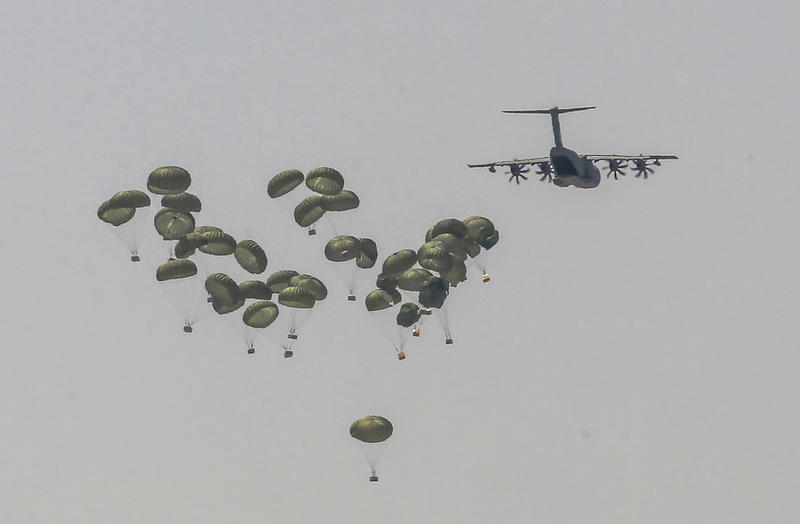
A plane drops humanitarian aid loaded with food supplies in the southern Gaza Strip
A plane drops humanitarian aid loaded with food supplies in the southern Gaza Strip, August 10, 2025. Photo by Abed Rahim Khatib/Flash90 *** Local Caption *** מלחמה חרבות ברזל עזה מטוס אוכל עזרה סיוע

What’s happening: The Hamas delegation led by Khalil al-Hayya remains in Cairo for ongoing talks over a potential new hostage deal and ceasefire.      

  • The talks are being led by the Director of the Egyptian General Intelligence Directorate Hassan Rashad. He has been in contact with Israeli officials and has kept them apprised of the developments, although Israel has not at this point formally joined the negotiations. 
  • According to Arab media reports the latest proposal calls for an initial 60-day interim ceasefire, during which:
    • All 50 hostages are released in stages, in exchange for Palestinian security prisoners, including terrorists who murdered Israelis
    • Hamas will “freeze” military operations. (It is currently unclear what the freezing entails, some have understood this as refraining to continue fighting, whilst other analysts have interpreted this as the storing of weapons in warehouses, potentially under supervision of the Palestinian Authority.)
    • An IDF withdrawal and redeployment to agreed new lines under supervision by the US and Arab states. 
    • In that time, negotiations over a comprehensive agreement for future governance of the Strip. 
  • On Wednesday, Chief of Staff Lt. Gen.  Zamir approved the “central idea” underpinning the IDF’s plans to conquer Gaza City. The plan includes the mobilisation of between 80,000 and 100,000 reservists.  
  • According to the IDF, “The chief of staff stressed the supreme importance of improving the troops fitness and readiness to mobilise reservists, while granting R&R and providing breathing room ahead of the next missions.” 
  • On Wednesday, over 370 trucks of humanitarian aid entered Gaza from both the north and south. According to COGAT, that is in additions to, “over 400 trucks were collected and distributed by the UN and international organisations. A further 119 pallets of aid were airdropped by international partners. Whist, “close to 140 patients and their caregivers exited Gaza through the Kerem Shalom Crossing to the Ramon Airport for treatment in a third country.” 
  • Despite the flow of aid, more than 100 international organisations have accused Israel of preventing the entry of humanitarian aid. 
  • COGAT rejected those claims saying that, “Israel acts to allow and facilitate the entry of humanitarian aid into the Gaza Strip, while Hamas seeks to exploit the aid to strengthen its military capabilities and consolidate its control over the population. This is sometimes done under the cover of certain international aid organisations, whether knowingly or unknowingly.”
  • COGAT stressed that some international organisations have refused to comply with a new Israeli defence establishment policy, which includes a formal registration process requiring, among other things, the submission of a list of the organisation’s employees operating in Gaza for prior security screening. This process is “intended to safeguard the integrity of the humanitarian system while preventing the infiltration of terrorist elements into the aid mechanism.”
  • It adds that such refusal “raises serious concerns about their true intentions and the possibility of ties between the organisation or its employees and Hamas…By contrast, nearly 20 international organisations that complied with the law and completed the registration process are bringing aid into the Gaza Strip regularly and in full cooperation. As evidence of this, approximately 300 humanitarian aid trucks enter the Gaza Strip every day through organizations registered under the new mechanism.”
  • Relating to the West Bank, Finance Minister Smotrich announced that he would advance the construction of 3,401 new housing units in the controversial area of E1 that connects Jerusalem to Maale Adumim in the east. 
  • The plan has been suspended for the past 20 years largely due to international pressure as it would effectively cut territorial contiguity between Ramallah, Bethlehem and east Jerusalem.  Smotrich was explicit in stating, “The E1 construction plans bury the idea of a Palestinian state and continue the numerous initiatives we have taken on the ground in the framework of the ‘de facto sovereignty’ plan that we began to implement upon the establishment of this government.” 
  • Despite the rhetoric, the timeline for this initiative remains unclear. Similar plans have been raised in the past, but never implemented.  

Context: Following the impasse of the talks in Doha, the renewed talks are currently being led by Egypt. 

  • Historically, in previous rounds of fighting between Israel and Hamas over the last decade and a half, it has always been Egypt that has led the ceasefire efforts. The only exception being President Obama’s efforts in 2014 to co-opt Turkey and Qatar into the process, which in hindsight only extended the fighting. 
  • The Egyptian government has taken a harsh stance against the Muslim Brotherhood inside Egypt, whilst both Turkey and Qatar ideologically identify with them, and by extension with Hamas.    
  • Earlier this week US Secretary of State Marco Rubio blamed Britain and France for the collapse of the ceasefire talks as the symbolic call for recognition of a Palestinian state emboldened Hamas’ negotiating stance.     
  • A report in the Washington Free Beacon asserted that the UN discreetly modified its classification metrics so that it could declare a famine in Gaza. The UN’s Integrated Food Security Phase Classification (IPC), has accused the IDF of causing a famine in Gaza. However they did not disclose that they changed metrics of measurement, in order to classify the situation in Gaza as a famine. In the past, the IPC has declared famine only after finding that 30% of children in an area are suffering from acute malnutrition, as measured by comparing their weight to their height. But for Gaza, the IPC lowered the threshold to just 15%, and instead of getting accurate weight and height measurements, they just measured the circumference of children’s arms, a method known to be far less precise.
  • Meanwhile parts of southern Gaza remain a quasi-autonomous area under the control of the Abu Shabab clan with IDF protection. Part of a pilot programme includes the establishment of a civilian mechanism that operates a school, a public kitchen, a field hospital, a police station and a mosque.  
  • Of significance, the curriculum being taught by the school is a combination of Saudi and Emirati curriculum which including tolerance of Jews and Israel.

Looking ahead: Israeli negotiators have not yet joined the talks in Cairo, but their departure will signal that a potential deal is still possible.     

  • Hostage families and their supporters have called for a one day strike on Sunday. The strike is supported by several local municipal authorities, universities and the Israel Bar Association along with private companies and other organisations and institutions. The main labour union the Histadrut will not join the strike, but will support individual acts of solidarity.
  • The IDF is continuing to develop their plans for an operation in Gaza City which are expected to be presented to the security cabinet next week.

Newsletter sign-up

Please enter your information below to subscribe to our daily newsletter and stay updated and informed.

Donate to BICOM

At BICOM, we rely on the generosity of people like you to keep our website and services running. Your donation, no matter the size, makes a real difference. Please consider supporting us today. For further information please email: [email protected]