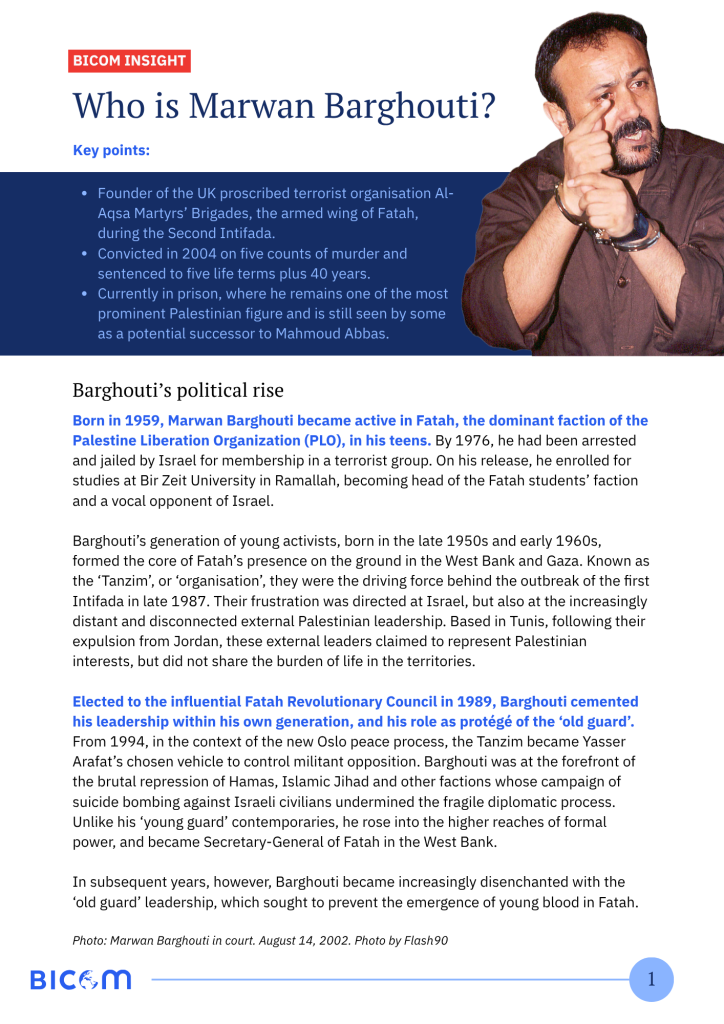
Who is Marwan Barghouti?
Key points:
- Founder of the UK proscribed terrorist organisation Al-Aqsa Martyrs’ Brigades, the armed wing of Fatah, during the Second Intifada.
- Convicted in 2004 on five counts of murder and sentenced to five life terms plus 40 years.
- Currently in prison, where he remains one of the most prominent Palestinian figure and is still seen by some as a potential successor to Mahmoud Abbas.
Barghouti’s political rise
Born in 1959, Marwan Barghouti became active in Fatah, the dominant faction of the Palestine Liberation Organization (PLO), in his teens. By 1976, he had been arrested and jailed by Israel for membership in a terrorist group. On his release, he enrolled for studies at Bir Zeit University in Ramallah, becoming head of the Fatah students’ faction and a vocal opponent of Israel.
Barghouti’s generation of young activists, born in the late 1950s and early 1960s, formed the core of Fatah’s presence on the ground in the West Bank and Gaza. Known as the ‘Tanzim’, or ‘organisation’, they were the driving force behind the outbreak of the first Intifada in late 1987. Their frustration was directed at Israel, but also at the increasingly distant and disconnected external Palestinian leadership. Based in Tunis, following their expulsion from Jordan, these external leaders claimed to represent Palestinian interests, but did not share the burden of life in the territories.
Elected to the influential Fatah Revolutionary Council in 1989, Barghouti cemented his leadership within his own generation, and his role as protégé of the ‘old guard’. From 1994, in the context of the new Oslo peace process, the Tanzim became Yasser Arafat’s chosen vehicle to control militant opposition. Barghouti was at the forefront of the brutal repression of Hamas, Islamic Jihad and other factions whose campaign of suicide bombing against Israeli civilians undermined the fragile diplomatic process. Unlike his ‘young guard’ contemporaries, he rose into the higher reaches of formal power, and became Secretary-General of Fatah in the West Bank.
In subsequent years, however, Barghouti became increasingly disenchanted with the ‘old guard’ leadership, which sought to prevent the emergence of young blood in Fatah.
He complained about their corruption, their disregard for good governance and rule of law, and concluded that they were failing to deliver independence for the Palestinians. Although he was careful to avoid direct confrontation, it was clear that his criticism was aimed directly at Arafat.
Second Intifada
The outbreak of the Second Intifada in late 2000 placed even greater strains on the complex relationship between old and young leaderships. Deeply disenchanted with the Oslo Process, and the unwillingness of the ‘old guard’ to reject it as a failed vehicle for Palestinian national aspirations, Barghouti advocated armed opposition to Israel.
As head of the Tanzim forces, and the more militant al-Aqsa Martyrs’ Brigades, Barghouti had the means to launch a ferocious attack on Israeli civilians. ‘We tried seven years of intifada without negotiations, then seven years of negotiations without intifada. Perhaps it is time to try both simultaneously,’ he is reported to have remarked.[i] To the dismay of the ‘old guard’, he also formed alliances with Islamist forces, arguing that the need for national unity was far greater than the differences between the factions. To his Israeli interlocutors, he argued that he was fighting the occupation, not the principle of Israel’s right to exist. ‘I am not a terrorist, but neither am I a pacifist,’ he declared, ‘I am simply a regular guy from the Palestinian street advocating only what every other oppressed person has advocated – the right to help myself in the absence of help from anywhere else.’[ii]
Arrest and trial
Barghouti was arrested by Israeli forces in Ramallah in April 2002, during the Second Intifada. In June 2004, he was convicted by an Israeli district court on five counts of murder for his role in terrorist attacks and sentenced to five life terms plus 40 years.[iii]
Furthermore, Barghouti was acquitted on 21 counts of murder in 33 other attacks due to insufficient evidence.
Barghouti rejected the legitimacy of the trial, presenting himself as a political leader rather than a criminal defendant, but the court found him guilty over the murders of five people. He was tried at the civilian court where he enjoyed the same rights and procedural guarantees as any other defendant, including a public defence team.
Israeli justice system has a strong reputation for independence, fairness and justice, documented by scoring best in the region and in line with G7 nations in internationally recognised Rule of Law index published by the World Bank. [iv]
His acquittal demonstrates the independence of the court and shows the level of evidence examination. The sentence and the trial were carried out in accordance with Oslo Accords which reaffirmed Israel’s right to prosecute individuals for acts of terrorism and murder committed in Israel.
Barghouti’s victims
- Greek Orthodox monk Tsibouktsakis Germanus, ambushed and murdered in his car near Jerusalem on 12 June 2001.
- Yoela Hen, a mother of two from Givat Ze’ev, murdered in Jerusalem on 15 January 2002 while filling her car with petrol on her way to a family wedding.
- Eli Dahan, Yosef Habi, and Salim Barakat, killed in Tel Aviv on 5 March 2002 during the Seafood Market attack, in which 35 others were injured.
In prison
Since his sentencing, Barhouti has become the most high profile Palestinian prisoner. In August 2009, at Fatah’s Sixth General Conference – its first in twenty years – he was promoted to the Central Committee, the faction’s highest decision-making body.
Later, he reinforced his credentials as a ‘leader-in-waiting’ with broad national appeal. He played an instrumental role in brokering the 2006 Prisoners’ Document – a reconciliation formula agreed by leaders from various factions currently in Israeli jails – and the 2007 Mecca Agreement, which produced a short-lived unity government between Fatah and Hamas in early 2007. The unity government collapsed when Hamas violently consolidated its control of Gaza in June of that year.
While in jail, Barghouti continues to receive his pay-for-slay salary from the Palestinian Authority. Israel’s Foreign Ministry calculated that by the age 85, Barghouti will have received almost $1,000,000, coming from a budget partly funded by taxpayers from a number of Western countries, including the UK.
Conclusion
- The organised campaign for Marwan Barghouti’s release comes at a highly sensitive moment, as questions over Palestinian leadership and Gaza’s post-war governance move to the forefront of debate.
- However this framing cannot erase the fact that Barghouti is a convicted murderer serving five life sentences for attacks that killed civilians, so totally unsuitable for high office.
- Barghouti’s potential release has repeatedly surfaced during negotiations over the October 7 hostages, but Israel has refused to include him in any deal, reflecting the depth of Israeli concern about his crimes.
- Any serious conversation about Barghouti’s future should begin not with slogans, statues, or celebrity-backed campaigns, but with the victims whose murders led to his conviction.
[i] Nicole Gaouette, ‘The ‘Palestinian Napoleon’ behind Mideast cease-fire’, Christian Science Monitor, July 3, 2003.
[ii] Marwan Barghouti, ‘Want Security? End the Occupation’, Washington Post, January 16, 2002.
[iii] State of Israel vs. Marwan Barghouti: Ruling by Judge Zvi Gurfinkel, District Court of Tel Aviv and Jaffa, Dec 12, 2002.
[iv] Rule of law index, The World Bank Group, 2024.