LATEST

Hamas and the Muslim Brotherhood

Key background
  • Hamas is an Islamist Palestinian nationalist movement which currently governs the Gaza Strip. It is proscribed by the UK and in the majority of western countries.
  • Its primary state backers are Iran, Turkey, and Qatar. It is also active in the West Bank, East Jerusalem, Syria, and Lebanon.
  • Since seizing control of the Gaza Strip in 2007, it has continuously launched attacks against Israel and weaponised civilian infrastructure by embedding itself into schools, mosques, and hospitals.
  • Hamas’s 7th October attacks on southern Israel killed 1200, and over 250 hostages were subsequently taken to the Gaza Strip.

Updated June 14, 2024

Hezbollah intensifies attacks on Northern Israel

In the north: Across Wednesday and Thursday, northern Israel suffered the heaviest barrages of Hezbollah rocket, missile, and drone fire so far.

  • On Wednesday, some 215 rockets were fired on northern Israel, while yesterday at least 100 projectiles were fired, including 40 in a two-hour barrage.
  • The IDF confirmed that five Hezbollah UAVs had penetrated Israeli airspace, and that Hezbollah had at one point launched nine drones at the Gailee in a single minute.
  • About 300 sirens sounded in northern communities, while four people were injured in an incident adjacent to the community of Margoliot on the northern border. The incident included anti-tank missiles that seem to have hit a vehicle.
  • As a result of an anti-tank projectile attack in the area of Manara, one IDF soldier was moderately injured and an additional soldier was lightly injured.
  • In response, on Wednesday IAF fighter jets struck a launcher in the area of Hanine in southern Lebanon, and four terrorist infrastructure sites in the area of Yater.
  • Lebanese media also reports at least seven casualties from an Israeli airstrike in the town of Jannata in the Tyre district.
  • Hezbollah attacks continued this morning, with sirens sounding in communities in the north across the length of the border.

Gaza Strip: Several projectiles were also fired on Israel from the northern Gaza Strip last night. Some were intercepted by the IDF’s Aerial Defence Array, while others fell in open areas. No injuries were reported.

  • In response, says the IDF, “aircraft and artillery struck the launch sites from which the projectiles were fired, as well as a weapons storage facility in the vicinity.”
  • Troops operated in the Zeitoun area and Sabra neighbourhood yesterday, in which dozens of Hamas fighters were killed and 50 terrorist infrastructures destroyed. The IDF also destroyed an 800-metre Hamas tunnel, located just a kilometre from the Israeli border.
  • The IDF also continues operations in the central Gaza Strip and in Rafah. In Rafah, “troops eliminated a number of terrorists and located large quantities of weapons and underground tunnel shafts. A number of explosive devices, as well as Hamas terrorist infrastructure sites, were located and destroyed by IDF ground troops. In one incident, a terrorist that was identified approaching IDF troops was eliminated in an aerial strike.”
  • Earlier in the week, “troops eliminated a number of armed terrorist cells in close-quarters encounters in the [Rafah] area. IDF troops also located and destroyed structures rigged with explosives, as well as weapons, ammunition, military vests, and additional military equipment found in the area.”
  • In the central Strip, troops killed a number of Hamas fighters on Wednesday, including one who took part in October 7th.

Context: With the northern front now the most intense focus of kinetic activity, Israel is braced for even further escalation.

  • Hitherto, the assessment had been that both sides wished to avoid all-out war, and that Hezbollah was content to keep hostilities at a level which diverted resources and attention from Gaza but stopped short of a full escalation.
  • The calculus of Hezbollah’s Iranian patron, too, has traditionally been that Hezbollah’s massive reserve of rockets and missiles (far more sophisticated than Hamas’s) be held in reserve to deter any attack on Iran’s nuclear programme.
  • While strikes in Syria attributed to Israel have attempted to stem the flow of weapons resupply to Hezbollah, the organisation is now seemingly on a more aggressive footing.
  • On Wednesday night, Israel conducted a targeted strike on senior Hezbollah commander, Taleb Sami Abdullah. The IDF called Abdullah, the commander of the Nasr Unit, “one of Hezbollah’s most senior commanders in southern Lebanon.” He is understood to be the most senior Hezbollah commander killed in the last eight months, during which time he had been responsible for many attacks on northern Israel, particularly on the city of Kiryat Shmona.
  • Senior Hezbollah official Hashem Saffieddine then said during Abdullah’s funeral that “our response after the martyrdom of Abu Taleb will be to intensify our operations in severity, strength, quantity, and quality… Let the enemy wait for us on the battlefield.”
  • The large amounts of rocket, missile, and drone fire in concentrated time periods is significant in that it represents Hezbollah attempting to overwhelm Israel’s aerial defensive array.
  • Whilst this has been a significant escalation, it represents only a fraction of Hezbollah’s capacity. They are thought to have stockpiled 150,000 rockets, including advanced precision munitions with heavy payloads, capable of targeting strategic sites deep into Israel.
  • With much of the damage from Hezbollah projectiles coming in areas of nature and wildlife, the Israeli Parks Authority has said that over 11,000 acres of land has burned over the past two weeks, and nearly 15,000 acres since the start of the year. The fires are exacerbated by the heat wave Israel is currently experiencing.
  • French and American efforts to secure a diplomatic solution to the conflict on Israel’s northern border have been ongoing since Hezbollah joined Hamas’s attack on Israel on October 8th.
  • While these efforts have so far been unsuccessful, French President Macron, speaking yesterday at the G7 summit in Italy, said that “With the United States we agreed on the principle of a trilateral [contact group], Israel, the United States and France to advance on the roadmap that we proposed and we will do the same with the Lebanese authorities.”
  • French Ambassador to Israel Frédéric Journès told Israeli media “The big problem is ‘how do you start the negotiation?’ Here, it begins to be complicated because Israel says ‘we want to disassociate it with what is happening in Gaza,” Journès said, adding that Hizbullah refuses to agree to that.
  • US Defence Secretary Lloyd Austin spoke with Israeli counterpart Gallant this week. A Pentagon spokesperson said “We are concerned about an increase in activity in the north. We don’t want this to escalate to a broad regional conflict and we urge de-escalation.”

Looking ahead: The IDF is undertaking a series of exercises in which troops are trained for different combat frameworks in the northern arena.

  • According to the IDF, the exercises included “combat scenario(s) at varying ranges, while emphasizing the capabilities of movement in complex terrain, advancement along mountainous routes, the activation of multi-faceted fire and combat in various terrain.”

June 11, 2024

UN Security Council endorses hostage deal

Hostage deal: The UN Security Council last night passed a US-sponsored resolution calling on Hamas to accept the deal. 14 states on the 15-member council voted in favour, with only Russia abstaining.

  • US Ambassador to the UN Linda Thomas-Greenfield  said the council had “united behind a deal that will save lives and help Palestinian civilians in Gaza start to rebuild and heal. United behind a deal that will reunite hostages with their families after eight months in captivity. United behind a deal that will lead to a more secure Israel and unlock the possibility of more progress, including calm along Israel’s northern border with Lebanon.”
  • In supporting the resolution, British Ambassador to the UN Barbara Woodward expressed the UK’s “steadfast support of a credible and irreversible pathway towards a two-state solution”, adding that “a sustainable peace must also include Hamas no longer being in control of Gaza and international support for the Palestinian Authority so that it can resume governance and security responsibilities across the West Bank and Gaza. The UK stands ready to support this.”
  • The final draft of the resolution removed a demand Israel not institute a security buffer zone on the Gazan side of the Israel-Gaza border.
  • Despite not having accepted the latest proposal, Hamas yesterday responded to the UN vote, declaring its “readiness to cooperate with the mediators to enter into indirect negotiations on the implementation of these principles that are in line with the demands of our people and our resistance.”
  • Israeli diplomat Reut Shafir Ben Naftali said that “from the very first days following Hamas’s invasion and brutal massacre on October 7th, Israel’s goals have been very clear: To bring all our hostages home and to dismantle Hamas’s capabilities. Israel is committed to these goals – to free all the hostages, destroy Hamas’ military and governing capabilities, and ensure that Gaza does not pose a threat to Israel in the future.”
  • In parallel to the UN, the US is continuing its regional shuttle diplomacy. Secretary of State Blinken, on his eighth visit to the region since October 7th, met with Netanyahu on Monday night. He reinforced the US’s ironclad commitment to Israel’s security, whilst expressing cautious optimism over a hostage deal.
  • According to Reuters, Netanyahu reaffirmed his commitment to the current proposal.

Gaza Strip: The IDF continues to operate against Hamas targets in the south and centre of the Strip.

  • The military announced that four IDF soldiers were killed and another six injured, five of them seriously in a booby trapped explosion that caused a three-story building in Rafah to collapse. Afterwards troops found a tunnel shaft underneath the building.
  • The fallen soldiers were named as Maj. Tal Pshebilski Shaulov, 24, from Gedera. Staff Sgt. Eitan Karlsbrun, 20, from Modiin, Sgt. Almog Shalom, 19, from Hamadia, Sgt. Yair Levin, 19, from Givat Harel. They all served in the Givati Brigade’s reconnaissance unit. Shalom and Levin had not yet completed their training.
  • Their deaths bring the total of fallen soldiers since the ground operation began to 299, and 650 since October 7th.
  • On Monday, the IDF said the Air Force (IAF), “struck and eliminated Hamas terrorists, including Nukhba Forces operatives, in the central Gaza Strip. Simultaneously, the IAF struck underground terrorist infrastructure in the Deir al-Balah area.”
  • In addition, “aircraft struck and dismantled approximately 35 terror targets throughout the Gaza Strip, including military structures, weapons storage facilities, launch sites, observation posts, terrorist cells, and additional military infrastructure.”
  • In the Rafah area, according to the IDF, “troops eliminated armed terrorist cells in close-quarters encounters and located intelligence materials in several targeted raids in the area. An IAF aircraft eliminated a Hamas sniper who posed a threat to the troops in the area.”

Northern front: Air raid sirens continue to be heard across northern Israel. There have been numerous account of hostile aircraft infiltrations mostly emanating from Lebanon but also further east.

  • This morning there was an interception off the coastal area of Haifa, the first time the city has been targeted since January.
  • Further up the coast on Monday, an IDF aerial defence system successfully intercepted two aerial targets over Nahariya. According to the IDF, “two additional targets that crossed from Lebanon fell in the area of Kabri. As a result, a fire broke out and damage was caused in the area.”
  • In addition, 50 projectiles were also fired at the central Golan from Lebanon. Several were successfully intercepted, while others landed in open areas. No injuries were reported.
  • Hezbollah also continues to launch anti-tank missile, on Monday several launches were identified toward the areas of Manara, Yir’on, Avivim, Margaliot, and Yiftach. According to the IDF, “several hits were identified on structures in the areas of Manara and Yir’on. Additionally, fires broke out in the areas of Yir’on, Yiftach and Manara.
  • In response, the IDF fired artillery towards to source of the fire in the areas of Salhani, Ayta ash Shab, and Hanine in southern Lebanon.
  • In addition, a surface-to-air missile was launched toward an IAF UAV that was operating in Lebanese airspace. As a result, the UAV was damaged and fell in Lebanese territory.
  • In response IAF fighter jets struck a Hezbollah military complex used to smuggle weapons from Syria into Lebanon in the Baalbek area.
  • The IDF also revealed that since the beginning of the war they have successfully intercepted over 150 aerial threats fired towards Israel from multiple fronts. This includes, “rockets, surface-to-surface missiles, and cruise missiles.”

Context: Israelis are still celebrating the heroic rescue of four hostages over the weekend, as further details emerged of the operation and the hostages’ conditions whilst in captivity.

  • However, 120 hostages remain captive in Gaza, now held for 248 days. Despite continued IDF progress in gaining operational control over much of the Gaza Strip, they have only successfully freed seven hostages, in three rescue missions over the last eight months.
  • The likeliest method for freeing large numbers of remaining hostages seems to be via a negotiated deal.
  • Israel’s Channel 12 yesterday gave full purported details on the current Israeli proposal for a ceasefire/hostage release deal.
  • The proposal, which formed the basis of President Biden’s public announcement of the latest terms in late May, offers a commitment to end the war in Gaza even before all hostages have been released by Hamas.
  • Across 18 clauses, the plan calls for a three-phase process, with Clause 15 providing for “restoration of a sustainable calm (cessation of military hostilities permanently) and its commencement prior to the exchange of hostages and prisoners…” in the second phase.
  • If accurate, this clause is hugely significant, given that the apparently unbridgeable difference between the two parties has previously been on whether or not a deal would provide explicitly for a permanent ceasefire.
  • As has been previously reported, the first phase would see the release of 33 hostages: all woman hostages, including soldiers, as well as men over 50 and all civilians with injuries or heath issues.
  • Israel, in turn, would release 30 Palestinian security prisoners per hostage (50 per hostage in the case of female soldiers). In a notable concession to Hamas demands, the names of the security prisoners released would be “subject to lists to be provided by Hamas based on precedence of their imprisonment.”
  • The released prisoners would include multiple inmates serving life sentences, who would be prevented from going to the West Bank but allowed to return to Gaza or move abroad.
  • The prime minister’s office immediately refuted the released text, insisting that its proposal did not allow for the ending of the war before the achievement of Israel’s war aim of the full defeat of Hamas. The “document that was presented is incomplete and misleads the public,” it said.
  • Now weeks after Biden first publicly presented the proposal, an official answer from Hamas remains outstanding. Secretary of State Blinken, currently on his eighth regional visit since October 7th, told reporters in Cairo yesterday that “my message to governments throughout the region… if you want a ceasefire, press Hamas to say ‘yes’.”

Looking ahead: Blinken is expected to continue his regional visit with a trip to Qatar, where efforts will be made to put additional pressure on Hamas to accept the terms of a deal

June 10, 2024

Four hostages rescued, Gantz resigns from government

What’s happened: More details have emerged of the joint IDF, Shin Bet, and Police operation which successfully rescued four Israeli hostages on Saturday.

  • Almog Meir Jan, Shlomi Ziv, Andrey Kozlov and Noa Argamani were all rescued from captivity in the central Gazan town of Nuseirat. While Argamani was being held alone, the three men were held together in the home of a Gazan doctor, Ahmed Al Jamal, and his son Abdallah Al Jamal, a Hamas spokesman and journalist. All four hostages are thought to be in good health.
  • According to Palestinian sources, more than 200 Gazans are thought to have died in the course of the rescue, both combatants and civilians, with Hamas having sequestered the hostages in densely populated civilian areas.
  • Chief Insp. Arnon Zmora, an officer in the Border Police’s elite Yamam counter-terror unit, was killed during the rescue. After his death, the name of the operation was changed from ‘Seeds of Summer’ to ‘Operation Arnon’.
  • The operation was conducted with intelligence assistance from the UK and the US, in the form of drone surveillance. Palestinian sources suggest undercover officers posed as local Gazan refugees and Hamas fighters in the leadup to the mission.
  • Argamani, images of whose terrifying kidnap on a motorbike went viral on October 7th, was able to be reunited with her mother who is dying of terminal cancer.
  • In a tragic turn of events, Meir Jan’s father Yossi Jan died only hours before his son was recovered. “My brother died of grief and didn’t get to see his son return,” said Jan’s sister Dina. “The night before Almog’s return, my brother’s heart stopped. We are very happy about Almog’s return, but the brain is unable to absorb that this is the end. We are broken.”
  • Meir Jan’s mother Urit said, “When I see him here with us, I recognize how important it is to get all of them out, all of them. Make every effort. I’m happy. I received my gift. I have a birthday tomorrow, and I received my gift. I want this for all the families.”
  • Abdallah Al Jamal, a sometime Hamas Labour Ministry spokesman had written several articles published by the Palestine Chronicle during the course of the war, several while the hostages were being kept in his home.
  • “This is further proof that the Hamas terrorist organisation uses the civilian population as a human shield,” the IDF said.

Gantz resigns: In the wake of the successful rescue, Minister Gantz cancelled a Saturday evening press conference at which he was expected to announce his resignation from the government.

  • Gantz then resigned yesterday, along with fellow National Unity Party MKs and ministers Eisenkot and Tropper, accusing Prime Minister Netanyahu of preventing “true victory” in the war against Hamas.
  • In a speech, Gantz said he had taken his party into government and into the war cabinet “because we knew it was a bad government. The people of Israel, the fighters, the commanders, the families of the murdered, the casualties and the hostages needed unity and support like they needed air to breathe.”
  • However, Gantz accused Netanyahu of sacrificing national interests to those of far-right cabinet ministers Ben Gvir and Smotrich. “Fateful strategic decisions,” he said, “are met with hesitation and procrastination due to [narrow] political considerations.”
  • During Gantz’s speech, Netanyahu took to X (formerly Twitter) to say “Israel is in an existential war on multiple fronts. Benny, this is not the time to abandon the campaign — this is the time to join forces.”
  • Ben Gvir, who had recently removed his Jewish Power party from coalition cooperation, reversed that decision in the wake of Gantz’s resignation and demanded to join the war cabinet himself.

Context: The success in freeing four hostages is a huge tactical victory, but does not change the overall strategic picture.

  • The daring raid deep into a densely populated civilian Palestinian area, underscores the ability of Israeli special forces to pull off the unexpected, backed by rigorous intelligence and preparation.
  • The operation collectively lifted Israeli spirits and brought a rare moment of national pride and unity, amid so much ongoing pain and heartache.
  • In eight months, so far only seven hostages have been successfully rescued in the three separate operations.
  • 120 hostages remain in Hamas captivity. According to Israeli estimate, 41 are presumed dead and another 20 with unclear status.
  • Despite the successful operation, substantial challenges remain:
    • Fighting continues in southern and central Gaza.
    • Northern Israel remains under constant attack.
    • Over 80,000 people remain displaced from their homes.
    • In the south, some have returned home. However, concerns remain that with ongoing sporadic rocket fire out of Gaza, and Hamas remaining in power, their security cannot be guaranteed
    • There are ongoing concerns over Iranian nuclear enrichment, expressed most recently in last week’s IAEA resolution, sponsored by the UK, France, and Germany, which condemned Iran for continuing to hamper the agency’s monitoring of its nuclear sites.
    • Israel continues to suffer the loss of international legitimacy.
  • Gantz and Eisenkot’s resignation is not enough to bring down the government, that now returns to the narrow right wing and ultra-Orthodox make-up with 64 seats in the Knesset.
  • Their resignation will give further support to the various protest movements calling to release all hostages, end the war, and announce new elections.
  • When he first threatened to leave the government in May, Gantz presented the Security Cabinet with a demand to formulate a plan which should include six objectives:
    • The hostages’ return;
    • Toppling Hamas and demilitarising the Gaza Strip;
    • Deciding on an alternative regime for Gaza;
    • A return home by the residents of northern Israel by September 1st;
    • Promoting normalisation between Israel and Saudi Arabia;
    • Endorsing the plan to broaden military service to all Israelis.
  • Israel continues to facilitate the flow of humanitarian aid into Gaza. On Sunday 60 aid trucks were unloaded on the Gazan side of Erez West, as well as 30 aid trucks that were unloaded from the US built temporary port. According to the COGAT, as of Sunday, “the content of 900 aid trucks is still waiting to be picked up by UN aid agencies.”
  • In addition, the IDF announced the establishment of the 11th field hospital in Gaza, as part of the effort to provide humanitarian aid to the residents of the Gaza Strip. “The field hospital compound has recently begun operating in the Al-Mawasi area within the Humanitarian Area in Khan Yunis. This hospital, the seventh to be established in Al-Mawasi, will be operated by the Red Crescent Organisation and is expected to include 40 beds, 3 operating rooms, and an intensive care unit.”

 Looking ahead: Without the National Unity Party in the government Netanyahu faces a dilemma, to cancel the inner war cabinet, to augment the inner cabinet with his hard right wing partners, or seek to include other more centrist figures voices from the opposition, possibly Gideon Saar or Avigdor Lieberman.

  • US Secretary of State Blinken arrives in the region today, his eighth visit since October 7th. He will visit Egypt, Israel, Jordan, and Qatar where, according to the State Department, he will “discuss with partners the need to reach a ceasefire agreement that secures the release of all hostages.  He will emphasise the importance of Hamas accepting the proposal on the table, which is nearly identical to one Hamas endorsed last month.” Despite their resignations, Blinken is set to meet with Gantz and Eisenkot

June 7, 2024

Starmer plans recognition of Palestinian state as part of peace process

Labour Party recognition: Reports in the UK suggest Labour Party leader Sir Keir Starmer is expected to make a commitment to Palestinian statehood in the party’s upcoming election manifesto.

  • Unlike recent moves by Ireland, Spain, and Norway, however, which recognised a Palestinian state immediately, Starmer is likely to follow the line of current Foreign Secretary Cameron – that statehood is to be part of a process, with recognition to come at what Reuters describes as “an appropriate time in peace talks”.
  • Starmer’s stance is expected to endorse delayed recognition, in stark contrast to his predecessor as leader, Jeremy Corbyn, who had previously insisted that recognising Palestine would be an early priority of his premiership.
  • Israel will nonetheless likely be concerned by a unilateral change in policy, due to the intimate UK-Israel bilateral relationship.
  • In the aftermath of October 7th, much of the Israeli public has become sceptical on the wisdom of pursuit of the two state solution, and there is minimal appetite in Israel to acknowledge Palestinian statehood at this time.
  • The concern of many Israelis stems from the question of how it can be ensured that a future Palestinian state will not involve Hamas, and that the significant reforms of antisemitic incitement and inducement to terror are enacted. There is scepticism also that so corrupt and ineffective an institution as the Palestinian Authority is capable of such reform.
  • However, both the Biden administration and Foreign Secretary Cameron have publicly referred to recognition as a possible element along the path to peace and two states, in moves which break the two states’ traditional position that such talk is premature until substantive issues have been addressed in bilateral negotiations.
  • A new Labour government will want to be seen to support pro-peace partners in the region, both Israeli and Arab, including Starmer building relations with the newly elected leader of the Israeli Labour Party Yair Golan.
  • If recognition is incorporated into part of a peace process, UK announcements could be part of dual reward/incentive to both sides. If, for example it were also to include moving the embassy and recognition of Jerusalem as Israel’s capital or affirming that the State of Palestine is the solution for Palestinian refugees, with no “right of return” to Israel that would threaten its status as the nation state of the Jewish people.
  • The UK government can also play a supportive role encouraging Israeli-Saudi Arabian normalisation as part of a wider regional deal.
  • Immediate recognition of the kind pursued by Ireland, Spain, and Norway runs the risk of raising unrealistic expectations, whilst having no direct effect on realities on the ground.

Israel criticises draft UNSC hostage resolution: Israel is concerned over e a US-led UN Security Council resolution in support of the hostage negotiation proposal announced by President Biden last week.

  • Israeli Ambassador to the United Nations Gilad Erdan has informed his US counterpart Linda Thomas-Greenfield that Israel will not support the resolution, which is set for debate in the next few days.
  • As well as providing support for the plan, the resolution, which may also face pushback from Security Council permanent members Russia and China, proclaims an “unwavering commitment to achieving the vision of a negotiated two-state solution… consistent with international law and relevant UN resolutions, and in this regard stresses the importance of unifying the Gaza Strip with the West Bank under the Palestinian Authority.”
  • According to Biden, the proposed hostage deal plan would have three stages:
    • In the first, a cease-fire would be imposed for six weeks, during which Israeli forces would withdraw from populated areas in Gaza. Hamas would release female, elderly and sick hostages and Israel would release hundreds of Palestinian security prisoners. Gazans would return to their homes.
    • Phase Two would see all remaining living hostages released, including male soldiers. Israel would withdraw its remaining forces from Gaza. A permanent cease-fire would be effected if Hamas lived up to its obligations.
    • Phase Three would see a major project of reconstruction begun in Gaza.
  • Israel has made clear that it will not accept a deal which conclusively ends the war in Gaza. Its objection to the Security Council resolution focusses on the use of the word “ceasefire”, as opposed to an original draft’s wording of “cessation of hostilities”.
  • Israel also objects to the resolution stressing that it “rejects any attempt at demographic or territorial change in the Gaza Strip, including actions that reduce the territory of Gaza, such as through the permanent establishment officially or unofficially of so-called buffer zones.” After October 7th, a buffer zone on the Gazan side of the Gaza-Israel border is currently viewed as essential to reassure and protect Israeli border communities.

UAE-Palestinian tensions: Axios’s Barak Ravid has revealed that UAE and Palestinian officials clashed at a recent meeting between Arab officials and US Secretary of State Blinken.

  • At the meeting, whose theme was planning a post-war strategy for Gaza, Blinken was joined by the foreign ministers of Saudi Arabia, Egypt, Jordan, Qatar, Kuwait and the UAE, as well as Palestinian minister Hussein al-Sheikh, Palestinian President Mahmoud Abbas’s closest deputy.
  • Sources claim that Emirati Foreign Minister Sheikh Abdullah bin Zayed criticised al-Sheikh and the Palestinian Authority, saying that he hadn’t seen much in the way of the reform of the Authority demanded by the US.
  • He reportedly referred to the Palestinian leadership as “Ali Baba and the forty thieves”, and that senior officials were “useless” and therefore “replacing them with one another will only lead to the same result.”
  • “Why would the UAE give assistance to the Palestinian Authority without real reforms?” he asked.
  • Emirati officials confirmed the reports and said that “His Highness added that if the Palestinian Authority paid as much attention to its own people as it does to security coordination with Israel the Palestinians will be in much better shape.”
  • The Emirati leadership is associated with figures within Fatah opposed to the leadership of President Abbas. The Palestinian closest to the regime in Abu Dhabi is longtime Abbas critic and former Palestinian Security Minister Mohammed Dahlan.
  • When Abbas recently replaced former Palestinian Prime Minister Mohammad Shtayyeh with Mohammad Mustafa, the UAE reportedly cautioned the US that, as a confidant of Abbas, Mustafa would be no improvement. They lobbied instead for Salam Fayyad, the former Palestinian Prime Minister widely admired for his moderation and pragmatic approach to state-building.

Looking ahead: Labour’s manifesto is expected to be published next week, ahead of the UK general election on July 4th.

  • Hostage deal talks involving Qatari, Egyptian and US mediators are continuing, though reports suggest Hamas is set to reject the terms of Biden’s/Israel’s proposal. The gulf between the two sides on the provisions for ending the war in Gaza appear impassable at present.
  • Prime Minister Netanyahu is to address a joint session of the US Congress on July 24th, following a bipartisan invitation from both Republican and Democrat House leaderships.

June 6, 2024

Hezbollah launches fatal drone strike as hostage talks appear stalled

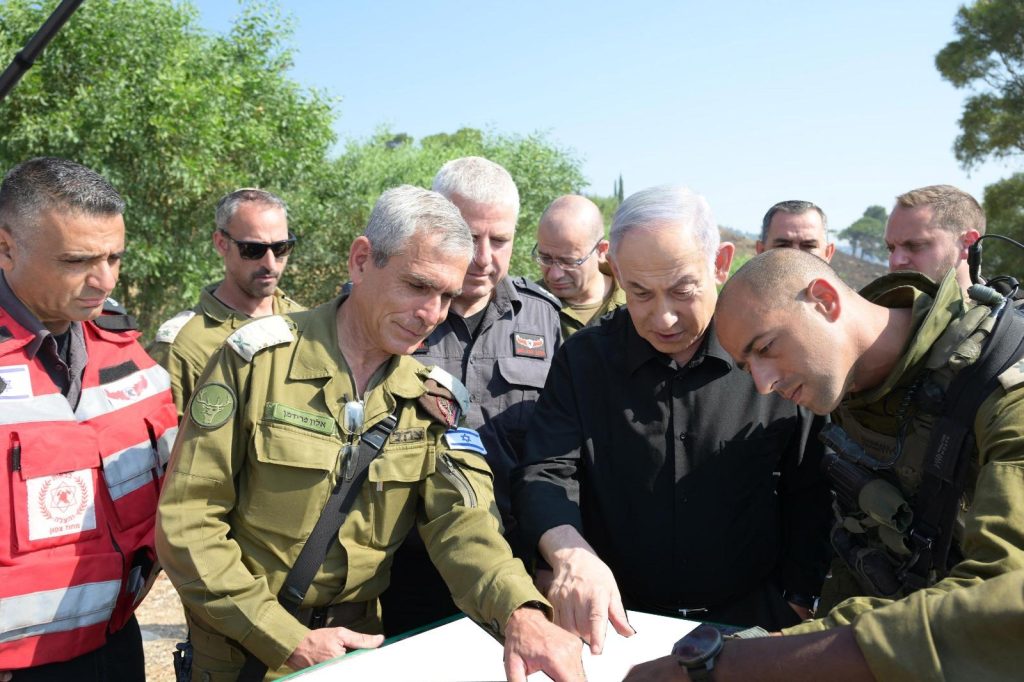
Photo credit: Amos Ben-Gershom (GPO)

The north: An IDF reservist was killed and at least ten people wounded yesterday in a drone attack on the Druze village of Hurfeish in the Upper Galilee.

  • The attack, claimed by Hezbollah, comprised two separate drone strikes, the second seemingly timed to deliberately target first responders.
  • The IDF named the fatality as Staff Sgt. (res.) Refael Kauders, 39. One of the injured is in critical condition. IAF helicopters evacuated the wounded to a Galilee Medical Centre in Nahariya and Rambam Hospital in Haifa.
  • Hezbollah also released footage showing a direct hit on an Iron Dome missile defence launcher yesterday.
  • The IDF confirmed strikes in response to the drone attacks, including Hezbollah infrastructure in Naqoura and Matmoura, buildings used by the terror group in Ayta ash-Shab, and an observation post in Khiam. Lebanese media last night reported Israeli strikes north of Bint Jbeil and in the area of Tyre.
  • President Yitzhak Herzog commented on the drone attack at the Jerusalem Day state ceremony at Ammunition Hill, saying, “We can’t remain indifferent to this terror. For months now, Israel has been attacked by Iranian proxies in Lebanon on a daily basis, clearly violating all international resolutions and agreements. The world has to wake up and realize that Israel is left with no choice but to defend its citizens. Israel will do this firmly and forcefully, and don’t come complaining when the situation gets out of control.”
  • Visiting the north yesterday, Prime Minister Netanyahu said, referring to the fires caused by Hezbollah attacks which this week consumed 3,460 acres of land, “Yesterday, the ground here burned. I’m glad that you extinguished that. But the ground also burned in Lebanon. Anyone who thinks that he can attack us and we will sit idly by is making a big mistake. We are prepared for a very intensive operation in the north. One way or another, we will restore security to the north.”

Hostage talks: Following President Biden’s Friday speech and ceasefire proposal, talks between Israel and Hamas appear close to collapsing. The US has blamed Hamas, with the President branding the group “the only obstacle to a complete ceasefire” and confirming “Israel’s readiness to move forward” with the terms he set out last week. Matthew Miller, a spokesman for the State Department, said that “Hamas should accept the deal now…the only thing standing between the people of Gaza and a ceasefire is Hamas.”

  • Last night, a Hamas spokesman said that the ceasefire proposal had been rejected by negotiators. He also confirmed that Hamas’s position was that that Biden’s proposal was simply a ruse designed to lure the organisation into another round of negotiations without an Israeli commitment to end the fighting and withdraw fully from the Gaza Strip.

Gaza Strip: The IDF continues to operate in the Rafah area and in central Gaza. It confirmed yesterday that it had taken “operational control” over east Bureij and Deir al-Balah.

  • Last night, the Israeli Air Force struck a Hamas compound embedded in a UNRWA school in the Nuseirat refugee camp it says was being used by 20-30 Nukhba commandos who had participated in the 7th October attacks as well as PIJ members. While it is unclear how many terrorists were killed, Palestinian sources suggest the strike caused dozens of civilian fatalities.
  • The IDF also continues its operations elsewhere in the Gaza Strip having located a rocket launcher it says was “ready to use” close to the border fence, identified and destroyed a significant tunnel used to store weapons in Rafah.
  • IDF troops also identified several suspects attempting to infiltrate Israel from the Rafah area. Troops engaged the suspects, who opened fire. The IAF eliminated two of the suspects, before tank fire killed a third.

Context: The drone attacks appears to be the most sophisticated attack on a civilian community since October 8th. While most of the victims appear to be soldiers, the attack was on a village football field, not a military installation.

  • The IDF will investigate how two such drones were able to penetrate Israeli airspace undetected, without triggering defence systems or warning sirens. Flying drones at low altitude helps prevent their detection, but it was still expected that the IDF had learned lessons from such tactics used by Hezbollah in its near-daily multi-site attacks on northern Israel over the last eight months.
  • Hezbollah has taken to trying to reduce Israel’s technological edge by targeting observation posts and surveillance equipment. Its attacks are increasing, with the Shin Bet recording over 1,000 attacks (rockets, anti-tank missiles, drones) in the month of May. In comparison, in January they recorded 334 attacks, and in February 534, whilst in both March and April over 740.
  • The precise Hezbollah attacks on both an Israeli civilian community and the Iron Dome launcher attests to their level of sophistication, both in terms of intelligence and operational capability.
  • One explanation for this increase is the connectivity of the northern and southern fronts, with Hezbollah’s intensified attacks increasing the pressure on Israel in Gaza.
  • 10 Israeli civilians and, after Kauders’s death, 15 soldiers and reservists have been killed on the Israeli side, while Hezbollah has reported 331 of its fighters killed. 62 operatives of other armed groups in southern Lebanon have also died. It is understood that around 25 civilians have also died in Lebanon – the high ratio of combatants to civilians killed indicating the precision of IDF strikes.
  • Military officials have briefed that as a result of IDF strikes on Hezbollah personnel, the group has switched up its operations, with operatives now travelling around in smaller numbers.
  • The US President’s ceasefire proposal was relatively similar to one rejected in January and involved three phases beginning with an exchange of Israeli hostages for Palestinian prisoners, the IDF’s withdrawal from the Gaza Strip, and the rebuilding of the coastal enclave.
  • However, the proposal envisions a “day after” in Gaza “without Hamas in power”. The group has repeatedly rejected such a post-war reality, and appears to be using this negotiating position to refuse attempts to reach a ceasefire.
  • Israeli Defence Minister Gallant vowed that “any negotiations with the Hamas terrorist organisation will only be conducted under fire”. Netanyahu has also been quoted as saying “I am not willing to stop the war…we can stop the fighting for 42 days in order to return hostages, but we will not give up on total victory.”
  • Despite Israel achieving almost complete operational control of the Strip, the attempted infiltration shows Hamas’s continued determination to launch attacks against Israel.

Looking ahead: With the north now the most significant kinetic front currently faced by Israel, the IDF has increased its preparations for more extensive engagement, possibly involving a ground incursion into southern Lebanon.

  • The Hezbollah-affiliated Lebanese news outlet al-Akhbar alleges that the UK has warned the Lebanese government that Israel means to launch a significant offensive in mid-June.
  • Operations in Rafah are predicted to last another month.

June 5, 2024

Fateful decisions await northern front and hostages

What’s happened: After two days of large fires caused by Hezbollah missiles and drones raging in northern Israel, firefighters have now gained control.

  • IDF Chief of Staff Lt. Gen. Halevi visited the area and said, “We are nearing the point at which a decision will have to be made, and the IDF is primed and very ready for that decision. We have been attacking here for eight months. Hezbollah has paid a very-very high price and has raised the intensity in the past few days, and we are prepared to pivot to an offensive in the north.”
  • Halevi added, “we are prepared after a very good process of training, up to the level of an IDF General Staff drill, to transition to attack in the north. Strong defence, readiness for offence, we are nearing the decision point.”
  • Defence Minister Gallant also held a situation assessment. According to his office, he “reviewed the operational and intelligence efforts by IDF troops in the face of Hezbollah’s aggression, the ongoing attacks in Lebanese territory to stop terrorists and the troops’ preparations for a high-intensity operation against the Shiite terrorist organisation.”
  • Earlier in the day, Ministers Gantz and Eisenkot met with the representatives of the (northern) Confrontation Line Communities Forum. After the meeting, Gantz said, “The biggest operative challenge today is in the northern theatre and in the country’s north, and the biggest moral challenge is in the south, in the Gaza Strip. Therefore, alongside the fighting, the right thing at this time is to get the hostages back, to act to get the residents of the north back home safely, to get the State of Israel back on track. That isn’t going to be easy. It will have costs; it will be painful; but it is the right thing.”
  • On Tuesday night, Israel’s inner war cabinet convened to discussed Hezbollah’s escalation of attacks on northern Israel.

Hostage negotiations: In parallel, Egyptian, Qatari, and American officials will be meeting today in Doha to discuss ways of reviving the hostage deal negotiations.

  • The sides await an answer from Hamas to the latest Israeli proposal. Israeli officials expect Hamas to respond affirmatively but conditionally, and to demand guarantees about the war’s conclusion. One Israeli official said, “Hamas won’t get a better offer than this.”
  • Israeli media also quoted a senior Israeli official saying, “We won’t submit a better proposal. We’ve stretched the limits of our flexibility.”
  • Hamas continues to demand the agreement guarantees the end of the war and an IDF withdrawal from Gaza.
  • Prime Minister Netanyahu spoke on the telephone yesterday with French President Macron to discuss the proposal. Netanyahu told Macron that “the proposal allows Israel to achieve all of the war’s objectives that it defined, including Hamas’s elimination.” Netanyahu also said, “Alongside freeing the hostages, that was and remains Israel’s fundamental objective in the war, and it is determined to achieve it.”

Context: There is growing pressure on the Israeli government to agree to a hostage deal and improve the situation in the north, either diplomatically or militarily.

  • Hezbollah has increased their level of attack. According to the Shin Bet there were over 1,000 attacks (rockets, anti-tank missiles, drones) in the month of May. There has been a gradual rise: in January they recorded 334 attacks, and in February 534, whilst in both March and April over 740.
  • As a result of the fires, the damage is twice the size of the area that was affected during the Second Lebanon War of 2006. Around 3,460 acres of woodlands has been damaged from rocket and drone fire out of Lebanon.
  • Whilst waiting for Hamas’s response to a hostage deal, both ultra-Orthodox parties have now declared their support for a deal.
  • On Tuesday Shas followed the United Torah Judaism (UJT) support from the day before. According to a Shas statement, “The deal contains far-reaching steps for bringing back the hostages and fulfilling the commandment to redeem captives. Shas supports the proposal and strengthens the prime minister and the war cabinet in withstanding all pressure to finalise the deal and save the lives of many of our brothers and sisters in need in captivity.”
  • The ultra-Orthodox support for a deal is important for Netanyahu to receive their political backing and further dilute the influence of far-right ministers Ben Gvir and Smotrich. It is also serves as welcome unifier for the wider Israeli public, particularly in light of the dispute over their service in the military.
  • There are suggestions that the ultra-Orthodox parties’ announcements came at Netanyahu’s behest, in a bid to keep Gantz in the government. Advancing a hostage deal could be the prerequisite that would say Gantz remain, despite his setting a June 8th deadline for Netanyahu to present a plan for the ‘day after’ in Gaza.
  • In the latest sign of dysfunctionality between the inner war cabinet and the wider security cabinet, according to Maariv the war cabinet asked to meet with the Fire and Rescue Authority commissioner to discuss the fires in northern Israel. National Security Minister Ben Gvir, who has ministerial authority over the commissioner, refused to authorise him to meet with the war cabinet and demanded that he meet with the entire security cabinet.
  • Meanwhile, in the south the IDF launched an operation yesterday into the Bureij area in the centre of the Gaza Strip. The IDF said they made swift progress and already exposed several underground facilities, and weapons storage sites.
  • The speed of IDF advancement is further illustration of the overall incapacitation of Hamas and the IDF’s increasing control in the Strip.

Looking ahead: Today is Jerusalem Day (marking the unification of the city in 1967). Three thousand police have been deployed to secure events marked by the traditional annual march through the old city this afternoon.

  • CIA Director William Burns is scheduled to arrive back in the region in the next few days to try to advance the hostage deal.

June 4, 2024

Fires rage in northern Israel from Hezbollah attacks

What’s happened: Fires continued to rage in Israel’s north overnight, caused by rockets and drones fired from southern Lebanon by Hezbollah yesterday.

  • An IDF Home Front Command’s fire battalion has worked in conjunction with Israel Fire and Rescue Services across a large area, comprising multiple northern communities, with the result that most fires are now under control.
  • With many residents of the northern border areas evacuated south since October 7th, no fatalities were reported. Six reservists and five civilians have been treated for smoke inhalation.
  • One fire in Amiad, brought under control today, consumed 4,000 dunams (nearly 990 acres) of land.
  • Fires caused by rocket and drone fire on Sunday destroyed 10,000 dunams (over 2,470 acres) of plant life, including in nature reserves. The damage was compounded by the unseasonably high temperatures throughout Israel.
  • A loud explosion heard this morning in Safed is currently being investigated.
  • Israel yesterday announced it had killed prominent Hezbollah fighter Hussein Sabra in an airstrike in Tyre, southern Lebanon. The IDF said Sabra was a senior figure in Hezbollah’s Force Build-up Unit, particularly involved in efforts to equip and enhance its Aerial Defence Unit.

Gaza: The IDF yesterday confirmed the deaths of four hostages: 51 year old Israeli-British citizen Nadav Popplewell from Kibbutz Nirim; 85 year old Amiram Cooper, one of the founders of Kibbutz Nir Oz; 80 year old Haim Perry from Kibbutz Nir Oz; and  80 year old Yoram Metzger from Kibbutz Nir Oz.

  • An expert committee of the Health Ministry, the Religious Affairs Ministry and chief rabbi determined their death based on intelligence, with the whereabouts of their bodies unknown.
  • News of the deaths sparked further protests against the government and demanding that a deal for the release of the remaining hostages be secured. Demonstrators blocked the Ayalon Highway last night for about an hour.
  • The IDF continues “intelligence-based, targeted operations” in Rafah.
  • “Over the past day, IAF fighter jets struck over 50 targets in the Gaza Strip, including terrorist infrastructure, weapons storage facilities and military structures.”

Context: Having been a second front during the nearly nine months of the war in Gaza, the north is now the primary front of kinetic activity.

  • Since October 8th, Israel and Hezbollah have traded fire on a near-daily basis, with Hezbollah launching over 4,700 missile, drone, and rocket attacks.
  • Hezbollah joined Hamas’s attack on October 8th, but at a level short of necessitating a full-blown escalation. The vast majority of targets struck have been close to the border area, to keep IDF forces occupied and divert resources.
  • A significant escalation has been seen in recent weeks. The Alma Centre finds that May was the most intense month of fighting in that time, with Hezbollah carrying out 325 attacks, an average of 10 a day. These include 95 incidents of anti-tank launches and 85 UAV infiltration incidents.
  • 10 Israeli civilians and 14 soldiers and reservists have been killed on the Israeli side, while Hezbollah has reported 331 of its fighters killed. 62 operatives of other armed groups in southern Lebanon have also died. It is understood that around 25 civilians have also died in Lebanon – the high ratio of combatants to civilians killed indicating the precision of IDF strikes.
  • Around 70,000 Israelis remain internally displaced, having been moved from homes near the border. A similar number of Lebanese citizens are also displaced.
  • Hezbollah has often targeted key northern military facilities, including the Galilee Formation’s headquarters, and the Mt. Meron air control base. The weekend saw hits on the Gibor Regional Brigade base near Kiryat Shmona with heavy-payload Burkan rockets.
  • Hundreds of homes in civilian communities in close proximity to the border have also been heavily targeted.
  • Beyond the physical damage, the combined effects of striking homes and military targets is intended to have a psychological effect on the Israeli population.
  • Hezbollah has significantly more sophisticated weapons than Hamas, including Iranian-produced Almas anti-tank guided missiles with a 10-kilometre range and the shorter range Burkan with its heavy payload. 340 such heavy rocket attacks have so far been launched. Iranian UAVs, with the ability to launch missiles, have also been deployed.
  • This greater sophistication was also demonstrated this weekend by Hezbollah downing an IDF Hermes 9,000 unmanned aerial vehicle, the third Hermes to have been downed since October 8th. Hezbollah’s ability to do this illustrates the extent to which Iran has helped it upgrade its firepower.
  • Israeli officials have reassured the public that despite the downing of these weapons, built in self-destruction mechanisms mean that no sensitive material falls into Hezbollah hands.
  • Israel’s response to these attacks has largely been a combination of air and artillery strikes into Lebanon targeting Hezbollah’s military leadership and infrastructure. While primarily destroying targets in the south of the country, some Israeli airstrikes have been reported as far north as Baalbeck and the Beqaa Valley – Baalbeck is a vital logistics hub for Hezbollah’s military operations and, sitting near the border with Syria, a key point on the smuggling route from Iran.
  • Israeli officials have repeatedly expressed support for US and French diplomatic efforts to reach a peaceful resolution, but have long anticipated that a potential ground incursion may be necessary at some point.
  • Israel views its current paradigm of 70,000 citizens being internally displaced due to Hezbollah’s aggression as untenable and intolerable. The longer they remain unable to safely return to their homes, the higher the risk of a military escalation in southern Lebanon.
  • While the US and France have spearheaded a series of diplomatic efforts to defuse this situation, they have thus far proved unsuccessful.
  • Israel continues to insist on the robust implementation of UN Resolution 1701 passed at the end of the Second Lebanon War in 2006. Most significantly, it stipulates Hezbollah forces, be pushed back as far as the Litani River ensuring Israeli civilian are out of range of Hezbollah’s accurate Kornet anti-tank missiles.
  • Any move away from the border on the part of Hezbollah fighters will need to be monitored and sustainable, since Hezbollah has a track record of initially complying with such deconfliction steps, before then moving its fighters back closer to the border.

Looking ahead: This week, the IDF continues to make preparations for a campaign in the northern arena.

  • Pressure is mounting on the government for northern residents to return to some form of normality, with the optimistic hope that by the start of the school year on September 1st, people will be back home. Ongoing escalations mean this is far from guaranteed.
  • The current situation suits Hezbollah in keeping Israel engaged in a perpetual state of conflict below the threshold of all-out war, while ensuring Israel has to commit resources which, in the longer term, has social and economic costs.
  • Efforts to reach a ceasefire in Gaza are set to continue, whilst the sides await a Hamas response to the Israeli proposal publicly floated by President Biden last

June 3, 2024

Israeli officials respond to President Biden

  • According to Biden, the plan would have three stages:
    • In the first, a cease-fire would be imposed for six weeks, during which Israeli forces would withdraw from populated areas in Gaza. Hamas would release female, elderly and sick hostages and Israel would release hundreds of Palestinian security prisoners. Gazans would return to their homes.
    • Phase Two would see all remaining living hostages released, including male soldiers. Israel would withdraw its remaining forces from Gaza. A permanent cease-fire would be effected if Hamas lived up to its obligations.
    • Phase Three would see a major project of reconstruction begun in Gaza.
  • President Herzog thanked President Biden for his speech and his “ongoing efforts to bring about the release of all the hostages held by Hamas in Gaza.“
  • Herzog added on X, “I told Prime Minister that I will give him and the government my full support for a deal which will see the release of the hostages. We must not forget that according to Jewish tradition, there is no greater commandment than redeeming captives and hostages – especially when it comes to Israeli citizens who the State of Israel was not able to defend and protect. It is our inherent obligation to bring them home within the framework of a deal that preserves the security interests of the State of Israel.”
  • On Saturday the Prime Minister’s Office released a statement saying, “Israel’s conditions for ending the war have not changed: the destruction of Hamas’s military and governing capabilities, the freeing of all hostages and ensuring that Gaza no longer poses a threat to Israel. Under the proposal, Israel will continue to insist these conditions are met before a permanent ceasefire is put in place. The notion that Israel will agree to a permanent ceasefire before these conditions are fulfilled is a non-starter.”
  • The plan received support from Minister Gantz who commented saying, “We are committed to continuing to move forward with the proposal to get back our hostages as was formulated by the negotiations team and approved unanimously by the war cabinet. In light of developments, the war cabinet must be convened as soon as possible together with the negotiating team to formulate the next steps.”
  • However, Ministers Smotrich and Ben Gvir attacked the proposal  and threatened to leave the government. “I just spoke to the prime minister and made clear to him that we will have no part in a government that agrees to the proposed outline and ends the war without destroying Hamas and returning the hostages,” said Finance Minister Smotrich. Ben Gvir added, “This is a reckless deal, one that represents a victory for terrorism and a danger for the State of Israel. Agreeing to a deal like this is not ‘total victory’ but total defeat.”

Context: 124 hostages remain in Hamas captivity, now for 241 days. This number was reduced by one this morning after the murdered body of Dolev Yehud, a 35-year-old resident of Kibbutz Nir Oz, was identified. It had previously been assumed that he had been taken hostage.

  • President Biden’s address was an endorsement of a compromise proposal, that he gave Israel the credit of agreeing to.
  • One of the aims of the speech was to place additional pressure on Hamas and signal to the US pro-Palestinian supporters that Israel is prepared to compromise. If this deal fails it will be on Hamas.
  • President Biden’s presented a broad roadmap to end the war, but it isn’t clear whether there is a detailed work plan.
  • It is unusual for a US president to present a plan in someone else’s name. However, it appears that the Israeli war cabinet approved the broad outline of this plan. However, many issues remain unresolved. The most problematic gaps include:
    • Reaching a permanent ceasefire / ending the war completely, whilst Hamas remains in power.
    • Lack of clarity over how many of the hostages are still alive, and whether Israel was negotiating for live captives or dead bodies.
  • Another concern relates to President Biden’s confidence that the war has been won and Hamas no longer poses a threat. Whilst rockets are still fired out of Gaza and the Hamas leadership is still in control the Israel public does not perceive this as the ‘total victory’ they were promised.
  • In parallel large public protests have continued. Tens of thousands of Israelis gathered in Tel Aviv on Saturday night, demanding that the government secure a deal to release the hostages.
  • Biden reiterated that the ceasefire could also lead to a cessation of Hezbollah attacks from the north as well as a normalisation agreement between Israel and Saudi Arabia.
  • Many view this speech as a final effort of President Biden to reach a wider deal. There is a limited window over the summer, after which all US focus will be on the presidential election.
  • Biden’s speech brought into sharp relief the existing divisions within the Israeli government. Already at the end of last week, Gantz’s party announced they were submitted a vote of no confidence in the current government – an usual move for a party that is currently part of the government.
  • Both Ministers Gantz and Eisenkot have been deeply frustrated by the government’s inability or refusal to present a vision for Gaza ‘the day after’ Hamas. In early May, Gantz publicly threatened to leave the government unless Netanyahu committed to a plan.
  • At that time, Gantz presented the Security Cabinet with a demand to formulate a plan which should include six objectives: the hostages’ return; toppling Hamas and demilitarising the Gaza Strip; deciding on an alternative regime for Gaza; a return home by the residents of northern Israel by September 1; promoting normalisation; and endorsing the plan to broaden military service to all Israelis.
  • However, even if Gantz were to resign from the government and take his party’s MKs with him, this would still leave the coalition with the governing majority (64 seats in a 120-seat Knesset) it enjoyed before October 7th.

Looking ahead: Efforts to reach a ceasefire are set to continue, whilst the sides await a Hamas response to the Israeli proposal.

  • Minister Gantz had set a deadline of June 8th for Israel to present a strategic plan or he would quit the government. There is speculation whether the adoption of this plan ensures he will remain in the government in order to develop and implement the ceasefire.
  • Prime Minister Netanyahu has been invited to address a joint meeting of both Houses of the US Congress. He will be the first foreign leader to address both Houses of Congress for a fourth time.

May 31, 2024

National Unity moves to dissolve Knesset

What’s happened: A bill to dissolve the Knesset and hold fresh elections was introduced to the Knesset yesterday by National Unity Party Chairperson MK Pnina Tamano-Shata.

  • Tamano-Shata said of the move: “October 7 was a tragedy that requires us to return and receive the people’s confidence and to form a broad and stable unity government that will be able to lead us safety to face the huge challenges in security, in the economy and primarily, in Israeli society.”
  • A National Unity Party statement then said “the person who chose to dismantle the emergency government at the country’s hardest hour was Netanyahu, who chooses, time after time, his personal interest over the national interest. Israel needs a government that promotes unity, not incitement, returning the hostages, returning the residents of the north home, and strives to real victory, not to slogans. Netanyahu, it is still not too late to come to your senses—either we win together, or you continue on your own in the divide and conquer method.”
  • A Likud statement in response said “at the height of war, Israel needs unity, not division, dismantling the government is a prize for Sinwar, capitulation to international pressure and undermines the efforts to free our hostages.”

Context: National Unity’s move to dissolve the Knesset signifies a highly unusual instance of a party trying to unseat a government of which it is currently a part. Previously a part of the opposition, Gantz took his party into the government on an emergency basis early in the war in Gaza. Both he and Gadi Eisenkot immediately joined both the security cabinet and the smaller war cabinet (Eisenkot as an ‘observer’).

  • In a speech earlier this week, Eisenkot, whose son was killed early in the fighting in Gaza, said “it is clear that this government needs to be replaced as soon as possible.” He called for elections to be held sometime between September and December this year.
  • Eisenkot also attacked the government’s narrative around ‘total victory’ and the operation in Rafah. “Anyone who says that we’ll disband three battalions in Rafah and after that be able bring back the hostages is sowing false illusions,” he said. “This is a much more complex event. The truth is that it will take three to five years to stabilise [Gaza], and then many more years to establish another regime.”
  • Eisenkot also commented on the level of influence he and Gantz were now having in government. “I can’t ignore that recently our influence has been reduced,” he said. “Political and other considerations have been inserted into decisions that we voted on behind closed doors.”
  • Both Gantz and Eisenkot have been deeply frustrated by the government’s inability or refusal to present a vision for Gaza ‘the day after’ Hamas. In early May, Gantz publicly threatened to leave the government unless Netanyahu committed to a plan.
  • At that time, Gantz presented the Security Cabinet with a demand to formulate a plan which should include six objectives: the hostages’ return; toppling Hamas and demilitarising the Gaza Strip; deciding on an alternative regime for Gaza; a return home by the residents of northern Israel by September 1; promoting normalisation; and endorsing the plan to broaden military service to all Israelis.
  • Even if Gantz were to resign from the government and take his party’s MKs with him, this would still leave the coalition with the governing majority (64 seats in a 120-seat Knesset) it enjoyed before October 7th.
  • The bill thus has no chance of passing unless MKs from other government factions can be persuaded to vote in favour. It is highly unlikely that five MKs from Netanyahu’s Likud can be persuaded to do so, even though some have recently echoed Gantz’s frustration that a commission of inquiry into the events of October 7th has not yet been formed.
  • It is also possible, though not likely, that coalition MKs from amongst the ultra-Orthodox factions United Torah Judaism and Shas could vote in favour of dissolving the government.
  • Elements from within these factions have recently threatened to quit the government unless legislation is passed securing the right of ultra-Orthodox Israelis to avoid being drafted into the IDF.
  • Legislation to codify this exemption was considered this time last year, but not floated due to opposition from within the government and fears that Israel’s Supreme Court could strike it down as being an infringement of the principle of equality.
  • Given their differences with Netanyahu over the prosecution of the war, pressure from opponents of Netanyahu and the Likud for Gantz to quit the government has been mounting of late.
  • After months of polling showing National Unity well ahead of Likud, and Gantz comfortably leading Netanyahu on suitability to be prime minister, Channel 12’s latest poll from yesterday showed a shift. The two parties are now much closer – National Unity on 25 and Likud on 21 – while Netanyahu now leads Gantz 36 to 30 percent on who would make the better prime minister.
  • Polls also indicate that a 60 percent majority of National Unity voters believe the party should quit the government.
  • This week, Yisrael Beiteinu Chairman Avigdor Lieberman initiated a so-called opposition ‘war room’ with Leader of the Opposition Yair Lapid, and Gideon Saar, who withdrew his New Hope faction from the government after he was excluded from the war cabinet.

Looking ahead: Large public protests demanding that the priority should be securing the return of the hostages, now held for 237 days, have coalesced with wider anti-government protests demanding fresh elections. The protests are likely to continue and perhaps grow.

  • Newly-elected Labour leader Yair Golan will be seeking to harness that protest energy, and some of the highly organised infrastructure which developed during last year’s anti-judicial reform protests, into greater Knesset representation for the Israeli left and other anti-Netanyahu factions.
  • On Sunday, a nine judge panel of the High Court of Justice will convene to hear the government’s plans for the question of the ultra-Orthodox and the military draft.
  • When Gantz made his ultimatum to Netanyahu, he gave June 8 as a deadline to formulate a ‘day after’ plan. Analysts are now suggesting he might withdraw National Unity sooner.
JO

May 28, 2024

Israel opens investigation into strike in Rafah

What’s happened: Israel’s independent General Staff Fact-Finding and Assessment Mechanism is to investigate Sunday’s IAF strike in Rafah.

  • The airstrike in the Tel Sultan area targeted and killed two senior Hamas officials in the city, including the commander of Hamas’s West Bank headquarters, but tragically resulted in the deaths of dozens of displaced Gazan civilians sheltering in tents when fires spread to the temporary shelters.
  • The Hamas health ministry, in unverified figures, reports 45 Palestinians dying as a result of the strike.
  • The IDF said “the attack was carried out against terrorists who are a target for attack, in accordance with international law, using precision munitions, and based on intelligence indicating the use of the area by Hamas terrorists.”
  • “Before the strike,” it said, “a number of steps were taken to reduce the risk of harming uninvolved civilians during the strike, including conducting aerial surveillance, the deployment of precise munitions by the IAF, and additional intelligence information. Based on these measures, it was assessed that there would be no expected harm to uninvolved civilians.”
  • “In addition, the strike did not occur in the Humanitarian Area in Al-Mawasi, to which the IDF has encouraged civilians to evacuate.”
  • Speaking in the Knesset yesterday, Prime Minister Netanyahu said, “in Rafah, we have evacuated about one million civilians. Tragically, despite our immense efforts to avoid harming non-combatants, an incident occurred yesterday. We are investigating it thoroughly and will learn from it, as is our policy and longstanding conduct. For us, any non-combatant hurt is a tragedy; for Hamas, it is a strategy. That is the core difference.”
  • A US National Security Council spokesperson said, “Israel has a right to go after Hamas, and we understand this strike killed two senior Hamas terrorists who are responsible for attacks against Israeli civilians, but, as we’ve been clear, Israel must take every precaution possible to protect civilians.”
  • Separately, an Egyptian soldier died yesterday following a clash with Israeli soldiers near the Rafah border crossing.
  • The precise circumstances remain unclear, with Israel suggesting that fire began on the Egyptian side, while Egyptian sources suggest that the Israelis opened fire, possibly in a confrontation with Palestinians.
  • Elsewhere in Gaza, troops located large amounts of military equipment and weaponry and dismantled an explosives manufacturing facility in Jabaliya.
  • The IAF, meanwhile, struck over 75 targets in the Strip on Sunday, including a “launch site in Jabaliya from which launches toward the city of Ashkelon in Israel were carried out throughout the war.”
  • Troops also dismantled an 800-metre-long tunnel in the central Strip.

Context: Israel remains under attack from multiple sources. On Sunday, eight rockets were launched from the Rafah area towards central Tel Aviv, the first time sirens have been heard in Tel Aviv since January.

  • The rockets were fired around 800 metres from where IDF troops where operating in Rafah. This demonstrates that Hamas retains the ability to launch long-range rockets. The timing of the launches is likely due to the advances the IDF is making in Rafah and a desire to use the weapons before troops disable the launch sites.
  • Over 90 Hezbollah rockets were fired from Lebanon on northern Israel yesterday. A barrage of around 30 rockets was fired at Kiryat Shmona yesterday evening and a similar sized barrage fired at Mount Meron.
  • The IDF struck back at the rocket launchers used to launch the Mount Meron barrage.
  • Pro-Iranian Iraqi militias yesterday launched two drones at Eilat, following similar attacks last week. IAF fighter jets and the IDF Aerial Defence Array downed both drones off the coast of the city, with no injuries or damage reported.
  • Sirens sounded in the western Galilee after two UAVs crossed into Israeli territory from Lebanon. One was intercepted while the other fell. No injuries or damage were reported.
  • The targets of the Rafah attack were Yassin Rabia, commander of Hamas’s West Bank headquarters, and Khaled Najjar, another senior member of the same unit.
  • Israel said Rabia “managed all of the military arrays of the West Bank headquarters… was involved in the transfer of funds for terror purposes and directed attacks by Hamas operatives.”
  • The IDF’s General Staff handles investigations into both mistakes and potentially criminal actions during wartime.
  • Israel’s Military Advocate General, Major-General Yifat Tomer-Yerushalmi said yesterday that since the beginning of the war, “approximately seventy investigations have been launched regarding incidents that raised suspicion of criminal offences.”
  • The General Staff Fact-Finding and Assessment Mechanism is independent from the IDF.
  • COGAT reports that humanitarian aid continues to flow into the Gaza Strip. 378 trucks were inspected and transferred yesterday through the Kerem Shalom and Erez West crossings.
  • “78 trucks of flour from the World Food Program were transferred to supply the organisation’s bakery operations across the Gaza Strip, and 154 aid trucks from Egypt made their way from the Rafah crossing to the Kerem Shalom crossing.”
  • Israel has presented Egypt with evidence supporting its version of events around the cross-border fire. Both sides seem keen to put the incident behind them.
  • Tensions between Israel and Egypt were already high due to Egypt’s opposition to an Israeli operation in Rafah. Cairo has feared that fighting in Rafah would lead to pressure on its border from civilians fleeing the area.
  • It has also sought to maintain control over both the Philadelphi corridor and the Rafah-Egypt crossing. There are both financial motivations for this, and a sense of wanting to protect its pride, which would be damaged by revelations that this border has been porous to smuggling from Egypt into Gaza.
  • Since the operation in Rafah began, the IDF has discovered ten smuggling routes along the Philadelphi corridor, an embarrassing example of Egypt being either unable or unwilling to stem the tide of smuggling. Six of the routes have already been decommissioned by the IDF.
  • In over 45 years of a so-called ‘cold peace’ between the two countries, while civilian ties have never transpired as might have been hoped, security cooperation has remained solid. It is in both countries’ interest for this to continue.

Looking ahead: The head of Mossad met with Qatari and US officials over the weekend. They now wait to see if Hamas will return to talks.

  • The basic positions of both Israel and Hamas appear irreconcilable. Israel insists that an agreement not explicitly provide for an end to fighting; Hamas that it does. It remains to be seen if wording can be formulated to satisfy both.
  • A previous Egyptian proposal calls for three stages, the last of which would see a one-year ceasefire committed to by both sides

Newsletter sign-up

Please enter your information below to subscribe to our daily newsletter and stay updated and informed.

Donate to BICOM

At BICOM, we rely on the generosity of people like you to keep our website and services running. Your donation, no matter the size, makes a real difference. Please consider supporting us today. For further information please email: [email protected]