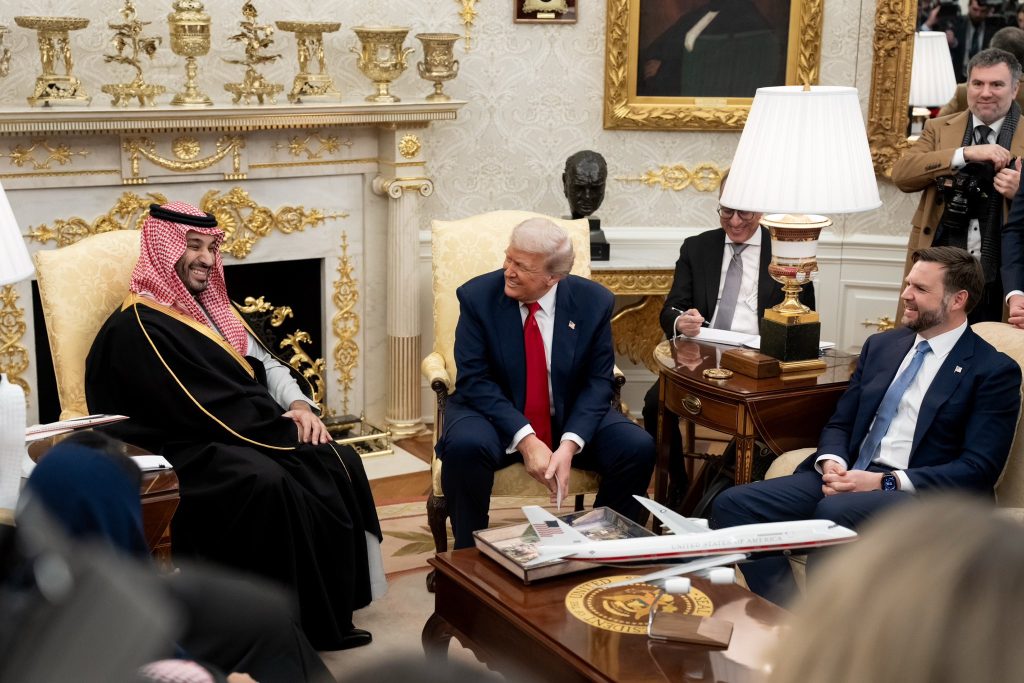
What’s happened: The US and Saudi Arabia signed “landmark agreements” that according to the White House will “deepen the US-Saudi strategic partnership.”
- Among the key elements of “The Strategic Defence Agreement” is the affirmation that Saudi Arabia views the US as its primary strategic ally, and includes cooperation in the field of civilian nuclear energy.
- According to the White House, “President Trump approved a major defence sale package, including future F-35 deliveries…The President secured an agreement for Saudi Arabia to purchase nearly 300 American tanks, enabling Saudi Arabia to build up its own defence capabilities.”
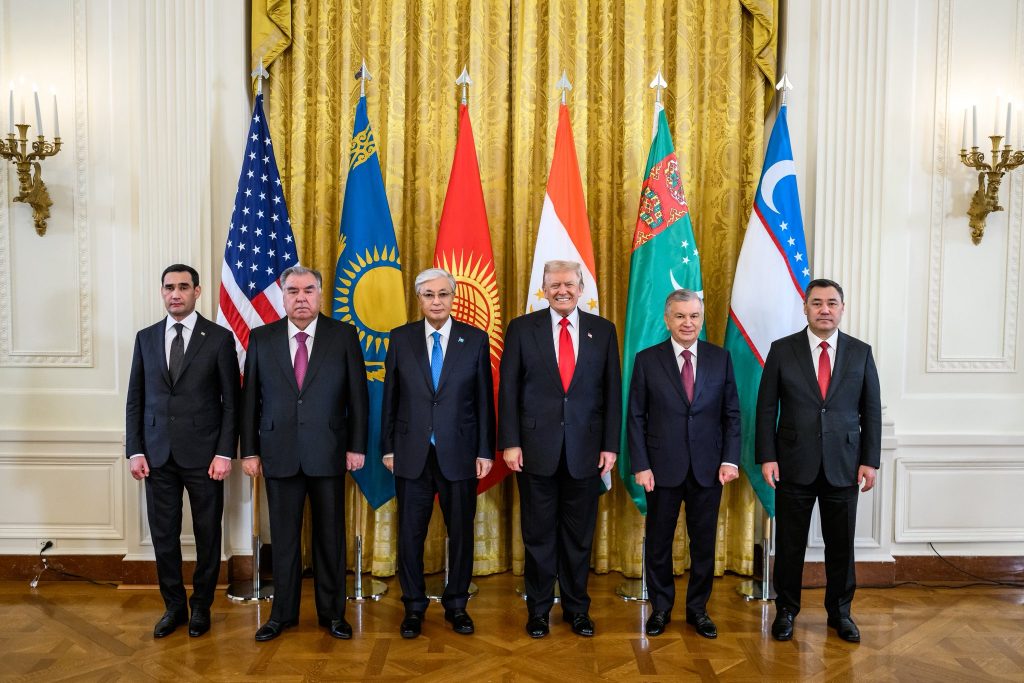
- US President Trump said before his meeting with Saudi Crown Prince Mohammed bin Salman (MBS) at the White House that Saudi Arabia and Israel are both great American allies.
- For his part MBS reiterated that normalising Saudi ties with Israel was contingent on a clear path to establishing a Palestinian state. He said, “We believe having good relations with all Middle Eastern countries is a good thing, and we want to be part of the Abraham Accords. But we want also to be sure that we secure a clear path of a two-state solution.”
- A retired Saudi army general Hassan al-Shahri, who is an official from the royal family, told Kan News that the talks between the crown prince and President Trump could jumpstart a future Israeli-Saudi dialogue about normalisation. However, he clarified that relations would not be normalised until a breakthrough is made on the Palestinian issue.
Context: The Israeli government had hoped that the US-Saudi security pact and the sale of F-35s would have been contingent on Israeli-Saudi normalisation.
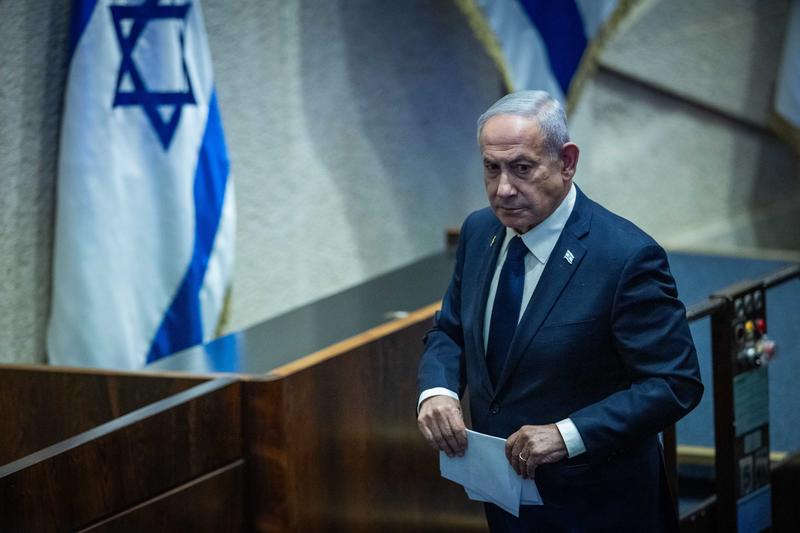
- The Saudis have not ruled out normalisation in the future, but their current posture suggests that they will be only be willing to start holding talks after the second stage of Trump’s plan is completed. The concern with this approach is that the Saudis are giving Hamas a veto on normalisation. Currently Hamas is refusing to make progress on disarmament.
- Hamas is receiving backing for its stance from Iran, who are wary that normalisation would strengthen the regional alliance against it.
- A second Saudi demand is for Israel to publicly endorse the Trump 20 Point Plan and the UN Security Council resolution regarding the pathway for the eventual establishment of a Palestinian state. This remains highly unlikely while Netanyahu continues to reiterate his opposition to a Palestinian state (and while the government is dependent on the support of Smotrich and Ben Gvir).
- The Saudis do not rule out talks on civilian and economic matters, but will stop short of normalisation without the progress on the Palestinian front.
- A senior Saudi adviser told Yediot Ahronot, MBS “wanted to give Trump and Netanyahu a glimmer of hope, but made no commitment. You have to understand from what he said that the crown prince is willing, but wants something in return on the Palestinian matter. The future of the Palestinians in the West Bank is of great interest to him. Don’t forget that bin Salman loathes Hamas and refuses to take in Palestinians from Gaza to Saudi Arabia.”
- On the issue of the F-35s, Israel is not opposed in principle, but reportedly asked for two conditions. These include excluding the plane’s most advanced systems and for the US to supply Israeli with other advanced military technology that has yet to be sold to Israel.
- The F-35 are considered the world’s most technologically advanced stealth jets. The advanced systems of sensors, cameras and radars allow the planes to monitor any aerial movement in the region and have the ability to provide targets to planes and to ground systems.
- In the end it could be that Saudi Arabia and Israel will receive the same systems. This is acceptable for some within the Israeli security establishment as they are confident that the additional Israeli built technology and the skill of Israel’s pilots will help maintain Israel’s qualitative edge.
- Others are alarmed that the long-term threat could creating future vulnerability and limit Israel’s regional operational freedom.
- It remains unclear whether Israel is a coordinated partner in a larger US–Saudi strategy or being marginalised as Washington and Riyadh advance bilaterally that Israel may just have to accept.
Looking ahead: It is expected to take several years to manufacture and deliver the jets to the Saudis, in which time the onus will be on Israel to continue to make further technological breakthroughs.
- Although Israel certainly views MBS as a future partner, the longer term political stability of Saudi Arabia remains a concern, which is sharpened if they possess advanced military and civilian nuclear capacity.