LATEST

Hamas and the Muslim Brotherhood

Key background
  • Hamas is an Islamist Palestinian nationalist movement which currently governs the Gaza Strip. It is proscribed by the UK and in the majority of western countries.
  • Its primary state backers are Iran, Turkey, and Qatar. It is also active in the West Bank, East Jerusalem, Syria, and Lebanon.
  • Since seizing control of the Gaza Strip in 2007, it has continuously launched attacks against Israel and weaponised civilian infrastructure by embedding itself into schools, mosques, and hospitals.
  • Hamas’s 7th October attacks on southern Israel killed 1200, and over 250 hostages were subsequently taken to the Gaza Strip.
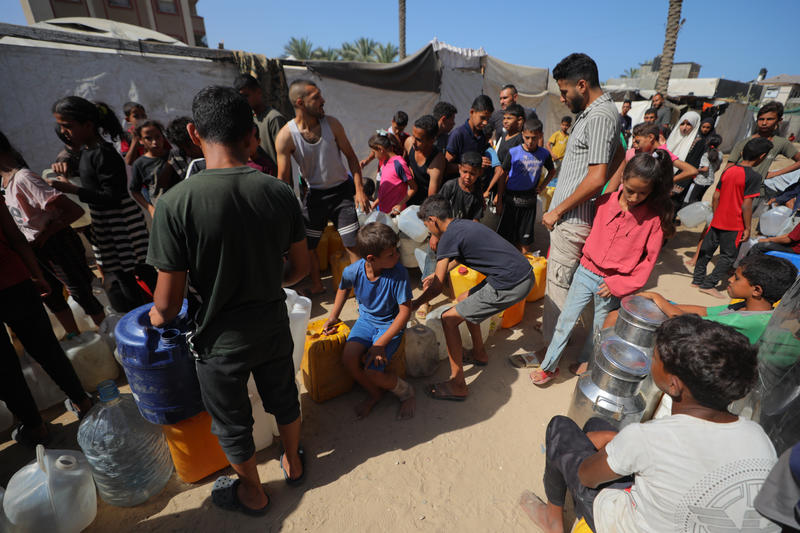
Palestinians wait in queue with water jugs to collect water from tankers in Deir al-Balah
Palestinians wait in queue with water jugs to collect water from tankers in Deir al-Balah, Gaza on October 2, 2025. Photo by Ali Hassan/Flash90

Updated October 3, 2025

Waiting on Hamas’s response to Trump’s peace plan

Gaza: During Yom Kippur Hamas were able to launch five rockets towards Ashdod, four were intercepted whilst one landed in an open area.

  • On Wednesday several projectiles were launched from the Khan Yunis area and landed in the aid distribution site in Rafah, but did not cause any damage. 
  • According to the IDF, “Despite the projectile launches fired, the aid distribution site opened yesterday, and thousands of weekly food packages were distributed to Gazan residents, without Hamas’ involvement.” 
  • According to COGAT over the last week, 1,517 aid trucks entered Gaza, whist 2,14 trucks were able to distribute aid, with an additional 404 awaiting collection inside Gaza.  
  • In addition the Gaza Humanitarian Foundation has distributed more than 175 million meals since their operations began at the end of May. 
  • The IDF has continued to expand its incursion and is now operating in the heart of Gaza City, an estimated 1.5 km from the coast. It has also created an additional divide south of the Capital, including security checks on those leaving to the south.  
  • Off the coast the Israeli navy took control of more than 40 vessels that participated in the “Gaza Freedom Flotilla.” Over 400 flotilla participants were arrested and brought to Ashdod Port ahead of their deportation from the country, no casualties were reported. 

Waiting on Hamas: Three days after US President Trump presented his peace plan for ending the war in Gaza, (giving Hamas a deadline of three or four days to respond), there has so far been no formal answer. 

  • It is understood there is an internal disagreement within the organisation between those who want to reject the plan and those who would prefer to consider it in depth, on condition that significant changes are made. 
  • Hamas appears to have several demands:
    • A clear timeline for the IDF to withdraw from the Gaza Strip.
    • Assurances that there will be internal Palestinian rule that isn’t dictated to by external parties. 
    • A refusal to fully disarm.
  • Hamas is also looking to coordinate their position with other Palestinian factions. 
  • According to the assessments, Hamas will likely choose the “yes, but” option, willingness to continue talks alongside presenting new demands.
  • 48 hostages remain in Gaza, including 20 who are still alive. The Trump plan would require Hamas to release all of them within 72 hours of the start of the ceasefire. Hamas has claimed that this deadline might be difficult to deliver, particularly as some are held by different factions.
  • Some senior Hamas members are also opposed to the deployment of “a temporary international stabilising force” in Gaza, to be operated by the US and Arab countries which Hamas sees as a new type of occupation.
September 30, 2025

Netanyahu endorses Trump peace plan

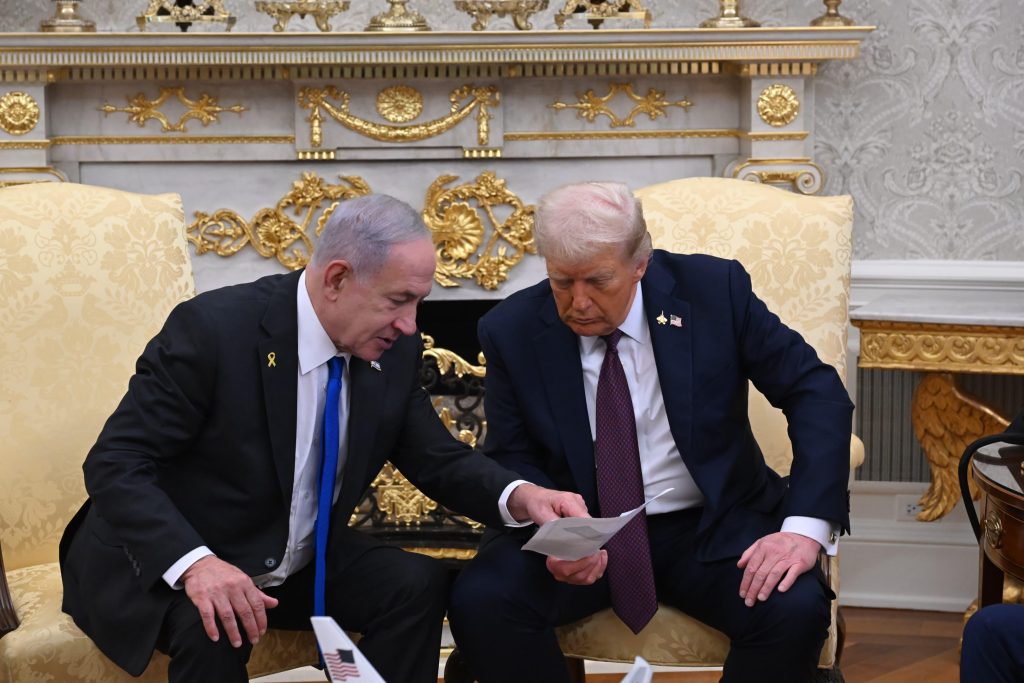
Prime Minister Netanyahu with President Donald Trump at the White House.
Prime Minister Netanyahu with President Donald Trump at the White House. September 29, 2025. Photo credit: Avi Ohayon, GPO.

What’s happened: President Trump unveiled his 20-point plan for ending the war at a White House press conference with Prime Minister Netanyahu, who accepted the plan on Israel’s behalf. The plan has also been endorsed by foreign ministers from Saudi Arabia, Jordan, the UAE, Indonesia, Pakistan, Turkey, Qatar, and Egypt.

  • Speaking after President Trump, Prime Minister Netanyahu said that the new plan “will bring back to Israel all our hostages, dismantle Hamas’ military capabilities, end its political rule, and ensure that Gaza never again poses a threat to Israel.” (More details below.)
  • Prime Minister Starmer announced his “strong support” for the plan to end the war, saying, “the new US initiative to deliver an end to the war in Gaza is profoundly welcome and I am grateful for President Trumps’ leadership.” French President Macron also endorsed the plan, adding that “Hamas has no choice but to immediately release all hostages and follow this plan.”
  • Before the announcement, Netanyahu called the Qatari Prime Minister Al Thani to apologise for the Israeli air strike on Doha on September 9. Specifically, the Prime Minister expressed regret that a Qatari citizen had been killed in the strike (which also eliminated five Hamas officials) and committed not to violate Qatari sovereignty again in the future. Netanyahu also told his Qatari counterpart, “I know your leadership has grievances against Israel and Israel has grievances against Qatar, from support for the Muslim Brotherhood to how Israel is portrayed on Al Jazeera to support for anti-Israel sentiment on college campuses.”

Trump plan in detail: The terms of the Trump plan would see Israel achieving nearly all the goals it set for itself at the war’s outset, but not those of some of the far-right coalition partners.

  • All Israeli hostages, living and dead, held by Hamas are to be released in the first 72 hours of the implementation of the agreement, before any changes are undertaken in IDF deployments. In exchange, Israel will release 250 Palestinians serving life sentences for terror offences and 1700 Gazans detained since the war began two years ago, including all women and children. For every dead hostage released by Hamas, Israel will hand over 15 bodies of Palestinians.
  • The agreement stipulates a staged withdrawal process of Israeli forces that does not end at the pre-war boundary. Each of three withdrawals is conditioned on benchmarks of Hamas disarmament and the entry of an International Stabilisation Force (ISF) manned by Arab and Muslim countries. The last stage in the agreement will still see Israel hold on to a narrow buffer zone on the border of the Gaza Strip.
  • Amnesty will be offered to Hamas members who “commit to peaceful coexistence” and “decommission their weapons.” Presumably allowing Israel to continue to act against those that do neither.    
  • An international “Board of Peace” headed by Trump and former Prime Minister Tony Blair will oversee the governance of the Gaza Strip by means of a “technocratic, apolitical Palestinian committee” not answerable, initially at least, to the Palestinian Authority (PA).
  • The re-entry of the PA into Gaza is conditioned on a set of reform’s in line with Trump’s 2020 Peace Plan. The reforms include provisions for rule of law, financial reform, an end to incitement and changes in school textbooks, and a monopoly of arms in the PA’s civilian law enforcement agencies that decommissioned arms from various militias and terrorist organisations.
  • The plan recognises the Palestinian “aspiration” for statehood, but nowhere guarantees it as an outcome. Palestinian self-determination is conditioned on the American demands for a reformed PA. 
  • There will be no mass expulsion of Palestinians from Gaza, no American suzerainty, and no “riviera.” The plan guarantees that “no one will be forced to leave Gaza, and those who wish to leave will be free to do so and free to return.” There is no provision anywhere in the plan for Israeli settlement of any part of the Strip or any Israeli annexation of territory.
  • The plan includes a massive ramping up of aid. It does not eliminate UNRWA, nor does it eliminate the US-backed Gaza Humanitarian Foundation.
  • The endorsements of countries such as Saudi Arabia and France are notable as Trump’s plan places conditions on the Palestinians to meet in order to move forward on the long-term aspiration for statehood rather than promising it to them at the outset or, as in Starmer’s initiative, offering recognition as a punishment for Israel. 
  • The new plan differs from previous ceasefire initiatives in that it ends the war right away, has all hostages released immediately, and does not involve a full Israeli withdrawal from all territory in the Gaza Strip.
  • It is also significant that along with Israel’s Arab allies, this plan is also endorsed by those countries that support Hamas, primarily Turkey and Qatar. 

Looking ahead: Hamas has not publicly stated whether it accepts Trump’s plan. Steve Witkoff, Trump’s envoy to the region, told US media that Hamas had indicted to him that they would “study the plan in good faith and provide an answer.”  He praised this response as “a very positive initial reaction for a group that hasn’t yet had time to fully review our proposal.”

  • Besides Trump and Blair, it is not yet known who will sit on the “Board of Peace.” The White House is expected to begin announcing the Board’s membership in the coming days.
  • At the press conference, Trump said that if Hamas did not agree to his plan, the US will let Israel “do what you would have to do.” In such a situation, he said, “Israel would have my full backing to finish the job of destroying the threat of Hamas.”
  • As part of Netanyahu’s apology to Qatar it was agreed that a trilateral (Israel, Qatar, US)   forum will be convened to work through areas of disagreement.

September 25, 2025

Fighting continues in Gaza, as Netanyahu heads to US

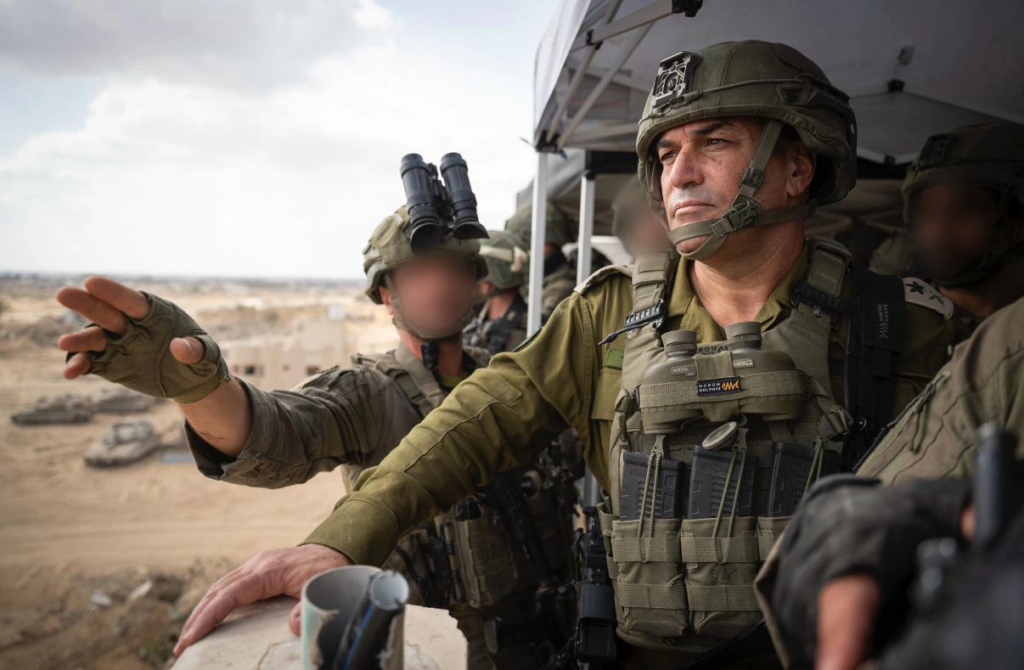
The IDF Chief of Staff Zamir tour southern Gaza on Wednesday, September 24, 2025.
The IDF Chief of Staff Zamir tour southern Gaza on Wednesday, September 24, 2025. Photo credit: IDF

What’s happened: The IDF Chief of Staff Zamir tour southern Gaza on Wednesday. He reiterated the dual objectives, “to create conditions for the release of the hostages and for Hamas’ decisive defeat.” 

  • He was careful to note that the IDF strikes “powerfully and precisely,” whilst “ensuring compliance with all security rules.”
  • The IDF’s assessment is that most of the civilian population has now left Gaza City
  • Zamir also called upon Gazan residents to, “rise up and break away from Hamas – it is responsible for your suffering. The war and the suffering will end if Hamas releases the hostages and relinquishes its weapons.”
  • The Chief of the Staff noted the bravery of Maj. Shahar Netanel Bozaglo, who was killed on the eve of the Jewish New Year, “Shahar left his home on October 7th, took command of a tank and fought in the communities near the Gaza Strip. From then until his death he fought bravely and with dedication for the security of the Israeli communities in the south and the entire State of Israel.”
  • This morning it was reported that another soldier, Staff Sergeant Chalachew Shimon Demalash, 21, from Beer Sheva, was killed in combat in the northern Gaza Strip yesterday. 
  • A total of 912 IDF soldiers have fallen since the beginning of the war on October 7, 2023.
  • A drone launched by the Houthis in Yemen hit a crowded commercial centre in Eilat yesterday during the Rosh Hashana holiday, injuring at least 50 people. Three people are still in hospital including one in a serious condition. The Port of Eilat has been effectively closed for two years due to Houthi attacks on shipping in the Red Sea.
  • As the holiday was beginning, Hamas released a video of Alon Ohel, who it has been holding hostage since abducting him from the Nova Music Festival on October 7, where nearly 400 festival-goers were murdered. The family has not approved the video for release and asked instead for only one still frame to be shared. In the video, Alon is clearly seen to be blind in one eye and in a poor state of health overall. Alon’s father Kobi said, “To my Alon, my dear boy, be strong. You are strong. We saw that you are strong. Believe in yourself and believe in this moment that is almost here.”

Context: Israel marked the Jewish New Year on the cusp of the Gaza war entering a third year. Beyond Gaza, the overall regional strategic picture is much improved for Israel specifically following the operations in Lebanon, Iran and Syria. At the same time however, Israel faces increasing diplomatic international isolation.

  • News from the UN General Assembly was dominated by the states extending recognition to a Palestinian State, an initiative pushed over the last few months by French President Macron.
  • On the sidelines of the UNGA, Macron met with Turkish President Erdoğan and Iranian President Pezeshkian. Regarding negotiations on Iran’s nuclear programme, Macron said after the meeting, “An agreement remains possible. Only a few hours are left. It is up to Iran to respond to the legitimate conditions we have set.”
  • In a speech before the General Assembly, Indonesia’s President Prabowo Subianto, whose country does not recognise Israel, said, “We must also recognise, we must also respect, and we must also guarantee the safety and security of Israel. Only then we can have real peace.” He vowed that once Israel recognised a Palestinian State, Indonesia, the world’s largest Muslim country, would recognise Israel. He also pledged 20,000 Indonesian soldiers to any future UN-led force that might be deployed in a postwar Gaza.
  • Other notable speeches were much more hostile. Qatar’s Emir Sheikh Tamim bin Hamad al-Thani said that “Israel is not a democratic country surrounded by enemies, but in fact it is an enemy to its surrounding neighbours.” 
  • Jordan’s King Abdullah said, “The current Israeli government’s provocative call for a so-called Greater Israel can only be realised through the blatant violation of the sovereignty and territorial integrity of its neighbours. And there is nothing great about that.” 
  • On the sidelines of the UN, President Trump met with several Arab and Muslim leaders. Reports suggest that Trump presented the latest framework principles for ending the war in Gaza, which includes:
    • Release of all the hostages.
    • A permanent ceasefire. 
    • Gradual Israeli pull-back and redeployment of Israeli forces from the Gaza Strip.
    • Developing plans for a day after including a mechanism for running Gaza without Hamas. 
    • Deployment of an international force that will include Muslim and Arab troops.
    • Arab states financial backing for the government and rehabilitation of the Strip.
    • A mechanism to integrate the Palestinian Authority into the new leadership.
  • Reportedly the Arab states agreed to this formulation but add their own conditions:
    • Israel will not annex parts of the West Bank or Gaza
    • Israel will not occupy parts of Gaza and establish settlements.
    • Israel will stop undermining the status-quo agreement on the Temple Mount. 
    • Immediately increase humanitarian aid into Gaza.

Looking ahead: Prime Minister Netanyahu departed last night for the US and is due to address the UN General Assembly on Friday morning New York time.

  • Netanyahu will meet President Trump to discuss several pressing issues including:
    • Coordinating Israel’s response to the wave of recognising a Palestinian State by Britain, France, and others. 
    • US led efforts to reach an agreement between Israel and the new Syrian government.
    • Iran’s ongoing efforts to reconstitute its nuclear programme and the continued attacks by the Houthis on Israel.

September 21, 2025

Statement on the UK’s unilateral recognition of a Palestinian state

BICOM Statement
BICOM Statement

In response to the Prime Minister’s statement on the UK unilateral recognition of a Palestinian state, BICOM questions how this performative gesture truly serves the interest of peace.

Not only does it reward and embolden Hamas, it uses recognition as a punishment on Israel, a first in international affairs.

This symbolic gesture does nothing to advance the UK’s stated objective of realising a two-state solution. This moves changes nothing the ground, but inadvertently weakens peace camps on both sides, and raises the bar of expectations, that when not met could lead to further violence.

The move weakens UK influence as an honest broker in the region and punishes a democratic ally with whom UK has many shared interests and values, not least security, intelligence and trade relations. There are some fundamental questions that remain unanswered:

  • What exactly is being recognised?
  • How will this contribute to ending the war?
  • Has it compelled Hamas to release the hostages, or has it emboldened them?
  • Has it improved the safety and security of both Israelis and Palestinians?
  • Has it disarmed Hamas, to prevent their violent suppression of its own people and their explicitly stated plans for the next October 7 massacre?

With little consideration for these fundamentals, it’s highly unlikely that a Palestinian state will be realised any time soon. Ironically, premature recognition is likely to lead to the prolonging of the war in Gaza, as Hamas have proven that terrorism is rewarded by the west.

Richard Pater, Director of BICOM

September 19, 2025

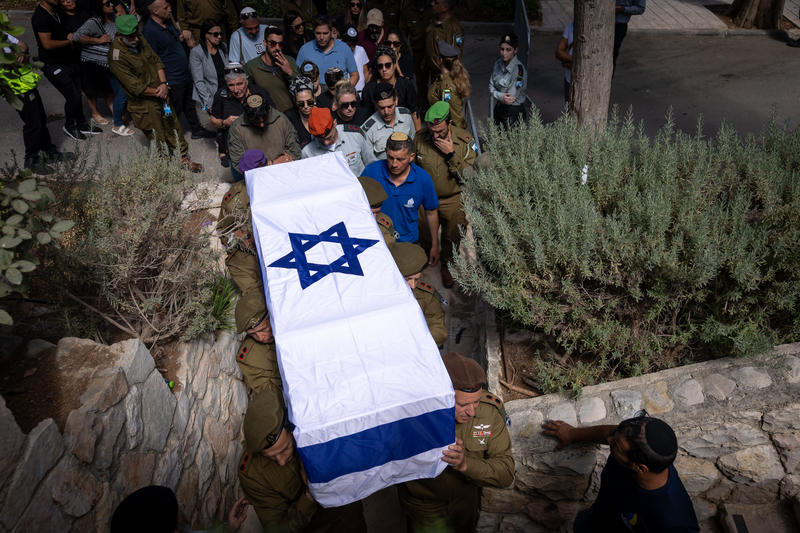
Israel mourns the loss of six soldiers, on two fronts

Family and friends attend the funeral of Lt. Col. (res.) Yitzhak Harush, 68, at Mt Herzl cemetery in Jerusalem. Harush was killed yesterday in an attack at the Allenby border crossing with Jordan. September 19, 2025.
Family and friends attend the funeral of Lt. Col. (res.) Yitzhak Harush, 68, at Mt Herzl cemetery in Jerusalem. Harush was killed yesterday in an attack at the Allenby border crossing with Jordan. September 19, 2025. Photo by Yonatan Sindel/Flash90 *** Local Caption *** הלוויה הר הרצל אלנבי פיגוע יצחק הרוש

What’s happened: Four soldiers were killed in southern Gaza on Thursday, whilst two were killed in a shooting attack on the Jordanian border. 

  • Reflecting on the loses, Prime Minister Netanyahu sent condolences to the families describing it as a “difficult evening,” before adding, “In the spirit of their heroism and in the strength of the souls of our fighters, we will continue to strike our enemies forcefully until we complete our war objectives.” 
  • The four soldiers killed in Gaza, were all young officers in their early twenties. According to IDF Spokesperson Brig. Gen. Defrin, “The soldiers were hit by a bomb that exploded during offensive activity in the neighbourhood of Jenina in Rafah. IDF troops are operating in Jenina and destroying terrorist infrastructure. The area  has still subterranean infrastructure that has not yet been destroyed. The troops are working to demolish it.”
  • In the attack at Allenby Crossing on the Jordanian border, a Jordanian citizen who was driving a humanitarian aid truck to the Gaza Strip, shot and killed two IDF soldiers; Lt. Col. (res.) Yitzhak Harosh a 68 year old and Sgt. Oran Hershko aged 20.
  • The gunman was later identified as Abd al-Taleb al-Qaisi a 57 year old Jordanian who had started working as a humanitarian aid truck driver three months ago. After the shooting, he pulled out a knife and stabbed them. The security team at the border crossing opened fire and killed him. 

Context: Amid these loses, the IDF are continuing to expanded their operations in Gaza City with the declared aim of placing additional pressure on Hamas in order to dismantle their control and create more favourable conditions to secure the release of the hostages. Of the 48 still held in captivity 20 are still thought to be alive, and now held for 714 days.

  • According to the IDF Spokesperson, “Since the start of the second phase of Operation Gideon’s Chariots II, we have already struck more than 1,200 terrorist targets.” 
  • Emphasis continues to be placed on encouraging civilians to evacuate the war zone, they estimate that more than 450,000 of the city’s residents have now moved southward.
  • Part of the Israeli planners’ thinking is that the movement of the population from Gaza City creates considerable pressure on Hamas. Gaza City had been both a symbol of Hamas rule and one of the last vestiges of its governance. There is hope that the flight of more than half a million people might prove to be a breaking point for Hamas. This is also why Hamas has placed physical blockades and pressure on the civilian population to prevent them from moving south.
  • Beyond Gaza, the IDF remain engaged in a multi-front confrontation. This week the IDF:
    • Once more struck the Port of Hodeidah in Yemen, which the IDF perceive as a strategic asset for the Houthi terrorist regime.
    • Also struck Hezbollah weapons storage facilities of Hezbollah’s elite Radwan forces in southern Lebanon.  Since the ground operation in Lebanon ended one year ago Israel has carried out around 200 targeted strikes against Hezbollah attempts to reconstitute itself in southern Lebanon, all within the provisions of the ceasefire agreement and the understanding reached with the US.
    • Continued counter-terror operations in the West Bank.
  • The initial investigation of the attack at the Allenby Crossing found that Jordanian citizens who enter Israel as part of the mechanism to send humanitarian aid to Gaza do not undergo security inspection by Israel after the Jordanian army sends their names to the IDF. It appears that the IDF trusted the Jordanian army to perform the required inspections as part of the bilateral strategic security cooperation. There was a similar shooting by a Jordanian at the same crossing almost exactly a year ago.

Looking ahead: As a result of the attack at the crossing, humanitarian aid from Jordan may now be suspended until the investigation is completed and the regulations for inspecting the Jordanian drivers are changed. 

  • Ahead of the Jewish High Holidays that begin next week there is growing concern over the potential increase in terror attacks emanating from the West Bank. 
  • In parallel, the UK is expected to declare its unilateral recognition of a Palestinian state that could also exasperate tension in the Palestinian arena.         
  • Israel is still calibrating its response to any declarations, and punitive measures for example closing down Palestinian facing consulates in Jerusalem. Others on the right are pushing for some element of annexation in response. These scenarios were reportedly discussed during US Secretary of State Rubio’s meeting with Netanyahu, amid concerns that this could rupture relations with the UAE. Israel is also wary that any extension of sovereignty risks jeopardising the wider Abraham Accords, which are part of Trump’s legacy.

September 18, 2025

Questioning unilateral recognition of a Palestinian state

Palestinians in Ein Hajla, in the Jordan Valley near the West Bank city of Jericho
Palestinians in Ein Hajla, in the Jordan Valley near the West Bank city of Jericho, on January 31, 2014. Photo by Hadas Parush/Flash90

New Research: With the UK’s recognition of a Palestinian statehood imminent, BICOM’s report:

  1. Assesses the Montevideo standards for recognition, examining how the Palestinian Authority does or does not meet them. And consider both cases lacking international recognition (e.g. Taiwan, Northern Cyprus, Somaliland) and cases of newly recognised states by the UK (South Sudan, East Timor, Kosovo).
  2. Demonstrates how premature recognition undermines peace efforts. Recognition can pressure both Israelis and Palestinians into actions that make a peaceful settlement harder, not easier. Recognition will not create a Palestinian state nor advance the creation of one; rather, it will be the most significant diplomatic gain for the Palestinian cause in decades, universally understood as having been made possible by the October 7 massacre.
  3. Analyses British policy on the two-state solution. If the two-state solution is indeed the desired goal, then policies must encourage conditions that make this outcome more likely and discourage those that make it less likely. Recognition at this stage, or interventions which halt the war before Hamas is defeated, protect and strengthen Hamas and are therefore counterproductive.
  4. Highlights the diplomatic consequences. Recognition would take place in the context of already worsening UK–Israel relations and would further deteriorate ties between two countries that until recently considered themselves strategic partners.

September 17, 2025

IDF launches major ground offensive into Gaza City

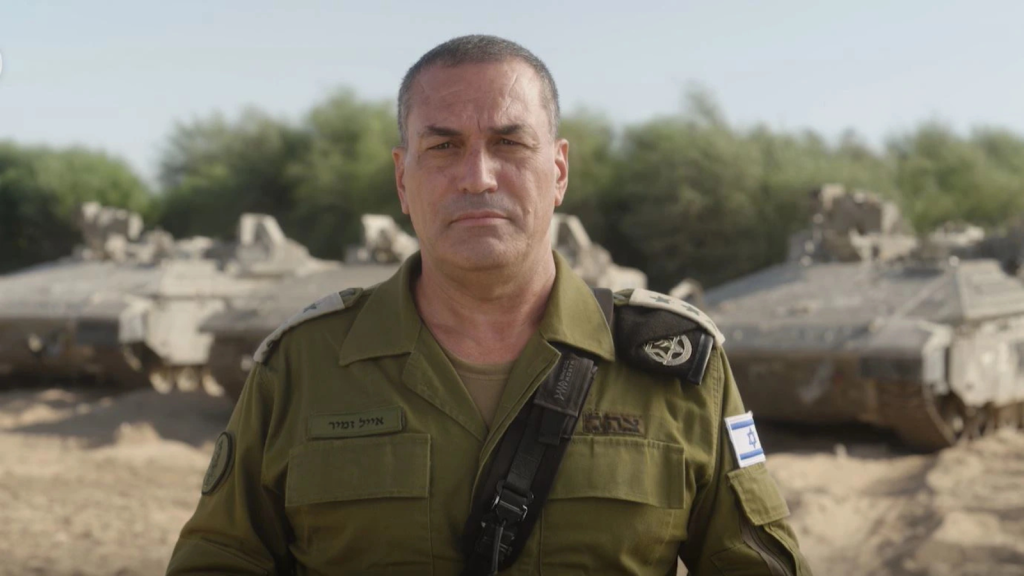
Eyal Zamir, Chief of General Staff of the IDF, accompanied troops from the 98th Division into Gaza City.
Eyal Zamir, Chief of General Staff of the IDF, accompanied troops from the 98th Division into Gaza City, September 16, 2025. Photo credit: IDF

What’s happened: The IDF has launched a major ground offensive into Gaza City. Two divisions have entered the city from two different directions, and a third is expected to join them in the coming days. 

  • Eyal Zamir, Chief of General Staff of the IDF, accompanied troops from the 98th Division into Gaza City. Addressing soldiers he said, “In the time since October 7, the day when we were brutally attacked, our operational doctrine has completely changed. In cooperation with the range of security organisations, we eliminated most of Hamas’s leadership, we degraded the entire Iranian axis of evil and we removed existential threats in the context of Operation Rising Lion. Those results, which were achieved through the sacrifice and courage of our brave soldiers in the air, sea and land, have created a new security reality and opportunities that might improve the State of Israel’s strategic situation and the reality in the Middle East to our benefit.”
  • UK Foreign Secretary Yvette Cooper condemned the new IDF offensive, calling it “utterly reckless and appalling” and warning that “it will only bring more bloodshed, kill more innocent civilians & endanger the remaining hostages.” She was joined in her condemnations by foreign ministers from Germany, the Netherlands, and other countries. The Canadian Foreign Ministry’s statement expressed concern that the Israeli operation “jeopardises the release of hostages” without mentioning the party that abducted and holds the hostages, and further said that “Israel must adhere to international law” without pointing to any international law that the Israeli offensive supposedly violated.
  • Responding to reports that Hamas was moving Israeli hostages into Gaza City and placing them above ground in places likely to be sites of intense combat, President Trump said, “I hear Hamas is trying to use the old human shield deal, and if they do that they’re going to be in big trouble.” 
  • Prime Minister Netanyahu also reacted to Hamas threats to harm the hostages, saying, “If they harm a hair on the head of even one hostage, we will hunt them down with greater force until the end of their lives — and that end will come much faster than they think.”
  • Israel ramped up its attacks on the Houthis in Yemen yesterday with a strike on the port facilities in Hodeida. Previous attacks have only focused on oil facilities at the port; yesterday’s strike was much broader and, if successful, puts the Houthis in a much more severe economic blockade than before.
  • Two British MPs were denied entry into Israel. Peter Prinsley and Simon Opher, both of the Labour Party, were due to visit the West Bank on a trip organised by the Council for Arab-British Understanding (CAABU) and Medical Aid for Palestinians (MAP).

Context: At least 350,000 Gazans have heeded the IDF’s call to evacuate the city and have moved to points further south. The army expects many more to do so now that the operation has begun, and it has announced a second evacuation route to be opened today at noon. This route, along the inland Salah a-Din road, will remain open until noon on Friday. Evacuations until now have taken place along the coastal route. The IDF estimates that even after this evacuation period, between 100,000 and 300,000 civilians will remain in Gaza City.

  • Israel Hayom reports that on the eve of the new operation, the IDF was already in control of roughly 40% of Gaza City, following operations in neighbourhoods on the outskirts of the city in Jabaliya, Sheikh Radwan, and Zeitoun.
  • In the week leading up to the new ground offensive, the Israeli Air Force struck 850 targets, with approximately 50 targets struck in Gaza City last night. The IDF estimated that Gaza City had around 2,500 Hamas fighters in it before its forces surrounded the city. Current assessments are that that number increased somewhat in the last week as Hamas fighters streamed in from other sectors in preparation for the IDF’s move into the city centre.
  • Opposition MKs have criticised the government’s priorities. “Conquering Gaza City yet another time on its own won’t deliver the goods,” said Benny Gantz, a former IDF chief of staff and defence minister, “Operation Gideon’s Chariots II, like the first, needs to be utilised to free our hostages, to destroy Hamas and to ensure a governmental alternative that isn’t Israel, and that is something Netanyahu hasn’t done until now for political reasons. Two years after the war began, Hamas is still administering the population, and we have to change that.”
  • In Haaretz, Amos Harel writes, “Military forces are advancing relatively slowly at this stage and are doing so very cautiously. By comparison, when the IDF entered the Gaza Strip at the end of October 2023 following the massacre in Israeli border communities, the units moved quickly, deep on the ground, even though Hamas’ defensive preparations at the time were more difficult to crack and penetrate than they are now.” Noting the lack of enthusiasm among top security officials for the operation, Harel describes Netanyahu’s decision to go ahead with the operation as “perhaps his biggest gamble since the beginning of the war nearly two years ago.” 

Looking ahead: Prime Minister Netanyahu announced that President Trump has invited him to come to the White House on September 29. This will be three days after Netanyahu is expected to address the UN General Assembly. 

  • The European Commission is expected to vote today to recommend a series of measures to be taken against Israel, including the suspension of a trade agreement and a renewal of import duties on Israeli products entering the European Union. In order to go into effect, the measures would need the approval of a qualified majority of European governments. Currently, opposition to the measures by Italy and Germany blocks such a majority, but speculation is rife that Italy could be persuaded to drop its opposition, especially if Israel takes retaliatory moves against the expected recognition of a Palestinian state next week, for example by shutting the French Consulate in Jerusalem. 
  • The Israeli security cabinet is scheduled to meet tomorrow evening.

September 16, 2025

IDF mounts pressure on Hamas as Arab states meet in Qatar

IDF forces expand ground maneuvers in Gaza City.
IDF forces expand ground maneuvers in Gaza City. Photo credit: IDF

What’s happened: The IDF has indicated that it has now “begun destroying Hamas infrastructure in Gaza City”, suggesting that its promised offensive has now begun earlier than anticipated. Israeli tanks were reported in Gaza City, and it is estimated that approximately 350,000 have evacuated to different parts of the Gaza Strip.

  • Objectives remain unchanged, namely dismantling Hamas and bringing the hostages home.
  • Two divisions are operating, and more will join them in due course. The IDF is working to set the conditions for civilians to distance themselves from combat zones and move into humanitarian areas.
  • Now that this offensive has begun, its priorities will be encircling and operating deeper within Gaza City. It follows close to two years of war since Hamas’s attacks on southern Israel on 7th October 2023, and is hoped to dismantle the terrorist group in its final bastion in the Gaza Strip.
  • Approximately 60,000 reservists were called up for this operation, augmenting the 70,000 already in reserve service.
  • Following Israel’s air strikes on Doha last week, Arab and Islamic leaders have met at an emergency summit convened in the Qatari capital. A joint Arab League and Organisation of Islamic Cooperation session, it included close to sixty countries including both Iran, all three Arab Abraham Accords signatories (the UAE, Bahrain, and Morocco), as well as Egypt and Jordan.
  • The summit was concluded with a joint statement calling for “all states to take all possible legal and effective measures to prevent Israel from continuing its actions against the Palestinian people…[including] reviewing diplomatic and economic relations with it, and initiating legal proceedings against it”, though it is unclear what practical steps will be taken in its aftermath, if any.
  • Commenting at the summit, the Iranian President, Masoud Pezeshkian, alleged that last week’s airstrike amounted to “pure terrorism”, and that no Arab or Muslim capital was safe from similar strikes. This condemnation comes despite Iran themselves also firing a ballistic missile at US bases in Qatar in June.
  • Qatar’s Emir, Sheikh Tamim bin Hamad Al Thani, accused Israel of having no genuine interest in peace, attempting “to thwart negotiations”, and pledged to “do whatever is necessary to preserve our sovereignty and confront Israeli aggression.”
  • It is unclear how Qatar may do this, especially given its post-strike statements that it will continue to mediate ceasefire and hostage release negotiations between Israel and Hamas.
  • Egypt has also reportedly called for the establishment of a Cairo-based joint Arab military command that would operate in a similar manner to NATO, providing assurances of mutual defence against external aggression and attacks.
  • Despite their attendance at the Doha summit and prior statements condemning Israel’s air strikes, none of the Abraham Accords signatory countries sent heads of state, instead being represented by senior officials.

Context: US Secretary of State Rubio is partway through a regional trip to visit both Israel and Qatar. He is now due to visit the UK for meetings with the Foreign Secretary, Yvette Cooper, and “to join President Trump’s delegation for his unprecedented second State Visit.”

  • While in Israel, Rubio reaffirmed that Washington’s priorities were the release of Israeli hostages and the destruction of Hamas, and refrained from directly criticising the Doha air strike in his public comments alongside Netanyahu.
  • Earlier this morning while travelling to Doha, Rubio also warned of a “short window” in which to secure a ceasefire in Gaza while praising Qatar for its ongoing mediation of negotiations between Israel and Hamas.
  • In a speech on Monday, Prime Minister Netanyahu also admitted that Israel was becoming increasingly isolated at a conference hosted by the Finance Ministry, specifically blaming Muslim immigration within the EU and online Qatari and Chinese propaganda.
  • Netanyahu said part of this isolation was economic, with Israel needing to become more self-reliant. The Prime Minister singled out the arms industry as one where Israel would come to rely more on domestic production than on trade, expressing out loud what has been a growing consensus in Israel since the war began nearly two years ago.
  • In the part of the speech that was most quoted, especially by critics of the Prime Minister, he said, “We are Athens and Sparta. But we’re going to be Athens and super-Sparta.”
  • Leader of the Opposition Yair Lapid responded that “isolation isn’t fate, it’s the product of the wrong and failing policies of Netanyahu and his government,” while former Prime Minister Ehud Barak said, “’Super Sparta’ is the end of the country: economically, politically and militarily.”

Looking ahead: Last night, Canada, France, Egypt, Jordan, Qatar and UK held a call to discuss “advancing peace”. Chaired by President Macron of France, a subsequent readout said that “all leaders agreed that the focus must remain on advancing peace and security, including reaching a lasting ceasefire, securing the release of all hostages and the disarmament of Hamas, and scaling up flows of life-saving assistance for Palestinian civilians.”

  • Ahead of President Trump and Secretary Rubio’s visit to London, it is likely that Prime Minister Starmer will raise these points, and attempt to further align the UK and US in calling for and advancing an immediate ceasefire and the release of hostages in Gaza, as well as increased aid provision.

September 15, 2025

US Secretary of State Rubio in Israel as Gaza offensive looms

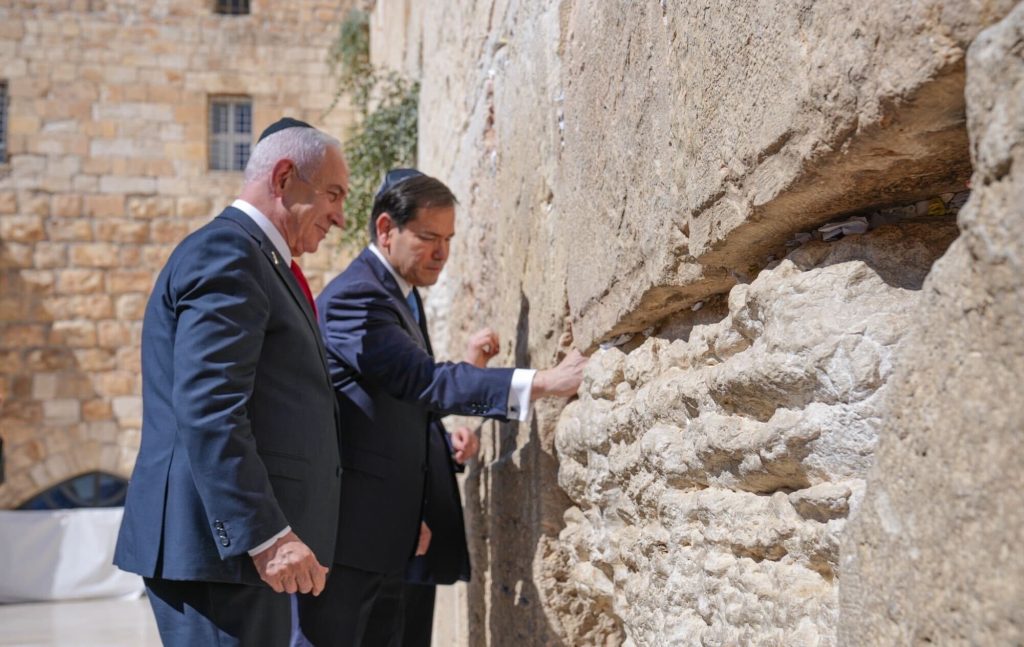
Secretary of State Marco Rubio and Prime Minister Benjamin Netanyahu at the Western Wall in Jerusalem
Secretary of State Marco Rubio and Prime Minister Benjamin Netanyahu at the Western Wall in Jerusalem. September 14, 2005. Photo credit: Secretary Marco Rubio / X

What’s happened: IDF preparations for a major ground offensive into Gaza City continue apace. Four high-rise towers in the city that the army claims were being used by Hamas were destroyed yesterday following evacuation orders. Similar tower strikes have been happening over the course of the last week as the IDF moves forces into the outskirts of the city.

  • According to IDF estimates, up to 300,000 people of the nearly one million who were sheltering in Gaza have already evacuated. The IDF believes that most of the rest will leave only when a major ground incursion begins. 
  • Haaretz reports that reconstruction work is underway on the European Hospital in Khan Yunis in the southern Gaza Strip, and that two additional field hospitals are being set up, also in the southern part of the Strip. A new water pipeline connecting the humanitarian zone in al-Muwasi was connected to Egypt, and another power line was connected to an existing desalination facility.
  • US Secretary of State Marco Rubio arrived in Israel yesterday and traveled to the Western Wall in Jerusalem, accompanied by Prime Minister Netanyahu. Today he is meeting with Prime Minster and other top officials to discuss the war in Gaza and other topics. He told journalists that the US was “not happy” with the Israeli air strike in Qatar last week.
  • Yesterday, Trump said Israel must “be very careful” and take action against Hamas, but emphasised Qatar’s importance. “Qatar has been a great ally to the U.S. A lot of people don’t know that. The emir is a wonderful person, actually.” Trump described Qatar as “a great ally.”
  • According to media reports, Israeli officials are expected to raise with Rubio the possibility of Israel annexing some of the West Bank in response to the planned recognition of a Palestinian state later this week by a number of countries, including France and the UK.
  • Foreign Minister Gideon Saar briefed diplomats in Jerusalem yesterday on Israel’s moves in Gaza and the West Bank.
    • Regarding the West Bank and the possibility of some kind of limited annexation, he said that no decision had been made yet.
    • Regarding a Palestinian state, he reiterated his opposition, and added that this was the overwhelming position of both Israeli officials and the Israeli public. Such a state, he said, would have as its “sole objective” the destruction of Israel.
    • On Gaza, he said that Israel had no interest in “controlling Palestinian’s lives there,” and spoke instead of a transitional period, possibly under an international mandate, as part of a comprehensive plan for the “day after” which was being worked out with the Americans.
  • It was reported yesterday the Royal College of Defence Studies had decided to exclude Israeli participants from its programs in the next academic year. Critics of the move compared this exclusion unfavourably with the open door the College maintains to non-allied non-democratic countries, such as China. Amir Baram, Director General of the Israeli Ministry of Defence and himself an alumnus of the Royal College, called the decision “a profoundly dishonourable act of disloyalty to an ally at war.”

Context: The Security Cabinet met last night to discuss the hostage crisis. Maariv reports that the meeting ran for more than three hours and covered a long list of scenarios, including that Hamas might harm the hostages as the IDF moved into  its last redoubts in Gaza City. The Israeli television station Channel 12 reported that Israel had formulated measures to be carried out in response to any Hamas move to harm the hostages, but did not specific what those measures might be.

  • IDF Chief of General Staff Eyal Zamir spoke with MKs in the Knesset Committee for Intelligence Affairs, a subcommittee of the Foreign Affairs and Defence Committee and a rare forum outside the Government where officials have access to highly classified briefings and intelligence. Multiple leaks from the committee meeting indicate Zamir’s dissatisfaction with the Government’s decisions on the Gaza offensive due to begin soon.
  • Zamir was quoted as not knowing what the Government’s goals in the operation were, including if the end result would be a full military administration of the territory, something the IDF has sought to avoid. Such direct military rule existed in Gaza from 1967 to 1994 and is expected to be a much more onerous task now than it was 31 years ago when it came to an end.
  • Zamir was widely quoted in the press as saying that even a successful operation in Gaza City would not defeat Hamas, and ultimately Israel would be pushed to mounting another offensive in the refugee camps in the central region of the Gaza Strip. 
  • Yedioth Ahronoth reports that Zamir specifically criticised the Gaza Humanitarian Foundation, the aid mechanism that was established to bypass the UN and Hamas. He also told the Knesset committee that even in a siege, the IDF would continue to allow humanitarian aid into Gaza.
  • Zamir told MKs that the Government’s plan put hostages at risk, put soldiers at risk, and did not have sufficient international legitimacy.
  • There are also reports that Hamas has moved living hostages above ground into homes and tents in Gaza in an effort to make them into human shields. A video released this week of one hostage, Guy Gilboa-Dalal, showed him in the back seat of a car above ground.

Looking ahead: Qatar will host an “emergency summit” today in Doha of Arab and Muslim countries to formulate a response to Israel’s attack on Hamas leaders in its capital last week. Despite reports of Egyptian attempts to create a formal military alliance, the draft resolution circulated before the summit includes strong condemnatory language but no practical measures. 

  • The Israeli public broadcaster’s Kan radio news bulletin reports that Israeli officials are bracing themselves for a wave of public condemnations once the IDF’s operation in Gaza City gets underway. 

September 10, 2025

Doha air strike triggers diplomatic storm and hostage concerns

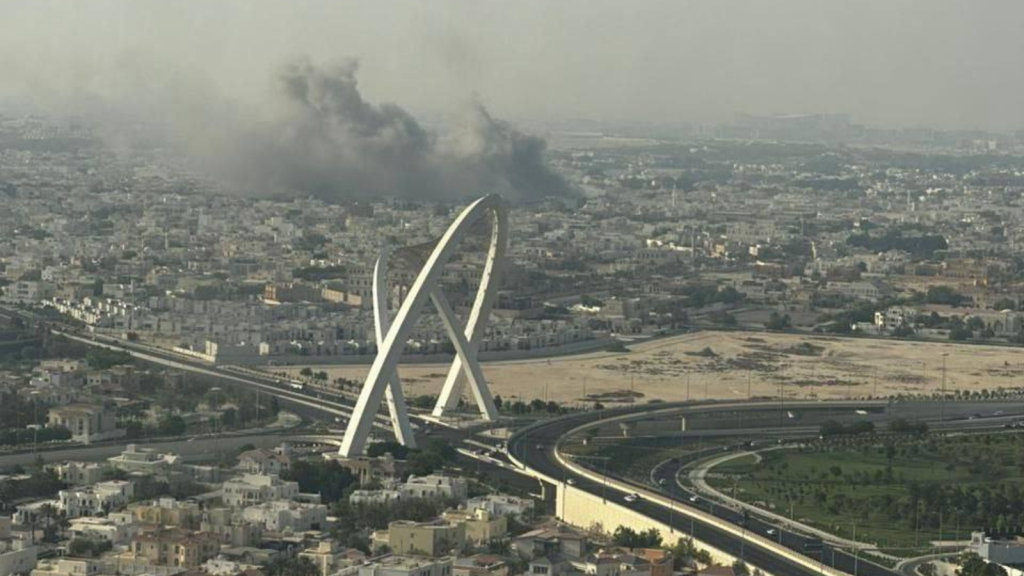
Smoke rises over Doha following the Israeli air strike targeting Hamas leadership on September 9, 2025.
Smoke rises over Doha following the Israeli air strike targeting Hamas leadership on September 9, 2025. Photo credit: X

What’s happened: The IDF and Shin Bet launched an attack on the Qatari capital of Doha yesterday in what is being described as “a precise strike targeting the senior leadership of the Hamas terrorist organisation.” The mission was led by the Israeli Air Force, with ten to fifteen jets participating and firing ten munitions at a single target. The US were informed of the operation as it was underway.

  • It is understood that the Hamas ceasefire negotiation delegation was targeted including the Hamas leader in Gaza, Khalil al-Hayya, Zaher Jabarin, who leads Hamas in the West Bank, Muhammad Darwish, head of Hamas’s Shura Council, and Khaled Mashaal, head of Hamas abroad.
  • While six individuals are reported to have been killed, five of those named were more junior Hamas members and one Qatari police officer. Thus far, there is no confirmation that the senior leaders have been killed while Hamas claims that they survived. Israeli defence officials are increasingly pessimistic that the intended targets were eliminated.
  • The international community has almost universally condemned the strike. Prime Minister Starmer said that it was a violation of Qatar’s sovereignty, and risked further escalation across the region while reiterating his calls for an “immediate ceasefire, the release of hostages, and a huge surge in aid into Gaza.”
  • President Trump said that “we are not thrilled about the way that went down today” while conceding that eliminating Hamas was a “worthy goal”, while the UAE condemned the attack “in the strongest terms,” while its Foreign Minister said the country was in “full solidarity with dear Qatar.” Saudi Arabia offered its “full support for the sisterly State of Qatar, and its condemnation of the blatant Israeli attack on the sisterly State of Qatar.”
  • The incoming UN General Assembly’s President, Annalena Baerbock, branded the strikes “concerning” adding that “sovereignty and territorial integrity of all member states must be respected and not violated.”
  • Prime Minister Netanyahu said yesterday of the operation in Doha that “the days are over when terror leaders will enjoy immunity in a particular place.”
  • The IDF has issued an evacuation order for the whole of Gaza City ahead of its anticipated offensive which will begin in approximately a month. Approximately a million Palestinians are impacted by this order, and are being encouraged to evacuate to a humanitarian zone in al-Mawasi in the southern Gaza Strip.
  • Elizabeth Tsurkov, a dual Israeli-Russian national who was being held hostage by Kataib Hezbollah in Iraq has been released to the US Embassy in Baghdad. An academic at Princeton University in the US, she was abducted while undertaking research in Iraq in 2023. While the circumstances surrounding her release are unclear, her cause was championed by the US and President Trump’s Special Envoy for Hostage Affairs, Adam Boehler.

Context: Israel’s strike on Doha follows the latest US ceasefire proposal. While Hamas indicated that it was willing to continue negotiations, it refused to accept the terms that were put to them. Shortly after, President Trump issued a “last warning” to the group, indicating there would be “consequences” unless they accepted a ceasefire.

  • For some Israeli analysts, the yesterday’s strike underscored the importance of ending perceptions of Qatar’s immunity given that it had long sheltered and supported Hamas.
  • One of the principal targets of the strike was Ghazi Hamad, who was quoted in the aftermath of the October 7 attack as saying, “Israel is a country that has no place on our land. We must remove it because it constitutes a security, military and political catastrophe to the Arab and Islamic nation… We must teach Israel a lesson, and we will do it twice and three times. The Al-Aqsa flood is just the first time, and there will be a second, a third, a fourth. Will we have to pay a price? Yes, and we are ready to pay it.”
  • Ahead of the operation, there was reportedly a concern in the defence establishment about the high stakes of the operation, particularly about its impact on the negotiations for the release of Israeli hostages.
  • Israel has not commented on its jets’ flight paths, with Israeli media reports indicating that the airplanes never entered Qatari airspace or, for that matter, the airspace of Saudi Arabia or the United Arab Emirates. Given Israel’s swiftness in issuing a statement after the strikes took place and before the jets would have been able to return to Israel, this suggests little concern on their part.
  • Since 7th October 2023, the Israeli Air Force has successfully operating in or over Lebanon, Syria, Iraq, Iran, Yemen, and Qatar with no losses.

Looking ahead: The Hostages and Missing Families Forum has issued a statement indicating serious concerns about the Doha strike saying that a “grave fear now hangs over the price that the hostages may pay…[and that] we know from the survivors who have returned that the revenge directed at the hostages is brutal.”

  • Despite attacking and criticising Netanyahu and Israel, the Qatari Prime Minister has indicated that Doha is still willing to continue mediating ceasefire talks.
  • Later today, the United Nations Security Council will hold an emergency meeting in response to Israel’s Doha air strike. It is expected that Israel will be strongly condemned against the background of UNGA which began yesterday.

Newsletter sign-up

Please enter your information below to subscribe to our daily newsletter and stay updated and informed.

Donate to BICOM

At BICOM, we rely on the generosity of people like you to keep our website and services running. Your donation, no matter the size, makes a real difference. Please consider supporting us today. For further information please email: [email protected]