LATEST

Israeli politics & society

Key background
  • The State of Israel was founded in 1948 with its foundational document being its Declaration of Independence. This declaration confirmed Israel’s nature as a Jewish and democratic state where all citizens were viewed as equals before the law, and freedom of conscience, worship, education, and culture were to be guaranteed.
  • Israel’s constitution is uncodified, but practically oriented towards a number of “Basic Laws” concerning state institutions and rights. They can only be overturned by a supermajority vote in the Knesset.
  • Similarly to the UK, Israeli government has three branches: the legislature (Knesset), judiciary, and executive (cabinet lead by the Prime Minister). The President is elected by members of the Knesset for a single seven-year term and acts as its head of state, but this role is almost entirely ceremonial.
  • Israel uses pure proportional representation to elect its MKs. As this functionally precludes any one party securing an outright majority, Israel is governed by coalitions formed by the leader of the party that generally wins the most seats.
  • The current President is Isaac Herzog, and the Prime Minister is Benjamin Netanyahu of the Likud. Other coalition partners include United Torah Judaism, Shas, the Religious Zionist Party, Otzma Yehudit, New Hope, and Noam.
Gadi Eisenkot, head of the Yashar party, holds a press conference with the party’s new member Yoram Cohen in Tel Aviv, May 5, 2026.
Gadi Eisenkot, head of the Yashar party, holds a press conference with the party’s new member Yoram Cohen in Tel Aviv, May 5, 2026. Photo by Flash90

Updated May 6, 2026

Former head of Shin Bet joins Eisenkot’s party

New Names: Ahead of the Israeli general election, a slew of new names have announced their intention to run for political office.

  • The latest name – and most senior new recruit so far – is Yoram Cohen, the former head of the Shin Bet, who yesterday announced that he is joining Yashar led by former IDF Chief of Staff Gadi Eisenkot.  
  • A week ago Eisenkot announced that Shaul Meridor will be joining his party. Meridor was the former director of the Budget Department in the Finance Ministry. If elected, he would be Israel’s first third-generation politician. His father Dan, was the cabinet secretary in Begin’s government and went onto serve as a minister for both justice and finance with Likud under Netanyahu, before forming the Centre Party. He continued to serve in a series of senior positions including minister of intelligence and deputy prime minister. Shaul’s grandfather Eliyahu was a commander in the Irgun and a Knesset member for the Herut faction (precursor to the Likud).
  • Inbar Yehezkeli has also joined Eisenkot’s list. She is former senior official from the Welfare Ministry. She has also led several civil society organisations focusing on protecting women and was also a senior social policy adviser to then-finance minister Moshe Kahlon.
  • Even before the merger with Yair Lapid to create the Together Party, Naftali Bennett  recruited senior female officials. The first of whom, Keren Terner, held a senior role in the Transport Ministry and is a former director-general of the Finance Ministry.
  • Another one, recruited by Bennett is former director-general of the Communications Ministry Liran Avisar Ben Horin.
  • In an effort to appeal to younger voters and reservists, Bennett also included Yonatan Shalev on his list. Shalev is a 23-year-old military reservist and founder of the “Shoulder to Shoulder” movement, a grassroots initiative advocating military service for all, particularly the conscription of the ultra-Orthodox.
  • Avigdor Liberman’s party Yisrael Beiteinu has also recruited some new blood including Sharon Sharabi, the brother of hostage survivor Eli Sharabi and murdered hostage Yossi Sharabi.
  • Also joining Liberman is Israel Ben-Shitrit, an IDF reservist who served as a deputy company commander and was seriously wounded in battle in Gaza in early 2024. He is a 40-year-old father of five from the southern town of Yeruham.  

Context: It is quite unusual to have so many political announcements before the election date has even been set, although everyone understands the election must be held by the end of October.

  • All the attention around new recruits has so far been focused on the opposition parties that are jockeying and competing against the current government. They all intend to cooperate after the election with the shared aim of defeating Netanyahu and forming the next government.    
  • According to recent polling, the Bennett – Lapid merger has not seem any dramatic change in voting patterns. They were hoping the move would increase their share of the vote and cement the pair as the leaders of the anti-Netanyahu bloc, but their differences appear to have put off some supporters that either perceive Bennett as too right-wing or Lapid as too left.
  • There remains the possibility of further mergers with both Bennett and Lapid appealing to Eisenkot to join them too. Eisenkot’s support currently appears to be growing, but it is not impossible that based on internal polling he may eventually join them too. Alternatively, Liberman is also courting Eisenkot and is open to a potential merger.
  • Benny Gantz’s Blue and White party has disintegrated in the polls and several of his current members of Knesset are also looking to join one of the other parties. In the latest blow, his founding partner Chili Troper announced that he was leaving the ticket. He could eventually join either Bennett or Eisenkot.      
  • Writing in Maariv this morning, Ben Caspit described Yoram Cohen as the “hottest item on the political shelf.”  He goes on to describe the similarities between Cohen and Eisenkot. “Both are sons of Mizrahi families: Eisenkot’s parents immigrated to Israel from Morocco; Cohen’s parents immigrated to Israel from Afghanistan, which is why he was nicknamed the “Afghan” throughout his 35-year career in the Shin Bet. Both firmly believe in the motto, “Don’t whine, excel.” Both grew up in the periphery and ostensibly didn’t stand a chance of succeeding. Both succeeded in reaching the top of the Israeli defence pyramid. Both are modest, country-first patriots. Both were raised in religious households. Eisenkot, as an adult, is not religious; Cohen is—the best of the national-religious community.”
  • There is also speculation over who will join the Likud. Among the rumours, Yossi Cohen, the former head of Mossad, would be the biggest ‘star’. There have also been suggestions that Netanyahu will recruit family members of victims of October 7, that would help him deal with criticism over the government’s failure. The Likud is one of the only remaining parties with internal democratic mechanisms that sees party members vote for the list. However, it has also been customary to give the party leader discretion to reserve some slots to place his candidates on the list. This may be the case again this time, though there are also calls to cancel the internal primaries with the fear that it will further unsettle the party and lead to more rifts and factions.
  • In the background there are rumours of another new party – “Likud 2.0” that would be led by current or former Likud ministers such as Gilad Erdan (former Israeli ambassador to the UN), Yuli Edelstein (former speaker of the Knesset) and Moshe Kahlon (former Finance Minister).

Looking ahead: The election date has not yet been set, but must be held by October 27, the latest and declared three months in advance.

  • One theory suggests Netanyahu may go a week early and settle for October 20, which would avoid association with the number seven [i.e. the disaster of October 7].
  • His ultra-Orthodox partners are keen for a date in early September. This is seen as their optimal time, as it falls in the lead up to the Jewish High Holidays and numerous opportunities to reach their target audience to shore up their support.
  • Another theory suggests Netanyahu would prefer a date that he can best present diplomatic and security achievements. This could be earlier or later, depending if for example he can sell a deal with Iran as a political win.

April 28, 2026

IDF chief criticises unethical behaviour

The IDF Chief of Staff Eyal Zamir addressing the Senior Command Forum, March 27, 2026.
The IDF Chief of Staff Eyal Zamir addressing the Senior Command Forum, March 27, 2026. Photo credit: IDF

What’s happened: The IDF Chief of Staff Eyal Zamir addressed the Senior Command Forum on Monday and spoke out against “unethical incidents.”

  • Zamir stressed that the army is built on values. When reviewing two and half years of intense combat, he reiterated, “unethical incidents we have seen are not justified. We must not compromise on our values. Erosion of values and standards can be as dangerous as operational threats.”
  • He continued, “The phenomenon of looting, if it exists, is disgraceful. If such incidents occurred, we will investigate them. I define clearly here as well: IDF personnel, in both regular and reserve service, will not use social media as a tool to spread controversial messages or for self-promotion. This is a red line that must not be crossed, and those who do so will face disciplinary action. The uniform we wear is a symbol of where we serve and of our values, we must not use it irresponsibly.” He was referring to the relatively new phenomenon of soldiers adding non-military badges onto their uniform.  
  • Adding further, “We will not allow political discourse in our ranks. The public looks to us and relies on us. We will not ask what others will say about us, but what is right for the IDF. We will continue to act according to a clear moral compass and will not allow deviation from the proper path.”
  • He also related to the role of women serving in the military, “Women are an integral part of the IDF and of its operational strength. There will be no exclusion of women in the IDF. Their integration is rooted in values and equality and is an operational necessity that must be pursued fairly and without prejudice.”
  • Among the IDF values taught to every recruit includes the obligation to protect human dignity of every individual, regardless of their ethnicity, religion, nationality, gender or status.
  • On Sunday Prime Minister Netanyahu also tried damage mitigation (following the recent image of IDF soldiers damaging a statue of Jesus in southern Lebanon) by meeting with a group of Christian soldiers serving in the IDF. He referred to them as an “extraordinary group of young men and women. These are Christian soldiers, men and women, in the Israeli Defence Forces. They fill all the important positions in our incredible military and they do incredible work.”
  • Netanyahu added, “This is completely contrary to what is presented outside. It’s not only that Israel fights for the rights of Christians around the Middle East, but that Israel has Christian soldiers who fight for the defence of Israel and for our Christian brethren throughout the area, throughout the region and beyond….Israel is the one country in the Middle East where the Christian community is thriving, is growing and it’s expanding.”

Context: The IDF Chief of Staff also addressed the ongoing operational issues as the IDF remains deployed across multiple fronts.

  • He related to the new security posture, and how across all sectors, the IDF has “established forward defence areas on the frontlines, adjacent to our communities, in the Gaza Strip, Syria, and Lebanon” adding that “We must be prepared to remain in these areas as long as sustained security for our communities has not yet been ensured.”He noted the political leadership is currently engaged in three negotiations relating to Iran, Lebanon, and Gaza.
  • On Lebanon he said, “The forward defence posture in Lebanon continues until the security of the northern communities is ensured. The negotiations currently underway are grounded in the military achievements we have secured.”
  • Despite President Trump’s declared ceasefire and two rounds of talks between Israeli and Lebanese officials in Washington, the fighting is ongoing. Prime Minister Netanyahu clarified that Israel retains freedom of action in Lebanon with the consent of the US and the Lebanese government.
  • Lebanese President Aoun has defended his government’s stance in negotiating with Israel. Responding to accusations from Hezbollah about treason, Aoun said, “Treason is the one who takes his country to war for external interests….My goal is to reach an end to the war with Israel in accordance with a ceasefire agreement.” Adding, “If this were a war on Lebanon, we would support it, but this is a war for the interests of others,” he said, referring to Iran, “and therefore I completely oppose it.”
  • On Monday the IDF struck more than 20 Hezbollah infrastructure sites in the Beqaa Valley and in southern Lebanon. Among the sites targeted were weapons storage facilities and rocket launch sites. However in the ten days since the ceasefire was announced the IDF have so far refrained from striking Hezbollah assets in Beirut.
  • In that same time-frame there have been over 40 separate incidents of Hezbollah missile and drone attacks on northern Israel and towards IDF troops operating in southern Lebanon.
  • The IDF have identified a new trend with Hezbollah’s deployment of suicide drones. Hezbollah operates two types:
    • The first are remote controlled and can be more easily intercepted electronically.
    • The second are connected by fibre optic cables, sometimes up to 15km away and can be operated remotely via a camera and deliver a six kg payload of explosives with exceptional accuracy. It was this type that killed an IDF soldier over the weekend and injured several more.
  • These drones relatively cheap, are similar to those deployed by Russia in Ukraine. The IDF is currently looking for a defensive solution.
  • There remains residual anger from Israelis in the north who continue to face ongoing attacks. On Monday, a drone exploded around 300 metres from a school in the Western Galilee.

Looking ahead: Communities in northern Israel continue to suffer from missile and drone attacks, and decisions over whether to open schools are made on a daily basis.

  • Parents and local authority leaders are demanding full protection for all homes and schools that are located up to nine km from the border.

April 27, 2026

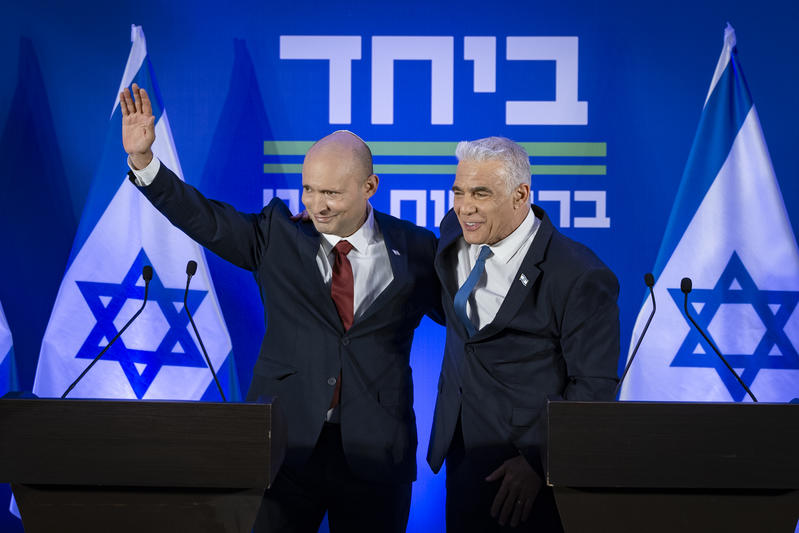
Bennett and Lapid unite to form Together Party

Opposition Leader and Head of the Yesh Atid party Yair Lapid and former Prime Minister Naftali Bennett speak during a press conference announcing a joint list named “Together” ahead of upcoming elections, to be led by Bennett, in Herzliya, central Israel, April 26, 2026.
Opposition Leader and Head of the Yesh Atid party Yair Lapid and former Prime Minister Naftali Bennett speak during a press conference announcing a joint list named “Together” ahead of upcoming elections, to be led by Bennett, in Herzliya, central Israel, April 26, 2026. Photo by Chaim Goldberg/Flash90

What’s happened: Politics: Former prime ministers Naftali Bennett and Yair Lapid will run together in the upcoming elections under a new united political party. On Sunday evening they announced the new list named “Together, Led by Bennett.”

  • Bennett said, “I am taking the most Zionist and most patriotic step we have ever taken, for our country… Our unity sends a message to all the people of Israel: the era of division is over. The era of repair has arrived.”
  • He re-committed to his three pledges:
    • “On the first day of the new government under my leadership, we will establish a state commission of inquiry into the October 7 massacre to bring truth to the families and answers to all the people of Israel,”
    • Initiate a universal conscription law, and stop funding ultra-Orthodox draft evasion.
    • Introduce the term limit of a prime minister to eight years.
  • Bennett added that he will:
    • “Safeguard the lands of our country and will not hand over a single centimetre to the enemy,”
    • Work to “strengthen an inclusive, welcoming Judaism without coercion.”
    • Bennett also said that a government led by him would advance same-sex marriage, along with civil marriage. The current status quo is under exclusive domain of respective religious authorities.
  • Lapid explained his thinking behind the move, “The State of Israel needs to change direction. This is a test of our leadership, and we will meet it. What you have seen today is the first step. We are here because this country needs unity like air to breathe. We are here for everyone who believes in democracy, believes in the deep Jewish foundation of the country, believes in the values of Zionism and our right to this land.”
  • In his view, “to win the elections, the entire Israeli centre must stand behind Naftali Bennett. Bennett is a clear right-winger, but he is a liberal, decent, law-abiding right-winger who did not sell his values – neither to Haredi extortion nor to corruption – he was an excellent prime minister, and he will be an excellent prime minister. This is what we need now.”

Context: Whilst no real surprise, the move cements the opposition bloc under Bennett’s leadership.

  • Lapid and Bennett first formed a political friendship and alliance when they both joined Netanyahu’s third government in 2013, and doing so blocked the entry of the ultra-Orthodox parties. That government survived less than two years after Netanyahu sacked Lapid as his finance minister. Since 2015 every Netanyahu government has included the ultra-Orthodox parties.
  • The only break in the Netanyahu monopoly was the brief 2021-22 broad coalition government that saw Bennett and Lapid serve as (short-lived) rotating prime ministers. There is no suggestion that rotation is on the agenda this time.
  • Bennett and Lapid’s broad coalition was the first in Israel’s history to include an Arab party, with the Islamic Raam Party and its leader Mansour Abbas part of the coalition.
  • The timing of the announcement, amid a fragile ceasefire and in the week following Israel’s Independence Day, also symbolises the first significant consolidation ahead of the election that must be held within six months, and must be announced in the next three months.
  • One of remaining issues to be determined is whether Gadi Eisenkot, who had initially recommended the three of them unite, will also join them. Both Bennett and Lapid are on good personal terms with Eisenkot, and the possibility remains open for him to join them at some point.            
  • Eisenkot who formed his Yashar party after serving as Benny Gantz’s deputy welcomed Bennett and Lapid’s decision to unite, saying that he had spoken to Bennett on the phone half an hour before the announcement. He said, “I see Naftali Bennett and Yair Lapid as partners and will continue to do, with responsibility and wisdom, what is right to achieve the victory and the change needed for the State of Israel.”
  • The move was also welcomed by other members of the anti-Netanyahu bloc.  
  • However the decision came under fierce criticism by the Likud and the right-wing parties accusing them of once more preparing to form a coalition with Raam, and by extension with the Muslim Brotherhood. Whist technically accurate, Mansour Abbas the leader of Raam is also seen as brave moderate leader, who in the past has acknowledged his place as a Muslim minority in the Jewish State.    
  • There is a general feeling in Israeli society that after the trauma of October 7 and the ensuing 2.5 years of war, the possibility of Jewish-Arab political cooperation – as represented in the previous Bennett-Lapid government of which Mansour Abbas was a member – has been weakened.
  • In a press conference in June 2024, Lapid said that “I have explained and we studied and I think that Mansour Abbas has also understood this, that they can’t be the 61st coalition member. It is impossible to establish a government that is dependent on them, without Israeli society and also Arab society not being able to deal with that. The Jewish and the Arab public are not ripe for a government in which the Arab parties will be the deciding voice.”
  • The polling has remained relatively static for some time, with Bennett’s party neck and neck with the Likud around mid-20 seats. It is Eisenkot’s party that has some momentum polling in the mid- teens, at the expense of Lapid’s Yesh Atid that has fallen into single digits.
  • The other advantage Bennett received by uniting with Lapid is significant financial backing. Although trailing in the polls, Yesh Atid is still the second largest party in the current Knesset and will therefore receive a substantial proportion of the state funding for the upcoming campaign.
  • It remains unclear how the merger will affect the opposition bloc’s overall success, but the other opposition parties are all confident they represent a specific sector, so Yair Golan’s Democrat Party are the representatives of the Israeli left, having combined the Labour and Meretz parties, (with their separate runs in the 2022 elections seen as an error). Meanwhile Avigdor Lieberman’s Yisrael Beteinu, with a right-wing but anti ultra-Orthodox sentiment has the sectoral backing of Russian-speaking immigrants. It is expected that the three or four competing Arab parties will also reunite their Joint List, that could increase their electoral power significantly.

Looking ahead: The election is scheduled for no later than October, and a formal 90 day campaign beforehand will begin after the Knesset has been dissolved.

April 23, 2026

Israel marks Independence Day amid fragile ceasefires

People celebrate Israel’s 78th Independence Day at Sacher Park in Jerusalem, April 22, 2026.
People celebrate Israel’s 78th Independence Day at Sacher Park in Jerusalem, April 22, 2026. Photo by Yonatan Sindel/Flash90

What’s happened: Israel celebrated 78 years of statehood yesterday. It was the first Independence Day Israel has marked since the October 7 invasion and massacre without any hostages being held in Gaza.

  • The State of Israel’s population stands at 10.2 million people, more than twelvefold since the state was founded in 1948. This includes 7.8 million Jews, roughly 45% of the world’s total.
  • Celebrations of Israel’s independence took place throughout the country yesterday without incident, as ceasefires in wars in Gaza, Lebanon, and Iran mostly held. An exception to that was a Hezbollah rocket attack on IDF positions in southern Lebanon and several nearby Israeli communities inside northern Israel on Tuesday evening.
  • Today, ambassadors to the United States from both Israel and Lebanon will renew talks begun at the beginning of the ceasefire last week. They will be joined by Secretary of State Marco Rubio and, for the first time, by the US ambassador to Israel Mike Huckabee.
  • The White House outlined its public positions on the Iran conflict yesterday, with White House Press Secretary Karoline Leavitt emphasising the US position on the nuclear issue, rather than on other issues which had been raised earlier such as Iran’s ballistic missile programme or its network of regional proxies. “Iran can never obtain a nuclear bomb to threaten the United States and our allies,” she told reporters, “and they must turn over the enriched uranium that’s in their possession.”
  • Both the US and Iran released videos of their forces enforcing their respective blockades. US videos showed a forced boarding of a ship near the Strait of Hormuz and of another unflagged ship, linked to Iran, in the Indo-Pacific, which was carrying 2 million barrels of Iranian oil that had been loaded at Kharg Island.
  • The US blockade operation has been called Operation Economic Fury, following on the kinetic campaign which was known as Operation Epic Fury. Iranian forces fired on and disabled at least three ships attempting to transit into the Gulf of Oman through the Straits.

Context: The ceasefire between Israel and Hezbollah declared on April 16 was due to last ten days. It did not stipulate any territorial changes, but rather kept positions frozen in place, leaving the IDF in control of swathe of Lebanese territory a few kilometres deep.

  • The Lebanese proposal to extend the ceasefire by one month (ten days in some media reports) would maintain these positions, and not require any withdrawals by the IDF. But the Lebanese proposal includes a demand that Israel stop demolitions inside the zone of southern Lebanon that it holds and would presumably continue to hold for the additional month of a ceasefire extension.
  • Israeli media report that some 20 Lebanese villages abutting the Israeli border are in the process of being demolished by Israeli bulldozers, many of which have been moved up from Gaza to complete the mission as quickly as possible.
  • In previous rounds of fighting, the IDF has watched as Hezbollah accessed weapons caches stored in residences in these villages and used them to conduct attacks on Israeli border communities. Particularly problematic from the Israeli perspective was the use of anti-tank fire on homes in Israeli communities along the border.
  • The present demolitions are intended to ensure that this pattern is not repeated, even in the event of a full Israeli withdrawal at some future point.
  • This fits into a larger Israeli lesson learned since the October 7 attacks. At the time, Israel made the decision to evacuate frontline communities on the northern border at the same time that a similar evacuation was necessary along the Gaza envelope.
  • For more than a year, tens of thousands (well over 100,000 at one point) of Israelis from both north and south were in temporary housing and hotels. Israeli officials have largely come to see the northern evacuation as a mistake that handed Hezbollah an unjustified victory.
  • While the US waits to see if Iran will moderate its position on any of the issues under negotiation, its naval blockade continues. So too do preparations for a renewed aerial assault on Iran to begin immediately with the end of the ceasefire. The US has now positioned a third aircraft carrier in the vicinity. Israeli officials anticipate that a renewed US air operation would last several days and would target Iran’s energy infrastructure.
  • Recent days have also seen repeated reports of another global power’s increasing involvement in efforts to hammer out a deal — China. Beijing is reportedly pressuring Iran to reach a compromise with the United States that would reopen the Straits of Hormuz, whose closure threatens China’s economy far more than it does those of the US and its Western allies.

Looking ahead: The ceasefire in Lebanon is due to expire on April 26. Efforts are underway in Washington to mediate a durable agreement between Israel and Lebanon, or, failing that, to extend the ceasefire so that negotiations can continue. The Lebanese have requested a one-month extension on the ceasefire. Israel’s position on this possibility is not publicly known.

  • The ceasefire declared in Iran on April 8 was originally due to last only two weeks. According to multiple US media reports, all sides have agreed to extend it until at least this coming Sunday. This would put the expiration of the Iran ceasefire on the same day as the expiration of the Lebanon ceasefire.
  • The parallel blockades have hurt all sides in the conflict, but don’t appear to be driving anyone to moderate their positions. The IMF warned this week that in a “severe scenario” of long-term blockade, global GDP could decline by 2% in 2026.

April 14, 2026

Israel marks Holocaust Remembrance Day

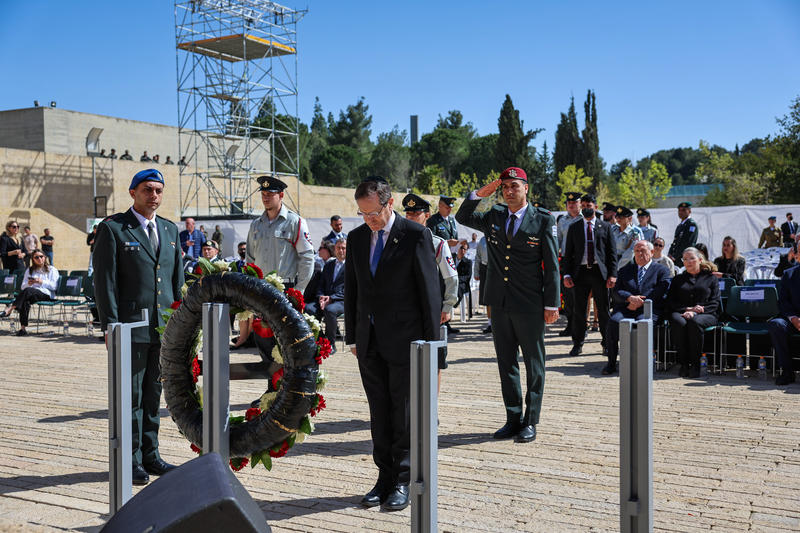
President Isaac Herzog lays a wreath during a ceremony marking Holocaust Remembrance Day at Yad Vashem in Jerusalem, April 14, 2026.
President Isaac Herzog lays a wreath during a ceremony marking Holocaust Remembrance Day at Yad Vashem in Jerusalem, April 14, 2026. Photo by Oren Ben Hakoon/POOL

What’s happened: This morning a memorial siren sounded across Israel in honour of Holocaust Remembrance Day.

  • The traditional opening ceremony at Yad Vashem in Jerusalem on Monday evening was this year prerecorded and was held without any audience because of the ongoing security situation.
  • In his speech President Herzog noted, “There are those who seek to destroy this home that we built, even today. For two and a half years, the State of Israel has been at war, since that frightful day, the October 7th massacre. In every place and every site I visit, I see Israeli society and the spirit that animates it. Across the length and breadth of the land, in bomb shelters, at sites destroyed by missile attacks, in hospitals, in command centres, and volunteer hubs, I see the solidarity, the heroism, the devotion, and the mutual responsibility.”
  • He used the opportunity to call for national unity, saying, “History has repeatedly taught us the high price of internal fighting and division and, alternatively, the strength of mutual responsibility and fraternity. Based on that memory, based on everything that our people has endured, we must say to ourselves, especially today: We did not rise from the fire of the crematoria only to burn in the fire of quarrel.”
  • Prime Minister Netanyahu said in his speech that the establishment of the State of Israel may not have ended antisemitism and belligerence against the Jewish people but, as opposed to the past, the people who seek to destroy us bring destruction down upon themselves.
  • Netanyahu said, “This year we will remember that the State of Israel is at its all-time peak in strength. Who could have imagined 80 years ago that our bold air force pilots and the American military’s pilots would defend, wing-to-wing, the Middle East, Israel and the United States of course, to defend civilization from barbarism.”  
  • As in previous speeches, Netanyahu connected the memory of the Holocaust to the Iranian threat. Netanyahu said, “Indeed, we have destroyed large parts of the industry of death that the Iranian regime had developed over decades: the nuclear plants, missiles, UAVs, the naval fleet, the air force, and vast quantities of other weapons systems. Had we not acted, the names Natanz, Fordow, Isfahan and Parchin might have been remembered eternally in infamy, just like Auschwitz, Treblinka, Majdanek, and Sobibor. But we acted, and how—in an unprecedented historic partnership with President Trump and the United States.”
  • Netanyahu also criticised Europe, which he said “has forgotten so much since the Holocaust, can learn many things from us, primarily: the sharp distinction between good and evil, which, in the moment of truth, requires us to go to war for the sake of good, for the sake of life. Europe, which vowed after World War II to defend the good, is infested today with a deep moral weakness. Europe is losing control over its identity, its values and its commitment to protect civilisation from barbarism.”

Context: Israel formally designated “Holocaust and Heroism Remembrance Day,” on the Hebrew date of 27 Nisan in 1951, after the Knesset debated several options.

  • The date chosen is a week after Passover, close to the anniversary of the Warsaw Ghetto Uprising, which began on Passover. For the then young State of Israel the main driver was to connect remembrance of the Holocaust with Jewish resistance. Whereas International Holocaust Remembrance Day on January 27 marks the anniversary of the liberation of Auschwitz-Birkenau.
  • This year there are 116,880 Holocaust survivors still alive and living in Israel. Just over 13,000 survivors died in the last year. There were 115 Holocaust survivors who were among the thousands evacuated from their homes as a result of the latest Iran war.            
  • In Israel, the memorial is also an opportunity to reflect on growing antisemitism around the world. There have been over 1,000 antisemitic incidents around the world in the last year, resulting in 20 Jews killed, 15 of whom  in the terror attack on Bondi Beach. This figure reflects a 30 year high.

Looking ahead: Direct talks between the ambassadors of Israel and Lebanon are due to begin later today in Washington.

  • In parallel, the operation Bint Jbeil is expected to continue for a few more days.
  • Next Tuesday Israel will mark Memorial Day for those fallen in wars and terror attacks, and the following day celebrate Israel’s 78th Independence Day.

March 31, 2026

Death penalty law passed but unlikely to withstand judicial review

A vote on the death penalty for terrorists who murder Israeli civilians at the auditorium in the Knesset, the Israeli parliament in Jerusalem, March 30, 2026.
A vote on the death penalty for terrorists who murder Israeli civilians at the auditorium in the Knesset, the Israeli parliament in Jerusalem, March 30, 2026. Photo by Chaim Goldberg/Flash90

What’s happened: The Knesset passed the Death Penalty for Terrorists bill into law last night, codifying into law what had been for years a slogan of the far-right. Opposition party Yisrael Beiteinu, an early pioneer of the slogan that even in its days as part of a coalition never seriously advanced the proposal, supported the bill. United Torah Judaism, an ultra-orthodox party inside the coalition, opposed it.

  • The law has drawn the ire of liberals in Israel and nearly all of Israel’s allies. It calls for a mandatory death penalty for those convicted of terrorist murder of Israelis.
  • The law is not expected to survive challenge in the Israeli Supreme Court, though as the legislation itself is largely understood to be populistic rabble-rousing, this may be the point.
  • Among its many weaknesses before judicial review: the distinctions it makes between crimes in the West Bank and inside Israel, the mandatory nature of the penalty (rather than execution being a maximum sentence), and the very fact of bringing a form of civilian law into the West Bank that isn’t limited only to Israeli citizens.
  • Nearly every professional body in Israel opposed the legislation. The National Security Council, a body inside the Prime Minister’s Office, warned that aspects of it contradicted international law. The Ministry of Foreign Affairs warned that it could put Israel in violation of treaty commitments.  Justice Ministry officials have also noted problematic the application of civilian legislation in the West Bank to non-Israelis (since 1967, an emergency order has allowed Israeli legislation to apply to Israeli settlers living in the West Bank, but the Knesset has largely refrained from legislation that directly applies to the Palestinians).
  • As a result, it is highly likely that the Supreme Court will determine that this new law is illegal, which would only add to the ongoing tension between the current government and the court.      
  • Itamar Ben-Gvir, the politician most associated with the bill, was seen in Knesset opening champagne to celebrate the bill’s passage, an image that rankled many in Israel not just for its poor taste and bad decorum, but also because it later emerged that at the time that was going on, senior officials already knew what the public did not yet know, namely that four IDF soldiers had been killed in combat.

March 12, 2026

War costs mount as Israel races to pass budget

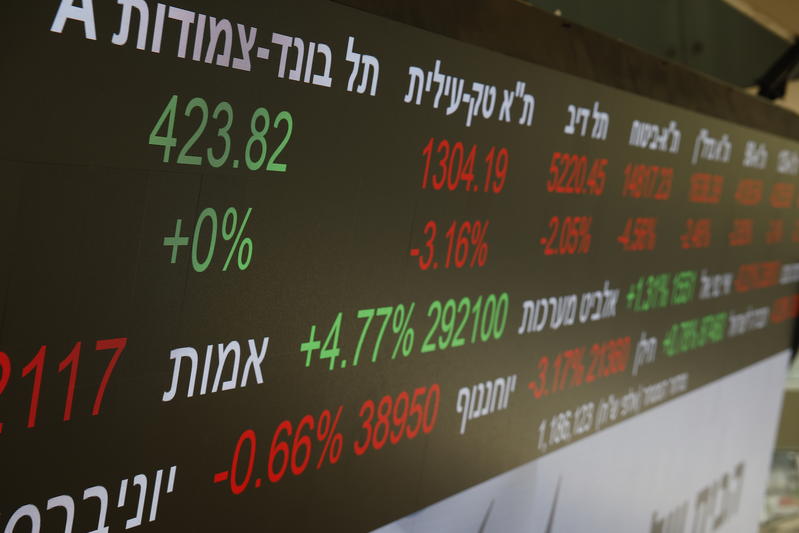
An electronic board displaying market data at the Tel Aviv Stock Exchange in Tel Aviv, March 2, 2026.
An electronic board displaying market data at the Tel Aviv Stock Exchange in Tel Aviv, March 2, 2026. Photo by Yehoshua Yosef/Flash90

What’s happened: The budget deadline is perhaps the most urgent economic issue connected to the war in Iran, but it is far from the only one, or even the most significant.

  • Fighting the war — on multiple fronts — is itself very expensive. Writing in Yediot Ahronot, Sever Plocker estimates, using figures from the Twelve Day War last year, that direct war expenditures can amount to 60 billion shekels per month. The loss of output from the partial shutdown of the economy amounts to some 30 billion shekels. Taken together with the costs of recovery and reconstruction from war damage, the war’s direct costs easily top 100 billion shekels (almost £25 billion) for each month that it rages.
  • Direct costs to the US are enormous in absolute terms ($11 billion dollars so far, according to an estimate in this morning’s New York Times), but unlike in Israel, negligible as a portion of total economic output.
  • The war threatens to impact the global economy too in ways which will affect Israel as well. Energy market disruptions could send the global economy into a recession, while a spike in energy prices could set in motion price inflation.
  • On the budget itself, the cabinet met Wednesday on Zoom and agreed to add 28 billion shekels to the 2026 defence budget. The deficit target was raised to 5.1% from 3.9%.
  • The budget also included a large amount set aside to “coalition funds,” the local euphemism for direct earmarks for the Haredi sector and West Bank settlers. This was already in the vicinity of 5 billion shekels and in the new budget approaches 6 billion. Israeli commentators speculated that this is what made possible the agreement of the Ultra-orthodox parties to vote for the budget despite not getting the conscription law, which had been their principal legislative priority for this Parliament.
  • Opposition MK Gilad Kariv of the Democrats described the budget as a “looting budget,” because it was, in his words, “the seizure of property and money in wartime.”

February 24, 2026

Israel to invest in more AI infrastructure

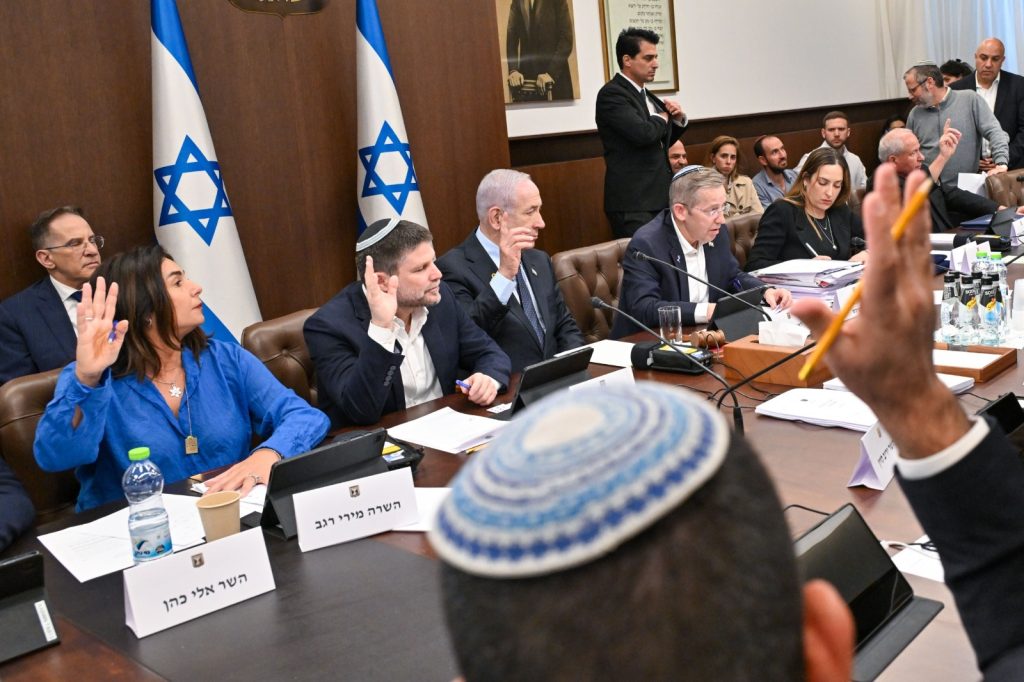
What’s happening: On Sunday, Prime Minister Netanyahu and Energy and Infrastructure Minister, Eli Cohen, announced and confirmed the Israeli government’s decision to invest in artificial intelligence infrastructure, starting with accelerating the building of a new server farm.

  • Addressing a government meeting, Netanyahu stated that the decision was a “major move because, ultimately, leadership in Artificial Intelligence (AI), and in my opinion, in quantum as well, will be a decisive factor in the continued cultivation of our power,” and “about gaining immense power advantages on a global scale.”
  • Netanyahu also confirmed that developed AI power was an “integral” part of this vision, acting as a force multiplier against Israel’s small territory and population.
  • Minister Cohen stated that the decision would “remove barriers and accelerate the processes for building data centres, which is a vital step on Israel’s path to becoming a global AI superpower.”
  • He also confirmed that AI infrastructure initiated in just the last three months represented over 5% of energy consumption of State of Israel, with more likely to come in the future.

Context: Israel has long been recognised as a world-leading high-tech powerhouse, and sits at the cutting edge of AI development, generative AI, and machine learning.

  • Israel has the world’s highest Research & Development (R&D) expenditure as a percentage of GDP fuelling its status as the Start-Up Nation. 
  • Also this week, the Haifa-based Technion Israel Institute of Technology was ranked the best university in computer science and artificial intelligence research in Israel and Europe, as well as among the top ten most important universities when researching machine learning.
  • In December 2025, Israel joined the US-led strategic initiative Pax Silica which is focused on securing and strengthening AI and technology supply chain.
  • Israel’s leadership in AI, was a contributing factor behind the “Roadmap for UK-Israel Bilateral Relations,” signed by Israel and the UK in  March 2023. The agreement established a strategic partnership between the two countries and included a substantial section on Science, Innovation and Technology, of which a AI was an important component.
  • The roadmap specifies a £20M framework for supporting academic and R&D ties between the UK and Israel. There was also a commitment to deepen further the bilateral science and technology partnership through “new and ambitious initiatives.”
  • Within that cooperation, Innovate UK and the Israel Innovation Authority, were jointly responsible for “supporting UK – Israel business led collaborative research and development (CR&D) projects resulting in new products, industrial processes, or services.”
  • Among the projects was UK – Israel AI Drug Discovery Taskforce. A group of senior representatives from leading pharmaceutical companies, start-ups, academic institutions, hospitals, Health Maintenance Organisations, and governmental agencies – from the UK and from Israel. The task force was established by SIN Israel, recognising the UK and Israel’s excellence on AI in Drug Discovery, and in order to promote the collaboration around this topic.
  • In December 2025, Israel was one of eight key countries invited to a White House summit on secure AI supply chains alongside Japan, South Korea, Singapore, the Netherlands, the UK, the UAE, and Australia.
  • AI is also emerging as a developing soft power and diplomatic tool, especially in the context of the Abraham Accords. In December 2025, Holon Institute of Technology (HIT) and the UK Abraham Accords Group (UKAAG) signed a landmark Memorandum of Understanding aimed at deepening artificial intelligence cooperation between Israel, the UK, and nations participating in the Abraham Accords.
  • Nvidia, the US-based tech company is also planning to invest $1.5 billion into Israel, specifically server farms. Israel is now Nvidia’s second-largest R&D hub outside the US, with more than 5000 employees spread across multiple facilities.

Looking ahead: Indian Prime Minister Modi is due to arrive in Israel tomorrow and address the Knesset. The two countries are also expected to sign a number of agreements including cooperation in emerging technologies, such as AI, quantum computing and cyber technology.

  • While the Israeli government had originally planned to build two new power stations by the end of the decade, this has since been superseded and will double, including those based on both gas and renewable energy sources.
  • The UK-Israel AI collaboration is striving towards a “2030 Roadmap” according to the 2023 Memorandum of Understanding.

January 29, 2026

Israeli government passes first reading of budget

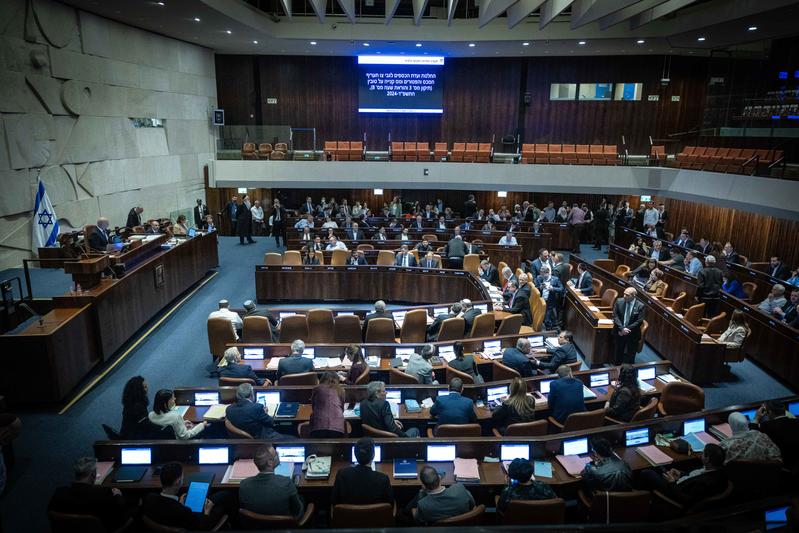
A vote on the state budget at the assembly hall of the Knesset, the Israeli parliament in Jerusalem, March 13, 2024.
A vote on the state budget at the assembly hall of the Knesset, the Israeli parliament in Jerusalem, March 13, 2024. Photo by Yonatan Sindel/Flash90

What’s happened: The coalition survived a budget vote in Parliament yesterday when a first reading of the 2026 budget passed by a 62 to 55 majority.

  • The ultra-Orthodox parties had threatened to boycott the vote and had, until yesterday, refused to support the budget without  securing a new bill on draft exemptions for the ultra-Orthodox public first.
  • The three ultra-Orthodox parties are the Sephardic Shas party, as well as the two Ashkenazi ultra-Orthodox parties, Degel Ha-Torah and Agudat Yisrael, which together run on a joint list known as United Torah Judaism (UTJ). Agudat Yisrael is the party of the Hasidic community and Degel Ha-Torah of the non-Hasidic Ashkenazi Haredi community, known informally as ‘Lithuanians.’
  • A vote scheduled for earlier this week had to be scuttled once it became clear that the coalition did not have a majority. Wednesday’s vote was made possible by Degel Ha-Torah’s decision to support the budget even without a final agreement on the conscription bill. Shas followed suit (though its leader Aryeh Deri was absent at the vote), but Agudat Yisrael did not vote with the coalition.
  • The chairman of Agudat Yisrael Yitzchak Goldknopf tied his party’s decision to abstain from the vote to his dissatisfaction with the steps taken against ultra-Orthodox draft-dodgers in the absence of a new law exempting them from service. “We cannot stand by,” he said in the Knesset debate. “This government will be remembered as the one who puts young men behind bars.”
  • Finance Minister Bezalel Smotrich hailed the new budget and the performance of the Israeli economy in general. “After two years of a costly war, the State of Israel is a powerhouse of strength,” he told members at the opening of yesterday’s parliamentary debate. “We predict a 5.2 percent growth in GDP in the coming year. Inflation is returning to the target range, between 2% and 2.5%, we are curbing the cost of living and preserving the value of the money of Israeli citizens.”
  • Opposition MK’s slammed the budget, with Yair Lapid describing it is as “unhinged” and another member of his party criticising in particular the record-breaking 7.5 billion-shekel allocation of “coalition funds,” the Israeli euphemism for direct political earmarks which mostly benefit the ultra-Orthodox community and West Bank settlers.

Context: Passing a first reading was a major hurdle for the 2026 budget and for the governing coalition in general. By law the Finance Committee is assigned 60 days to review the budget between the first and second reading. If the Knesset cannot pass a budget in its final form by March 31, parliament is automatically dissolved and new elections are scheduled within two months. In this year’s case, that would be only a minor drama as elections are currently scheduled for no later than October of this year.

  • When no budget is in effect, the state operates by the so-called “one twelfth rule,” whereby all outlays from the last agreed budget are maintained on a month-to-month basis until a new budget is passed. In 2020, Israel operated on such a continuation budget for the entire fiscal year.
  • The current budget proposal projects 812 billion shekels (about £190 billion) in expenditures, of which 112 billion shekels (about £26 billion) is slated for defence. There will be an operating deficit of about 3.9% of GDP, significantly lower then the figures for 2025 (4.7%), 2024 (6.8%), and 2023 (4.2%), but still much higher than the operating deficit during 2002, the last full year before the war in Gaza broke out, when it stood at 1.9% of GDP. In 2020, the year of the pandemic, the deficit was a staggering 11.4% of GDP.
  • The political drama in the lead-up to the budget vote had little to do with the actual budget and more to do with the contentious efforts by the government to come up with a compromise on ultra-orthodox draft exemptions. Though no final compromise was reached, negotiations with the Chair of the Foreign and Defence Committee and the Committee’s legal counsel on a few controversial passages in the text of a draft form of that bill reached a breakthrough on Tuesday. 
  • The current version of the conscription bill would grant a blanket exemption for full-time yeshiva students and set modest targets for drafting ultra-Orthodox men who are not enrolled in full-time study. There are currently 80,000 military-age ultra-Orthodox men who have avoided entirely national service. The IDF says it needs at 12,000 to meet its current manpower shortage.
  • The version of the bill currently being advanced would ostensibly force a number close to that (but still smaller) to enlist, however, as critics point out, many of the legal sanctions for evading the draft, such as a cut in daycare subsidies for fathers who avoid mandatory services, would become dead letters, almost guaranteeing no real enforcement of the draft requirement. The bill would also end legal sanctions against those who dodged the draft in the year leading up to the bill as well. In its current form, it is likely to be challenged in court — and overturned.
  • The Committee’s legal counsel had earlier blocked text that the coalition MK’s favoured with the warning that in its current form, the law would easily be struck down by the Supreme Court as violating the equality provisions of Israel’s quasi-constitutional Basic Laws. The exact phrasing of the new compromise solution is not yet known, but is widely expected to be struck down anyway on similar grounds.
  • Historically in Israel, coalitions are fractious with different factions functioning at cross purposes with each other. The current narrow, right-wing, coalition in power since the election of 2022 has been unusually solid and stable, with few major areas of disagreement despite being remarkably unpopular in public opinion polls since its first months in power. The issue of draft exemptions for the ultra-Orthodox public has been one of the only issue that has emerged as a major point of contention inside the otherwise relatively united coalition.

Looking ahead: Following the successful vote last night, the budget bill moves back to the Knesset Finance Committee. It will need to pass a second and third reading in the plenum to become law.

  • Even with a budget, the coalition will still need to conjure a compromise on the conscription bill to stay in power to the end of this parliament’s term. For that compromise to have any legal validity it will have to involve language that does not invite intervention from the Supreme Court invalidating the law entirely. Neither of these events — and certainly not both — appear likely at this time.

December 24, 2025

New revelations reignites Qatargate scandal

Eli Feldstein, who were arrested in the so-called Qatargate investigation seen at the District Court in Tel Aviv, on May 15, 2025.
Eli Feldstein, who were arrested in the so-called Qatargate investigation seen at the District Court in Tel Aviv, on May 15, 2025. Photo by Avshalom Sassoni/Flash90

What’s happened: An explosive interview by a former spokesperson for Prime Minister Netanyahu regarding the leaking of classified documents, dominated headlines in Israel and ignited reactions on all sides of the political divide.

  • Eli Feldstein, a former spokesperson for Netanyahu and a suspect in two ongoing criminal investigations into national security breaches in the Prime Minister’s Office, spoke at length on the programme Yihye Tov on the public broadcaster Kan. The interview was split into three parts, with the first two broadcast over the last two nights and the third due to be broadcast tonight.
  • The interview on Kan as well as an investigative report on the Hebrew i24 network sparked renewed interest in two overlapping scandals: the leaked classified documents and the Qatari influence campaign in the Prime Minister’s Office. Feldstein is connected to the ongoing investigation into both.
  • In the parts already broadcast, Feldstein confirms that the leak of classified information to the German newspaper Bild in September 2024 was done to influence Israeli public opinion and reduce pressure on the Prime Minister on the hostage issue. In the second part of the interview, broadcast last night, Feldstein alleges that Netanyahu knew of the leak beforehand and approved of it afterward.
  • He does not offer any specific proof of Netanyahu’s alleged knowledge of the leak beforehand, in contrast to the very specific details he does provide about Netanyahu’s alleged subsequent approval  as well as the Prime Minister’s alleged direct involvement in an effort to plant a question at a press conference after the leak which would allow Netanyahu to insinuate in his answer that the IDF had deliberately hiding the information in the leaked document from him.
  • In the first part of the interview, broadcast two nights ago, Feldstein paints  a picture of Netanyahu focused on crafting a media strategy that would absolve him of “responsibility” for the October 7 massacre.
  • The Prime Minister’s Office denounced Feldstein’s statements as “a long series of false and recycled allegations” from someone with personal motives trying to deflect responsibility from himself.

Context: The revelations of the last 48 hours concern two separate scandals, with overlapping involvement from three key figures close to the Prime Minister.

  • The first scandal, which was the focus of most of the interview that was broadcast on the Kan public broadcaster, concerns the unauthorised handling of classified documents, allegedly in an attempt to influence domestic Israeli public opinion.
  • The alleged actions occurred in the days immediately following the murder of six Israeli hostages in a Gaza tunnel. On August 31, 2024, IDF forces discovered the bodies of six hostages who had been executed by their captors one or two days before. The hostages had survived eleven months of captivity, abuse, and deliberate starvation since their abduction by Hamas on October 7, 2023.
  • When the Hamas terrorists detected an Israeli forces operating nearby, they chose to murder the hostages to ensure that they would not be rescued, as had happened only a few days earlier with the Israeli Bedouin hostage Qaid Farhan al-Qadi. The discovery of the bodies sparked outrage in Israel leading to the largest demonstrations at any point in the two years of the war, with estimates of over 500,000 people assembled at various protest sites on September 1 as well as a general strike.
  • It was in this context that the Prime Minister’s spokesperson Eli Feldstein leaked a classified intelligence assessment from months earlier that speculated that Hamas was using the hostage issue to manipulate the Israeli public and divide it.
  • According to Feldstein, the documents were deliberately leaked to a non-Israeli media outlet not subject to Israeli censorship because no Israeli outlet would have been able to legally reveal classified information that had not been cleared for publication.
  • The leak, and subsequent reporting about the leak, took the wind out of the sails of the protest movement, and the pressure on the Prime Minister to reach a hostage deal rapidly abated after the initial burst of anger over the murdered six hostages.
  • Feldstein himself was not authorised to see the classified documents in question. He was also not directly employed by the Prime Minster’s Office, as he had not been granted the necessary security clearance. His salary was not paid for by the PMO, but rather through a complicated arrangement where money was transferred to him allegedly from an American lobbyist with connections to Qatar. In the interview, Feldstein claimed he did not know about the Qatari connection at the time.
  • The second, overlapping, scandal concerns an alleged Qatari influence campaign in the Prime Minister’s Office, involving Feldstein himself and two other figures considered very close to Netanyahu, his aide Jonatan Urich and the lobbyist Yisrael (“Srulik”) Einhorn.
  • Feldstein spoke very little about the Qatar affair in the first two parts of the interview. The third part will be broadcast tonight. 
  • At the same time, an investigative report on the Hebrew i24 channel, normally seen as broadly sympathetic to Netanyahu, revealed a close coordination between Urich and Einhorn to release statements to the Israeli press, ostensibly reflecting the views of senior security officials, which tallied with Qatari priorities and very often disparaged Egyptian role in the hostage negotiations. Einhorn’s PR firm had earlier received payment from Qatar to promote the country’s image in the lead up to the 2022 World Cup.

Reactions: Most politicians and media figures aligned with the governing coalition denounced Feldstein and defended Netanyahu, with the exception of Minister Amichai Chikli (Likud) who said that there was “no way to defend what was revealed” and called for an investigation into the Qatar affair.

  • Those opposed to Netanyahu were scathing in their criticism. Former Prime Minister Naftali Bennett said that “Netanyahu’s office betrayed the State of Israel and IDF soldiers during wartime and acted on behalf of Qatar for financial gain, and Netanyahu himself is covering it up…Whether Netanyahu knew or did not know that his office was working for the enemy in time of war, both possibilities require his immediate resignation.” In other media appearance, Bennett repeatedly used words like “treason” and “betrayal” to describe the alleged actions of the Prime Minister and some of his closest advisers.
  • Gadi Eisenkot, chair of the new Yashar party, and briefly a minister in Netanyahu’s expanded war cabinet, said that “while the country was shaking with anger and pain over the murder of our six hostages in the tunnels, while the Israeli people went into the streets heartbroken—the prime minister wasn’t engaged in getting the rest of the hostages back, but rather in psychological warfare against his own citizens. He waged a psychological campaign that was designed to poison the public and to silence the families’ outcry.

Looking ahead: Israel is due to hold a general election by 27 October 2026. However, the election could be brought forward due to difficulties surrounding the budget and legislation on Haredi draft exemptions. There are also rumours circulating that Netanyahu will dismantle his government and will call an early election.

  • Prime Minister Benjamin Netanyahu’s party, Likud, is leading in the polls, but his governing coalition is projected to fall short of an overall majority.
  • In parallel, Prime Minister Netanyahu continues to appear in court facing trial on corruption charges. At the end of November, he requested a pardon from President Isaac Herzog, which is currently under consideration.

Newsletter sign-up

Please enter your information below to subscribe to our daily newsletter and stay updated and informed.

Donate to BICOM

At BICOM, we rely on the generosity of people like you to keep our website and services running. Your donation, no matter the size, makes a real difference. Please consider supporting us today. For further information please email: [email protected]