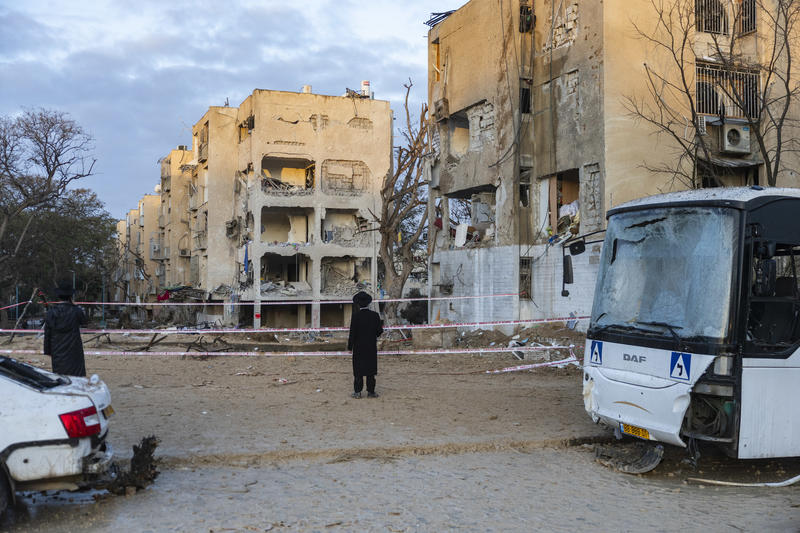
What’s happened: Over the weekend two southern Israel communities suffered direct hits from Iranian ballistic missiles.
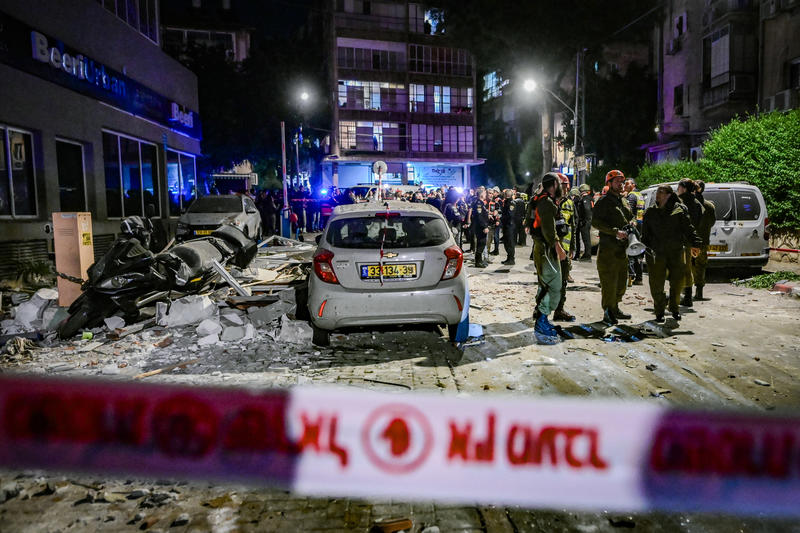
- In Arad on Saturday night, eighty-eight people were wounded. Ten are reported to be in serious condition, with 19 in moderate condition, 55 in light condition and four who suffered from shock.
- Four residential buildings were damaged in the missile attack, with large numbers of rescue workers dispatched to the scene to help recover the wounded, many of whom were inside the damaged buildings.
- Earlier on Saturday, fifty-four people were wounded by a ballistic missile that struck Dimona. A 12-year-old boy was hospitalised in serious condition.
- The mayor of Dimona, Benny Biton told Kan Radio, that the residents’ behaviour had been exemplary, adding that rescue crews had evacuated all 475 people trapped within the damaged buildings.
- At the scene in Arad, Police Commissioner Danny Levy reinforced the message that people in shelters were protected.
- The IDF confirmed that interception attempts had failed, but emphasised that these were Iran’s standard ballistic missiles and “not an unusual or unfamiliar ordnance.”
- President Herzog visited Arad on Sunday and said that, “the Iranians do not differentiate between Muslims and Jews and Christians or between the elderly and the young. All civilians are there to be killed and destroyed, but we are here to show something else: we are ever resilient.”
- In northern Israel, the IDF has informed the family of an Israeli farmer killed in Misgav Am near the Lebanon border that he died from a deadly misfire by Israeli artillery fire.
Context: Despite the costly failed interceptions, the IDF revealed that 92 per cent of Iranian missiles have been intercepted, but stress that there is no hermetic solution.
- As Israel enters the fourth week of wars with Iran and Lebanon, it has enjoyed numerous tactical successes but faces the risk of a drawn-out war of attrition. Iran’s missile attacks have adapted in timing, type, and distribution, maintaining pressure on Israel’s home front despite sustained Israeli strikes.
- Israeli strikes against Iran, including targeted eliminations and infrastructure destruction, have apparently not yet substantially weakened the regime or reduced Iran’s counter-strikes.
- The US struggles with how to address Iran’s blockade of the Strait of Hormuz, with President Trump facing the dilemma of either escalating or appearing weak.
- Crucially, Iran still possesses around 450 kg of highly enriched uranium (HEU); a strike on Natanz may have aimed to prevent the Iranians relocating their stockpile. There is ongoing speculation whether a US or Israeli led special operation could extract the HEU.
- Visiting Arad on Sunday, Prime Minister Netanyahu said that Iranian actions over the weekend were proof that “Iran endangers the entire world.”
- “In the last 48 hours, Iran targeted a civilian area. They’re doing that as a mass murder weapon. Luckily, no one was killed, but that’s due to luck, not their intention. Their intention is to murder civilians.
- “Second… they fired on Jerusalem right next to the holy sites of the three monotheistic faiths, the Western Wall, the Church of the Holy Sepulchre, and the Al-Aqsa Mosque. And by dint of a miracle, again, none of them were hurt, but they were targeting the holy sites of the three major monotheistic religion.
- “Third, they fired an intercontinental ballistic missile on Diego Garcia. That’s 4,000 km. I’ve been warning all the time. They have now the capacity to reach deep into Europe. They already have fired on European countries, Cyprus. They are putting everyone in their sights.
- “Fourth, they’re stopping a maritime international route, energy route and trying to blackmail the entire world. What more proof do you need that this regime that threatens the entire world has to be stopped? Israel and the United States are working together for the entire world. And it’s time to see the leaders of the rest of the countries join up.
- Netanyahu added that Israel had defined two goals – to “break completely their nuclear programme, break completely their missile programme, break completely their capacity to produce the components for both of these programmes.” He added that the country was well on the way to achieving these goals. “We’ve also set a goal of creating conditions for the Iranian people to overthrow this tyranny that has tormented them and made life miserable, and is making life miserable for the entire world. And I hope we achieve that too.”
Looking ahead: Trump’s deadline regarding Iran opening of the Strait of Hormuz expires in a few hours.
- According to the latest assessment of IDF Chief of Staff Zamir, they are “mid-way” through the campaign. On Sunday Zamir said that, “the extensive damage that we have inflicted on the Iranian regime in the past three weeks is beginning to accumulate into a systemic, strategic military, economic and governmental achievement. As a result of that, the evil regime is weaker. Iran is more vulnerable and is without significant defensive capabilities. The regime’s leaders, who developed capabilities with the goal of annihilating us, are battered and confused.”