LATEST

Hamas and the Muslim Brotherhood

Key background
  • Hamas is an Islamist Palestinian nationalist movement which currently governs the Gaza Strip. It is proscribed by the UK and in the majority of western countries.
  • Its primary state backers are Iran, Turkey, and Qatar. It is also active in the West Bank, East Jerusalem, Syria, and Lebanon.
  • Since seizing control of the Gaza Strip in 2007, it has continuously launched attacks against Israel and weaponised civilian infrastructure by embedding itself into schools, mosques, and hospitals.
  • Hamas’s 7th October attacks on southern Israel killed 1200, and over 250 hostages were subsequently taken to the Gaza Strip.
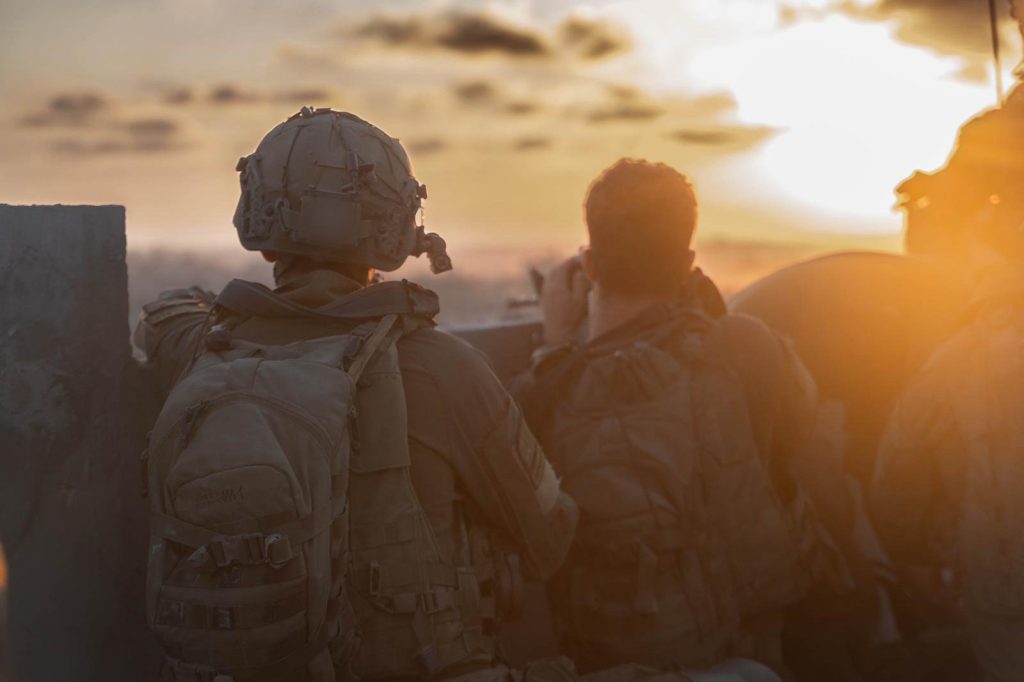
Israeli soldiers seen near the Israeli border with the Gaza Strip
Israeli soldiers seen near the Israeli border with the Gaza Strip, November 10, 2025. Photo by Tsafrir Abayov/Flash90 *** Local Caption *** עזה ישראל חמאס צבא גבול מלחמה חרבות ברזל

Updated November 13, 2025

Ceasefires in Gaza and Lebanon under pressure

What’s happened: At a meeting yesterday of the so-called “Mechanism,” the multilateral monitoring committee for the implementation of the November 2024 ceasefire which ended the Israel-Hezbollah war, no agreement was reached on further weapons decommissioning.

  • The Lebanese newspaper Al-Akhbar, generally aligned with Hezbollah, reports that the meeting was “not positive” and that the Lebanese Armed Forces (LAF) refused a demand to carry out inspections in private homes, where Hezbollah is believed to be storing weapons.
  • Reports in Palestinian media this morning indicated that the IDF carried out limited strikes at targets in Khan Yunis and Beit Lahia in the Gaza Strip. Since the ceasefire went into effect in October 10, the IDF has occasionally carried out such strikes against Hamas ceasefire violations.
  • At a meeting of foreign ministers in Canada, the G7 nations reiterated their “strong support” for President Trump’s Comprehensive Plan for Gaza. The statement also called on Iran to “resume full cooperation with the International Atomic Energy Agency, including enabling inspections of all nuclear facilities and materials.”
  • A spate of violence by radical West Bank settlers captured the attention of Israeli and foreign media. Settlers were filmed setting fire to a factory and olive grove, as well as attacking IDF soldiers. Secretary of State Marco Rubio was asked at the G7 meeting if the outbreak of settler violence in the West Bank could endanger the ceasefire in Gaza. “We’ll do everything we can to make sure it doesn’t happen,” he told reporters.
  • A new corruption scandal burst into public consciousness in Israel yesterday. A senior police official was briefly detained yesterday for interrogation under suspicions that he had intervened in a very sensitive corruption investigation in order to benefit an associate of his. A court injunction prevents the publication of the identity of the police officer in question (though his rank of Deputy Commissioner is known) or any other details regarding the investigation. Last week the Israel Police announced the completion of a two-year undercover investigation into corruption at Israel’s largest trade union. The Police force is also involved in the unfolding scandal around the former military Advocate General.
  • At the same time, the Israel Police and the Minister responsible for the police force, Itamar Ben-Gvir, had a public spat over Ben Gvir’s efforts to block the promotion of a high-ranking police superintendent, allegedly, as a punishment for her involvement in the investigations which led to indictments against Prime Minister Netanyahu.
  • Netanyahu’s ongoing trial was thrown into a turmoil yesterday by the very public intervention of President Trump, who released a letter he sent to Israeli President Isaac Herzog asking him to pardon the Prime Minister.

Context: The “Mechanism” meeting in Lebanon comes against a backdrop of major diplomatic initiatives from the United States to stabilise the post-Assad regional order. Ambassador Tom Barrack, the Trump administration official most closely associated with these efforts, issued a long statement yesterday summarising US positions and hailing some of the recent developments. “This was a week to remember,” Barrack wrote.

  • In the statement, he praised the Syrian President’s decision to join the US-led coalition against ISIS. “Damascus will now actively assist us in confronting and dismantling the remnants of ISIS, the IRGC, Hamas, Hezbollah, and other terrorist networks, and will stand as a committed partner in the global effort to secure peace.”
  • Called on Congress to repeal the Caesar Act, the 2019 law that placed severe sanctions on Syria. Last week, the administration announced a suspension of some of the Act’s provisions.
  • Referenced efforts at “redefining Turkish-Syrian-Israeli relations and advancing the alignment that underpins the Israel-Hamas ceasefire, as well as various Lebanese border issues.”
  • Praised the roles of Qatar and Saudi Arabia, but was particularly effusive in his praise of Turkey.
  • Described President’s Trump’s regional strategy as “security first, prosperity next.”
  • The violence in the West Bank was criticised by both President Herzog and Major General Bluth, who currently heads the Central Command that covers the West Bank. 
  • Herzog called the events severe, shocking and serious. “Such violence against civilians and against IDF soldiers crosses a red line, and I strongly condemn it. All state authorities must act decisively to eradicate this phenomenon and to strengthen the IDF soldiers and security forces who guard us day and night.”
  • Bluth criticised the “reality in which anarchist fringe youth act violently against innocent civilians and against security forces” adding that it must be “dealt with firmly” which requires “the combined efforts of all branches of the State of Israel: education, welfare, law enforcement, and disciplinary measures.” He added that the directive to IDF soldiers is clear: “do not stand idly by, and do everything in your power to prevent any act of nationalist crime.”

Looking ahead: Israel Hayom reports that both the US and Israel are making preparations for a “Plan B” for Gaza should the ceasefire plan fail and not progress to the second stage. These are different plans addressing different problems.

  • The American effort, led by Jared Kushner, seeks a diplomatic alternative to the implementation of the second stage of the ceasefire.
    • The second stage calls for Hamas disarmament, an Israeli withdrawal, and an International Stabilisation Force (ISF). But so far Hamas has not disarmed, and no country has expressed any willingness to join an ISF that might be tasked with disarming it.
    • In practice, this means that the first phase of the ceasefire, with Gaza partitioned into a zone under Israeli control and a zone under Hamas control, could last much longer than originally intended in the ceasefire agreement.
    • According to the report in Israel Hayom, Kushner is keen to advance some reconstruction efforts even in a situation in which the two sides are stuck in the first phase.
  • On the Israeli side, the discussion of a “Plan B” is focused on military efforts.
    • Chief of General Staff Eyal Zamir reportedly told the cabinet that the IDF is preparing a contingency plan if the ceasefire fails.
    • Presumably this comprises both a plan of action if the first phase lasts longer than intended as well as a plan for the resumption of combat should the ceasefire fall apart entirely.

November 12, 2025

Standoff in Gaza continues as al-Sharaa visits Washington

A yellow concrete block placed by the Israeli army is seen in the buffer zone east of Jabalia in the northern Gaza Strip
A yellow concrete block placed by the Israeli army is seen in the buffer zone east of Jabalia in the northern Gaza Strip, November 2, 2025. Photo by Fathi Ibrahim/Flash90

What’s happened: Israel and the US are staking out positions on the future of Gaza, as concerns mount in the US that the first stage of the ceasefire might be turning into a stable status quo, rather than a temporary measure leading to a more comprehensive political agreement.

  • According to reports, both Israel and the US are examining various modes of cooperation with informal militias in Gaza that are not aligned with Hamas.
  • The standoff over the one hundred or so Hamas fighters holed up in tunnels on the Israeli side of the Yellow Line near Rafah also continues.
  • Syria too has emerged as an issue where Israel and the US have partially overlapping positions and priorities. This week, Syrian President Ahmed al-Sharaa became the first Syrian President to be hosted at the White House since 1946. The US announced a partial suspension of sanctions against Syria.
  • While in Washington, al-Sharaa said to the US media that Syria was “engaged in direct negotiations with Israel, and we have gone a good distance on the way to reach an agreement.” But he stressed that “to reach a final agreement, Israel should withdraw to their pre-December 8 borders.” Al-Sharaa added that “Mr. Trump supports our perspective as well, and he will push as quickly as possible in order to reach a solution for this.”
  • By referencing the pre-December 8 borders, al-Sharaa is referring to the situation prior to the fall of Assad’s regime in Syria. Following that, Israel expanded the Golan perimeter and intervened to protect Syrian Druze, particularly in the al-Suwayda region. Al-Sharaa’s phrasing, however, may imply an acceptance of Israel’s control over the Golan Heights.
  • Israel’s Minister of Strategic Affairs Ron Dermer, who served as the main point man in Israel’s relationship with the Trump administration, has resigned his post in Cabinet. Dermer had long indicated his desire to quit, but stayed in his post in order to see through the completion of the ceasefire deal which ended the war in Gaza. In his resignation letter, he wrote, “This government will be remembered both for the October 7 attack and for its management of the two-year, seven-front war that followed.”

Context: While US officials are also those most enthusiastically pushing for an expansion of the Abraham Accords to include the new Syrian regime. The Syrian President himself is much less enthusiastic. In an interview with the Washington Post, he rejected the possibility of a full normalisation of relations with Israel in the near future, though he indicated that his country is in direct contact with Israel on a number of issues.

  • Al-Sharaa claimed in the interview that the Trump administration supported his position that Israel should withdraw to the positions it held on December 8, 2024, the day the Assad regime fell. He also rejected Israel’s demand for the demilitarisation of the region of Syria south of Damascus, something Israel has been de facto enforcing since a spate of violence targeted the Druze minority in the region earlier this year.
  • Regarding the Hamas terrorists trapped in the tunels behind the Yellow line, there were conflicting media reports about Israel’s position on the issue amidst the US efforts to resolve the crisis as quickly as possible. The US is keen for the fighters to receive safe passage on condition that they surrender their weapons. Israel reportedly objects to this arrangement, as some of the besieged terrorists are believed to be members of Hamas Nukhba forces that carried out the October 7 massacre. An unnamed Israeli official quoted on Kan, the Israeli public broadcaster, called the proposal to have them leave the tunnels without their weapons “naïve,” since, according to the same official, “weapons will be waiting for them at home.”
  • One option reportedly being considered according the Israel’s Channel 12 News was exile to a third country.
  • Advancing to the next phase of the agreement requires the full handover of the remaining deceased hostages as well as the establishment of an International Stabilisation Force (ISF). But four deceased hostages remain in Gaza, and few countries have expressed any interest in joining the ISF without a clear mandate from the UN. Of the countries that have indicated that they could join, most are only willing to take on peacekeeping roles and do not wish to be a part of any effort to actively disarm Hamas or remove it from power. A report in Reuters datelined in Manama, Bahrain cited “ten diplomats” as saying that governments “remain hesitant to commit troops.”
  • The result for now is that the status quo of the first phase, rather than leading to the next phases, appears to be settling into something longer and more stable. The Yellow Line is clearly demarcated by the IDF with yellow concrete blocks. Moreover, a resolution of the tunnel standoff in Rafah will only further the distinction between the two zones – on one side of the line will be only Israeli forces, and on the other Hamas will have nearly completely reasserted its control.
  • The Reuters report also cited “six European officials with direct knowledge of the efforts to implement the next phase” of the Gaza ceasefire, as well as a Jordanian Minister details growing concerns that the Gaza Strip is being partitioned for the long term into two roughly equally sized zones, one under Israel’s control and under Hamas’s. According to the ceasefire agreement, Israel withdrew its forces to the so-called Yellow Line, leaving the IDF in control of 53% of the Strip. Most of Gaza’s population is in the remaining 47%.
  • The de facto partition casts a shadow over reconstruction efforts too. A report in Maariv claims that US reconstruction efforts could, in the immediate term, be focused only on the Israeli-controlled sector of the Strip. The pledges of Arab money for reconstruction in the rest of the Strip are on hold as long as Hamas’s role remains unclear.

Looking ahead: The US continues its efforts to get a UN Security Council resolution that would authorise an international force to implement the agreement. But the text won’t change the basic conundrum:

  • there is a consensus that Hamas should disarm and a willingness to contribute to Gaza’s reconstruction and governance once Hamas is disarmed;
  • the international community does not want the IDF to do the disarming;
  • no other countries want to do it either.

November 10, 2025

Fallen IDF officer’s body returned home after 11 years

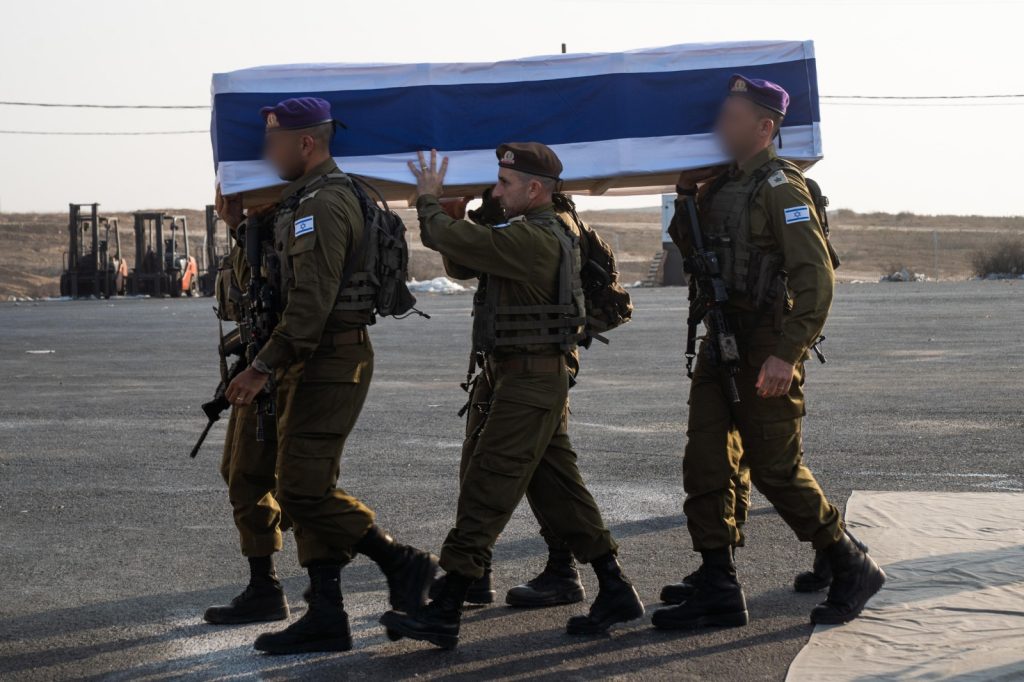
A team of reserve fighters consisting of members of Lieutenant Hadar Goldin's company, who accompanied him on his final journey across Israeli territory.
A team of reserve fighters consisting of members of Lieutenant Hadar Goldin's company, who accompanied him on his final journey across Israeli territory. Photo credit: IDF.

What’s happened: The body of Lt. Hadar Goldin who was killed 11 years ago in Gaza during Operation Protective Edge was returned to Israel yesterday.

  • Goldin was 23 at the time of his death, and his body was abducted by Hamas and held in a tunnel in Rafah.
  • After the Red Cross handed over the coffin to the IDF on Sunday, the military held a poignant ceremony which included Goldin’s former comrades as well as the former deputy commander of his unit, Eitan Fund, who had led the pursuit of Hadar’s abductors into the tunnels, and the then commander of the Givati Brigade, Ofer Winter.
  • On Sunday night, his parents Simcha and Leah Goldin made brief statements outside their home, exactly as they had done the day after his capture. Simcha Goldin said, “We have brought Lt. Hadar Goldin from Sayeret Givati, our son, a warrior, to Jewish burial. The IDF brought Hadar to Jewish burial. Not anyone else. The IDF. And that’s why we are taking the IDF’s values, in the name of which we have been walking for more than 11 years, because that is what Hadar bequeathed to us, values that say that we don’t abandon soldiers on the battlefield, because that’s a value and we don’t compromise on values in order to secure interests, and we fight for fighters.”
  • His mother Leah said, “It took us 11 years to get him back with the help of the IDF and the security forces. I was forced to go world-over just to realise that we have values that are shared by everyone regardless of race, gender or creed. The value of our camaraderie and mutual responsibility. Bringing the deceased to Jewish burial. And the third is called human dignity. Those are the values that we truly fought for.”
  • Prime Minister Netanyahu issued a statement noting, “I always had in my room two pictures – of Oron Shaul and of Hadar Goldin, may they rest in peace. And I knew that we would bring them home… I know the agonies that his family endured. I also know the longing for his return, which united the entire Israeli people. And today we are united in the fact that we have finally returned him to his parents and family for Jewish burial.”

Context: Goldin fell in battle on August 1, 2014 in Rafah, when Hamas violated the ceasefire at the end of Operation Protective Edge. His body had been held for 4,177 days.  

  • He was part of an elite reconnaissance unit of the Givati Brigade  that had been trying to locate tunnels when terrorists emerged from a shaft, attacked the IDF force and killed three soldiers: Goldin, Maj. Benaya Sarel and Staff Sgt. Liel Gidoni.
  • His return brings closure for the family and more broadly for Israeli society. On Sunday night, his parents spoke at entrance of their home, exactly as they had done the day after his capture.  
  • Over the weekend, the body of Lior Rudaeff was also returned. Rudaeff, a Sgt Major in reserves served as deputy security coordinator and a member of the Nir Yitzhak rapid response team. He fell in battle defending the Kibbutz on October 7th, and his body was taken captive by Islamic Jihad. Lior was 61 years old at the time of his death, and his death was officially determined on May 7th, 2024. He leaves behind his wife, four children, three grandchildren, father, sister, and brother.
  • According to Israeli media reports the IDF had intelligence on the location of Lt. Goldin body and had IDF troops operating in the area, trying to locate him. Hamas apparently realised that Israel had learned where his body was buried and so could not hold off on releasing it any longer. The intelligence was based on information garnered from a small group of senior Hamas commanders that were privy to the information. Following the elimination of the most senior commanders (including Dief and Sinwar) during the war, it was assessed that only five people alive knew the location, they were granted immunity from attack so the secret would not die with them.
  • Over the last few days, Turkey had encouraged Hamas to hold onto the body and only release it in return for safe passage for the estimated 200 Hamas fighters thought to be in underground tunnels within the zone under Israeli control. Hadar’s body was ultimately returned in the context of the ceasefire deal – thanks to the US backing Israel’s position.    
  • IDF Chief of Staff Zamir had told the security cabinet last week that there was no deal for safe passage for the trapped terrorists, and that they would either surrender or be eliminated.
  • Israel has continued to encourage the mediators to keep the pressure on Hamas and Islamic Jihad to release the rest. However it may be case that Hamas will struggle in returning the remaining four bodies of hostages still buried in Gaza. The latest assessment is that Islamic Jihad is holding one deceased hostage whom it can return immediately to Israel, while the location of the final three is unclear.  
  • In parallel the IDF continues to focus on the decommissioning of Hamas tunnels within the area under its control and remain vigilant in thwarting any attempts by Hamas to breach the Yellow Line. On Saturday there were at least two recorded incidents of attempted infiltrations.  

Looking ahead: The funeral for Hadar Goldin will take place tomorrow morning in the military cemetery in Kfar Saba.

  • The next stage of the deal will include turning over responsibility for civilian control inside Gaza Strip to the US led Civil-Military Coordination Center (CMCC).
  • There are still four bodies being held in Gaza. They include three Israelis: Meny Godard, Ran Gvili and Dror Or, and Thai farmer Sudthisak Rinthalak.
  • However, the future of the agreement will depend on the Israeli intelligence assessment concurring that every effort has been made to locate the remaining bodies.

November 6, 2025

Body of Joshua Mollel returned to Israel

Joshua Mollel. Mollel had only arrived in Israel 19 days before the Hamas rampage; it was his first time traveling outside of his home country. According to his family, he came to learn about Israeli farming and planned on returning to Tanzania to open his own agricultural business.
Joshua Mollel. Mollel had only arrived in Israel 19 days before the Hamas rampage; it was his first time traveling outside of his home country. According to his family, he came to learn about Israeli farming and planned on returning to Tanzania to open his own agricultural business. Photo credit: Joshua Mollel

Hostage update:  A body handed over to Israel by Hamas yesterday has been confirmed to be that of Joshua Mollel, a 21-year-old Tanzanian national who was working as an agricultural intern on Kibbutz Nahal Oz where he was murdered by Hamas terrorists on October 7, 2023.

  • Mollel had only arrived in Israel 19 days before the Hamas rampage; it was his first time traveling outside of his home country. According to his family, he came to learn about Israeli farming and planned on returning to Tanzania to open his own agricultural business.
  • Following the confirmation that the body was indeed that of a deceased hostage, the Israeli Prime Minister’s Office put out a statement saying, “The Israeli government shares in the deep sorrow of the Mollel family and of all the families of the fallen hostages.”
  • Six deceased hostages are still in Gaza.
  • The standoff over the estimated 150 Hamas fighters holed up in a tunnel on the Israeli side of the Yellow Line continues, with some reporting in the Israeli media indicating that Israel believes the body of Lt. Hadar Goldin, who was killed in combat with Hamas in 2014, might be held in the tunnel where the Hamas fighters are, and other reports casting doubt on the claim.

November 5, 2025

Another fallen hostage returns to Israel

Ruby Chen, Father of Israeli hostage Itay Chen attends a protest calling for the release of hostages held by Hamas terrorists in the Gaza Strip, outside the U.S. Embassy Branch Office in Tel Aviv, July 4, 2025.
Ruby Chen, Father of Israeli hostage Itay Chen attends a protest calling for the release of hostages held by Hamas terrorists in the Gaza Strip, outside the U.S. Embassy Branch Office in Tel Aviv, July 4, 2025. Photo by Avshalom Sassoni/Flash90 *** Local Caption *** איתי חן מלחמה חטופים משפחות תל אביב חרבות עצרת שגרירות ארצות הברית ברזל מלחמה

What’s happened: The remains of the deceased hostage Staff Sgt. Itay Chen, were returned to Israel last night.

  • As in the past, the identification process was first completed by the National Institute of Forensic Medicine before his family was notified.
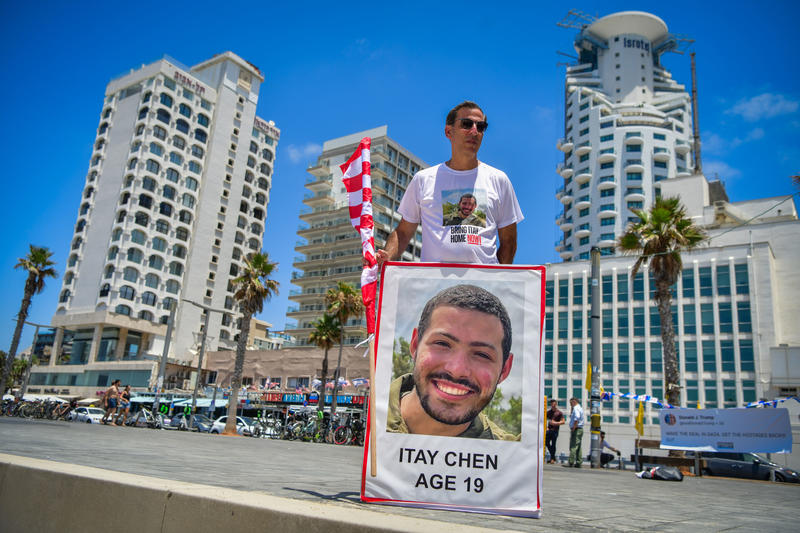
  • Itay Chen was killed while defending  Nahal Oz on October 7 and his body was taken into Gaza by Hamas. His death was announced five months later.
  • In parallel, the IDF has continued to operate in the Gaza Strip in the Israeli controlled areas south and eastwards of the Yellow Line. The IDF Spokesperson’s office confirmed that, “an underground tunnel route spanning hundreds of meters long and tens of meters deep was located in the Jabaliya area and dismantled…The route was used by Hamas terrorists for prolonged stays and for organising terrorist activities against IDF troops.”
  • Moreover, IDF soldiers have also identified a compound containing launchers, rockets, and launch positions belonging to Hamas…in the centre of the Shejaiya area in northern Gaza.”

Context: Itay Chen is the last kidnapped IDF soldier from this war. On October 7 he fought with his tank crew that included Sgt. Tomer Leibovitz, Captain Daniel Peretz and Staff Sgt Matan Angrest. The only survivor of the crew was Angrest, who was taken as hostage, while the bodies of Peretz and Chen were also taken to Gaza.

  • Another seven deceased hostages still remain in the Gaza Strip  761 days since October 7.
  • Included in these seven still held in Gaza are the remains of Hadar Goldin, who was killed during Operation Protective Edge in the summer of 2014.
  • Israel is satisfied that the return of bodies has continued, but is keen to speed up the process and retrieve all the remaining hostages. The latest  estimations are  that Hamas knows the location of three or four remaining bodies. Even if Hamas does not know the whereabouts, it may be that allowing Hamas to search (within Israeli controlled areas) will be faster than the IDF doing it, as Hamas may have more precise information.
  • The extensive Hamas tunnel network remains an ongoing operational challenge for the IDF. It is estimated to be over 550km in length, (and possibly longer) and according to the most recent assessment from the Ministry of Defence, only 40 per cent of the tunnels mapped have so far been destroyed. Operationally the IDF is now prioritising destroying the tunnels in the area it currently controls.
  • Hamas claims that around 200 armed terrorists are trapped below ground in a network of tunnels within the Israeli controlled area. Hamas has asked (via mediators) to grant them safe passage out of the area which poses a dilemma for the IDF. On  one hand, their presence endangers troops, but Israel is also unwilling to grant these fighters amnesty. Israel is currently demanding the return of all the deceased hostages before a decision is made on the trapped Hamas operatives.  
  • Since the demarcation of the Yellow Line there have been several incidents of Gazans trying to cross it. According to IDF rules of engagement, they are only targeted if they pose an immediate threat, and otherwise are arrested.  
  • As part of the preparation for the next phase, Israeli and US teams now share a joint war room as part of the CMCC (Civilian-Military Coordination Center), which is primarily aimed to coordinate civilian projects. The mechanism also allows them to jointly monitor ongoing potential Hamas preparations to carry out future attacks.  
  • Humanitarian aid continues to enter Gaza, at an average rate of approximately 600 trucks a day including food, fuel and gas. In contrast to the US and Israeli backed GHF that delivered over 185 million meals directly to the Gazan civilian population during the five months it operated up until the ceasefire, the current aid is being facilitated by the UN and other international organisations which allows Hamas to control the distribution once inside the Strip.
  • According to a new report by UN Watch hundreds of UNRWA workers maintained ties with Hamas, and other terror groups. The study presents 490 verified cases of agency employees who praised massacres, incited violation or were personally active in the terror organisations.

Looking ahead: As winter approaches, hundreds of thousands of Gazans remain without a permanent home. With the ceasefire holding, and increased aid entering the Strip it is now Hamas’ responsibility to disarm to allow the reconstruction efforts to begin.

  • The UN Security Council is expected to vote in the next two weeks to endorse the US plan to establish an International Stabilisation Force. However it currently appears that many Arab countries that are supposed to contribute soldiers are unwilling to do so until Hamas is disarmed.

November 3, 2025

Three more hostage bodies returned to Israel

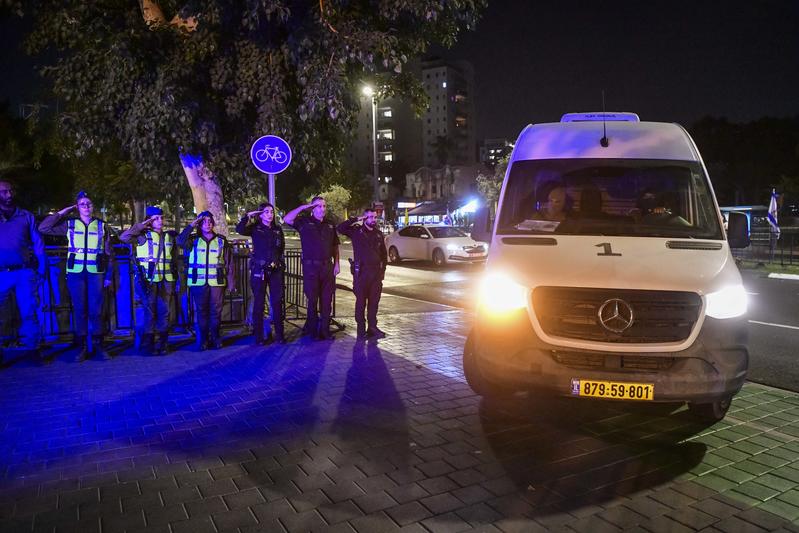
Israeli security forces pay their respects as the convoy carrying the bodies of hostages arrives at the Abu Kabir Forensic Institute in Tel Aviv, November 2, 2025.
Israeli security forces pay their respects as the convoy carrying the bodies of hostages arrives at the Abu Kabir Forensic Institute in Tel Aviv, November 2, 2025. Photo by Avshalom Sassoni/Flash90 *** Local Caption *** אבו כביר חרבות ברזל מלחמה שחרור חטופים עסקה חזרה

What’s happened: Additional bodies have been returned for burial in Israel over the weekend.

  • On Sunday night Hamas returned three bodies to Israel. They were later identified and named as:
    • Colonel Asaf Hamami, commander of the Southern Brigade of the Gaza Division. He was killed during the battle for Kibbutz Nirim and was kidnapped along with his troops, Staff Sergeant Tomer Yaakov Ahimas and Sergeant Kiril Brodsky.
    • Staff Sergeant Oz Daniel, a fighter in the 77th Armoured Brigade. On October 7th, he fought with his tank crew and was abducted along with his three tank crewmates: Nimrod Cohen, who was released after more than two years in captivity; Shaked Dahan, whose body was returned for burial; and Captain Omer Neutra.
    • Captain Omer Maxim Neutra was born and raised in Long Island, New York, and volunteered to enlist as a lone soldier in the Armoured Corps, subsequently completing officer training and becoming a tank platoon commander. He was abducted with his tank crew (along with while Oz Daniel) while commanding the team.
  • On Sunday funerals were held for the two hostage bodies returned on Friday. Amiram Cooper, who was 85 at the time of his murder by Hamas, was laid to rest at Kibbutz Nir Oz, where he was one of the founding members. Sahar Baruch was killed at the age of 25 during a failed IDF rescue mission. He was buried in his kibbutz, Beeri.
  • In an interview to 60 Minutes, President Trump said that the ceasefire in Gaza was not fragile, and repeated his threat that Hamas would be obliterated if it failed to behave decently. Trump said, “You hear about Hamas, but Hamas could be taken out immediately if they don’t behave. They know that. If they don’t behave, they’re going to be taken out immediately. If I want them to disarm, I’ll get them to disarm very quickly. They’ll be eliminated. They know that.”
  • In Lebanon over the weekend Israel targeted a commander of Hezbollah’s Radwan Force, regarded as one of the most significant elimination of the past year. The senior commander had been responsible for the delivery of weapons for restoring Hezbollah’s military infrastructure in southern Lebanon. Three additional Radwan fighters were also eliminated travelling in the same vehicle.
  • Outgoing Military Advocate General Yifat Tomer-Yerushalmi was found Sunday night after a search along Tel Aviv’s Cliff Beach that led to her being arrested. Earlier in the day, her car had been found empty at the site. Her phone is still missing.
  • She stepped down as the IDF lead military prosecutor last week following her admission that she had leaked classified video footage from the Sde Teiman Base in southern Israel where alleged abuse of incarcerated Hamas terrorists had taken place. She is also accused of making a false affidavit to the High Court and covering up the subsequent probe.

Context: The return of the remaining hostages remains Israel’s top priority. Whilst Hamas remain in breach of the agreement, all the other stages of the deal are on hold.

  • There is concern that Hamas is deliberately dragging its feet in order to squeeze further concessions.
  • The second Hamas breach of the agreement are the continued efforts to attack IDF soldiers in areas still controlled by Israel inside Gaza.
  • Mediators have raised the option for Israel to agree to allow Hamas terrorists safe passage out of Gazan territory that is under Israeli control. Some Hamas fighters are trapped inside tunnels. Israel is said to be studying the issue.
  • Israeli media reports suggest the US will call for the International Stabilisation Force to be deployed along the yellow line, in an area that will keep the IDF and Hamas apart. This presumably will require a further Israeli withdrawal / redeployment.  
  • Discussions continue about the composition of the International Stabilisation Force (ISF). The US is expected to submit a motion to the UN Security Council that will serve as the ISF’s mandate. Whilst the mission will be led by US CENTCOM and include British planners the bulk of the troops deployed are expected to be Muslim or Arab. Israel has vetoed Turkish and Qatari involvement and the countries touted as potentially sending troops are UAE, Jordan, Morocco, Pakistan, and Indonesia. Their role will be to maintain law and order while wider members of the international community will help set up civilian infrastructure like schools and health clinics, as well reestablishing infrastructure for the supply of electricity, water and sewage management.  
  • In parallel, there is ongoing concern over how Hamas has been able to reassert control over many areas west of the yellow line.
  • Prime Minister Netanyahu related to the threat from Hamas on Sunday, noting, that while the organisation suffered crushing blows, it is trying to recover. He added that “there are still Hamas pockets in the areas under our control in Gaza” including in Rafah and Khan Yunis which Israel plans to eliminate.
  • Netanyahu also clarified that while Israel reports to the US, “we do not ask for their permission…. We maintain the supreme security responsibility, and we will not relinquish it.”
  • Netanyahu warned that while Hezbollah was taking hits, it is also “trying to arm itself and recover.” He added that Israel expects the Lebanese government “to do what it committed to do, namely to disarm Hezbollah,” while clarifying that Israel would exercise its right to self-defence as stipulated in the ceasefire conditions. “We will not allow Lebanon to become a renewed front against us and will act as necessary.”
  • The latest strikes against Hezbollah coincide with the first anniversary of the ceasefire. Israel has detected that that Hezbollah has stepped up their efforts to rebuild their military capabilities. Since the November 2024 ceasefire Israel has eliminated almost 340 Hezbollah fighters.

Looking ahead: The remains of eight hostages are still being held by Hamas. It is hoped that sustained pressure can bring more of them home.

  • Chairman of the US Joint Chiefs of Staff General Dan Caine arrived in Israel and visited the Civil-Military Coordination Center in Kiryat Gat, from which the US is overseeing its Gaza operations. The Americans announced that they would take full responsibility for the humanitarian issue in Gaza as of November 7.
  • Hezbollah had been given a deadline of the end of 2025 in which to disarm. The US are expected to place further pressure on the Lebanese Government to deploy state forces and challenge Hezbollah’s supremacy in the south.

October 29, 2025

Israel commits to renewal of ceasefire

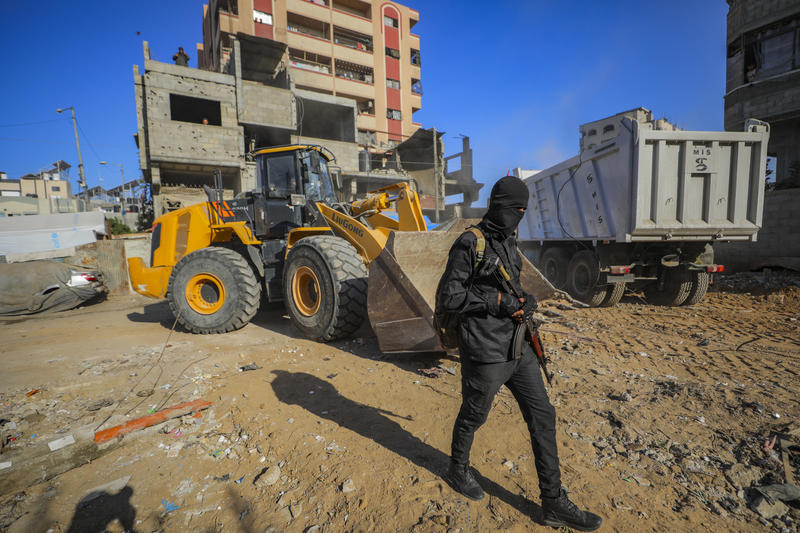
Members of the Qassam Brigades use heavy machinery to search for the bodies of Israeli hostages.
Members of the Qassam Brigades use heavy machinery to search for the bodies of Israeli hostages in the Nuseirat refugee camp in the central Gaza Strip, October 28, 2025. Photo by Ali Hassan/Flash90 *** Local Caption *** עיר בניינים פלסטיני הרס עזה מלחמה חיפושים גופות חטופים חמאס

What’s happened: Following Israeli air strikes throughout the night and this morning, the IDF this morning announced that the ceasefire in Gaza is now back in effect.

  • An Israeli reservist was killed in combat yesterday in Rafah in the southern part of the Gaza Strip. Sgt. Yona Feldbaum, 37, leaves behind a wife and five children. He is the third soldier killed since the ceasefire agreement was implemented.
  • The incident yesterday took place east of the Yellow Line, in an area designated as under Israeli control by the ceasefire agreement. An IDF unit was conducting an operation in the Al-Jenina neighbourhood of Rafah to dismantle a large underground tunnel route prepared by Hamas. A terrorist squad hiding in the tunnel emerged and fired an anti-tank missile at the engineering vehicle carrying Sgt. Feldbaum. A few minutes later, they fired at another armoured vehicle, but no one was injured.
  • Hamas has claimed that the unit which carried out the attack in Rafah yesterday was not under its command and that it remains committed to the ceasefire.
  • Even before the deadly incident, Israeli patience with Hamas ceasefire violations was running thin. A full week has passed since the last time Hamas handed over a deceased hostage, something it was committed to doing as soon as possible under the terms of the agreement.
  • Israeli officials released drone footage yesterday of a staged exhumation of a hostage body that Hamas had performed for the benefit of the Red Cross. Hamas operatives brought the remains to a pit they had dug, hastily buried it, and the summoned the Red Cross for the ‘discovery’ of a gravesite. The remains that were handed over to Israel were not even of one of the remaining hostages, but rather additional remains of a body of an Israeli hostage whose body had already been retrieved and buried. In Israel this was seen as further evidence of Hamas trying to engineer an image of difficulty in locating the remaining deceased bodies. Of 13 remaining deceased bodies, Israel believes Hamas can easily locate and hand over 10, despite the terror organisations protestations to the contrary.
  • Following the deadly incident in Rafah and the ongoing impasse over the release of the remains of Israeli hostages, the IDF launched an air offensive yesterday evening, striking Hamas targets throughout the Gaza Strip. Hamas health authorities reported 60 Gazans killed in the new Israeli airstrikes.  According to the IDF they struck “over 30 terrorists holding command positions.” 

Context: The Israeli government continues to closely coordinate its decisions and actions with the Trump administration.

  • US officials responded to yesterday’s developments with a double message, emphasising that the ceasefire was still in place while supporting Israel’s retaliatory actions.
  • President Trump appeared to endorse Israel’s operation yesterday. “They killed an Israeli soldier, so the Israelis hit back, and they should hit back,” he told reporters yesterday aboard Air Force One. “Hamas is a very small part of peace in the Middle East and if they’re good, they’re going to be happy, and if they are not good they’re going to be terminated. Their lives will be terminated. And they understand that.” Vice President JD Vance told reporters yesterday that despite the fighting, he believed the ceasefire would hold.
  • Israel is continuing to explore further options if Hamas remains in breach of the agreement by failing to return all the bodies of the remaining 13 hostages. One option is to expand the zone currently under its control.  Right now Israel holds 53% of the Strip’s territory, with a ‘yellow line’ delineating the temporary boundary between Israeli-held territory and Hamas-run territory. Further stages of the ceasefire – after all hostages are released – are supposed to bring about further Israeli territorial withdrawals as well as an International Stabilisation Force. But if the ceasefire does not advance, it is likely that Israel will stay in its current deployment, with a large buffer zone between the Israeli border communities attacked on October 7 and a shrunken Hamas-run Gaza Strip.
  • In the meantime, the IDF continues to turn its attention to the northern border, where a tense ceasefire has held for exactly eleven months, punctuated with frequent Israeli enforcement operations targeting Hezbollah weapons production and smuggling. Both Israel and the US are waiting to see if the Lebanese Armed Forces can successfully disarm Hezbollah by the end of 2025.
  • According to Israel media, the current assessment is that Hezbollah has 10,000 rockets in its arsenal, as opposed to the 120,000 it was estimated to possess before it began launching attacks on Israel on October 8, 2023. Hezbollah has not thus far responded to Israeli strikes since the ceasefire, nor did Hezbollah launch any rockets at Israel during the Twelve Day War with Iran. But Israel remains on the alert for a Hezbollah attack of some kind, especially as the organisation’s domestic status becomes increasingly desperate.
  • The Houthis in Yemen have not launched any attacks on Israel since the Gaza ceasefire went into effect earlier this month, but Israel holds no illusions that their war against the Jewish state has been definitively concluded.

Looking ahead: With the renewal of the ceasefire this morning there is hope that more hostage bodies will be returned. Despite the air strikes last night Hamas announced they have recovered two more bodies that could be returned to Israel in the next 24 hours.  

October 28, 2025

Israel considers next steps after Hamas breaches hostage deal

IDF in the Gaza Strip.
IDF in the Gaza Strip. Photo credit: IDF

What’s happened: It has been confirmed that the remains handed over by Hamas to Israel last night belonged to a deceased hostage who had already been returned to Israel for burial, and not to one of the 13 deceased hostages whose bodies have yet to be returned.

  • Israeli officials are currently deliberating how to respond to this flagrant violation by Hamas. Prime Minister Netanyahu will meet with security officials to discuss options, but will also coordinate their response with the US.
  • Israeli frustration with the slow pace of handovers is growing. Israel has allowed unarmed Hamas members, accompanied by Egyptian and Red Cross officials, into Israeli controlled areas east of the Yellow Line to help locate bodies of Israelis abducted by Hamas. The latest assessment  suggests Hamas has exact locations of the bodies of at least five (and up to ten) of the remaining hostages, but that it is deliberately holding back on their return.
  • President Trump’s ultimatum to Hamas to release all hostages by midnight last night passed, so far without consequence.
  • Despite the ceasefire, Hamas and Islamic Jihad operatives attempted an attack on Israeli forces in Gaza yesterday from a tunnel in the Israeli-controlled sector of the Strip. IDF soldiers on the ground spotted the terrorists and opened fire. Hamas officially claimed that the squad involved in that attempted attack was not in contact with its central command and was not obeying orders, but Israeli officials expressed doubt that this was the case.
  • A joint operation of the National Counter-Terrorism Unit of the Israeli Border Police and the Israeli Air Force yesterday took place near Jenin in the West Bank yesterday. Three terrorists were killed by snipers as they emerged from a cave. The cave itself, with all the terrorist infrastructure, was subsequently destroyed by an air strike. Air strikes in the West Bank are exceedingly rare. According to Israeli authorities, the operation foiled an attempt by the terrorists to carry out an imminent attack.

October 27, 2025

Efforts continue to recovery hostages bodies

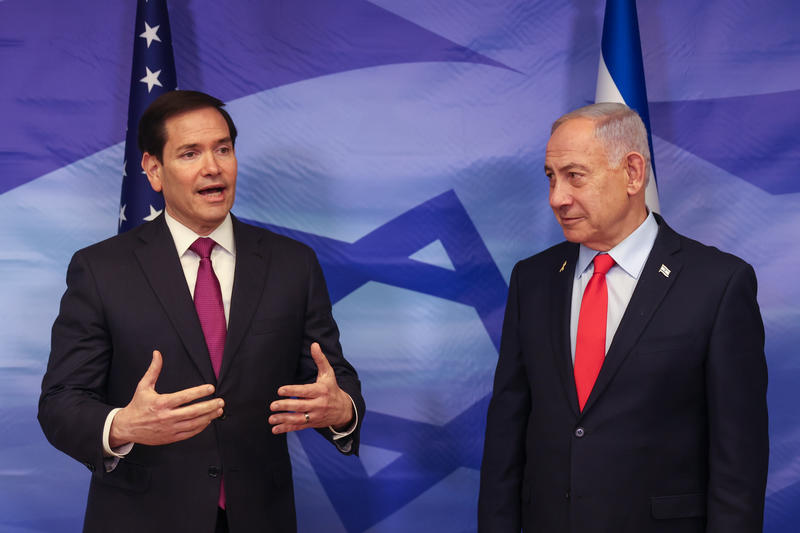
US Secretary of State Marco Rubio and Israeli PM Benjamin Netanyahu at PM Netanyahu's office in Jerusalem, October 23, 2025.
US Secretary of State Marco Rubio and Israeli PM Benjamin Netanyahu at PM Netanyahu's office in Jerusalem, October 23, 2025. Photo by Oren Ben Hakoon/Flash90 *** Local Caption *** רוביו שר החוץ ביבי ראש הממשלה בנימין נתניהו

What’s happening: In close coordination with Israel, an Egyptian team entered Gaza with heavy diggers to try to locate and retrieve hostage bodies.

  • Israel gave consent for Egypt to bring in the heavy equipment and gave the Egyptians the geolocations where it believes some of the bodies are buried.
  • In addition, Israel has allowed Hamas representatives to cross the Yellow Line in the Israeli held part of Gaza in order to try and locate hostages’ bodies together with the Red Cross.
  • The searches follow the latest comments by President Trump over the weekend that, “Hamas is going to have to start returning the bodies of the hostages…quickly, or the other countries involved…will take action.”
  • President Trump also related to the two bodies of American citizens, Itay Chen and Omer Neutra, still held by Hamas. During his visit at the end of last week US Secretary of State Rubio said that, “the remains are going to be released. That’s going to happen. And if it doesn’t, then the deal got broken. But it’s going to happen.”
  • Rubio also met with the families of the American-Israeli hostages and later wrote on X that “We will not rest until their—and all—remains are returned.”
  • Defence Minister Katz also released a statement noting, “The most urgent moral mission is, of course, the return of all the hostages and the fallen to their homes, and we will do everything to fulfil this sacred and critical mission.”
  • Katz revealed that 60 per cent of Hamas’s underground tunnels network still remains, saying, “I have instructed the IDF to prioritise the destruction of the tunnels as the central task in the yellow zone currently under our control.” Katz added that this would be coordinated with the US to, “find a way to thoroughly address the dismantling and destruction of all terror tunnels in the remaining territory under their responsibility, alongside disarming Hamas.”
  • On Saturday the Israeli Air Force struck the Nuseirat area in the central Gaza Strip, west of the yellow line. The IDF Spokesperson’s Office confirmed, “The IDF targeted an Islamic Jihad terrorist who planned to carry out a terror attack against IDF forces in the immediate future. The troops in the Southern Command are deployed in the area in accordance with the terms of the ceasefire agreement and will continue to act to eliminate any immediate threat.”

Context: According to point four of the Trump plan, Hamas should have returned all hostages, the living and dead, within 72 hours, so they are already in clear violation.

  • It has now been six days since the last remains of hostages, Arie Zalmanowicz and Tamir Adar, were returned to Israel.
  • Thirteen bodies remain in Gaza. According to Israeli intelligence, Hamas know the location of at least eight bodies of hostages.
  • The entry of Egyptians marks the first time since the ceasefire that Israel has allowed a foreign team to enter Gaza. Last week Israel refused entry to dozens of Turkish rescue workers. 
  • Egyptian President Sisi made a personal commitment at the peace summit he hosted in Sharm el-Sheikh that the Israeli bodies will be returned.
  • The entry of the Egyptian team was agreed upon during talks in Israel with Egyptian General Intelligence Director Hassan Rashad. An additional Israeli security team visited Cairo over the weekend to coordinate it.
  • The latest Trump post once more underscores how the president remains personally committed to the return of all the bodies. On the one hand he backs the Israeli position, whilst he also continues to carry favour with the Qataris. The latest example was his fawning praise heaped on the Qatari emir when they met on board Air Force One, whilst it refuelled in Doha.  
  • The general assessment in Israel is that Hamas is lying and deliberately refusing to return the bodies it has in its possession. This is partly in order to prolong the current ceasefire and hold off the next stage that includes the demand for them to disarm. In addition, they are keenly aware of Israeli society’s sensibilities on this matter.
  • Israel is keen to add further pressure on Hamas including the threat of resuming the fighting. Israel could also re-arrest prisoners recently released  to the West Bank, or impose restrictions on the humanitarian aid.
  • Following a train of senior US officials visiting last week, the Israeli government pushed back at the notion that it is a US ‘protectorate’. Nevertheless Israel is increasingly reliant on the US, as there are divergent opinions on would-be regional allies.
  • Saudi Arabia is keen to play a dominant role in rebuilding Gaza, but will not fund anything until a new Palestinian led government of technocrats is formed in Gaza.  
  • Turkey is thought to be trying to rebrand Hamas, and maintain its influence in Gaza, however the US has so far backed the Israeli position vetoing an entry of the Turkish troops as part of the International Stabilisation Force.
  • Egypt continues its longstanding efforts to bring about reconciliation between Fatah and Hamas.
  • In the meantime, Hamas continues to reassert control, killing off rivals and reorganising their forces.

Looking ahead: In his weekend social media post, Trump gave Hamas a 48 hour deadline – which expires today – but left in unclear what the consequences of failure to deliver would be.  

  • It remains unclear which countries will deploy troops into Gaza while Hamas maintain their weapons. Egypt for example has refused to send in soldiers and is only willing to send military advisors and prefers a Palestinian entity to take control. Similarly, the UAE and Saudi Arabia also oppose sending forces in while Hamas continues to retain military command there. The other countries involved, Indonesia, Azerbaijan, Jordan and Morocco have reportedly taken a similar stance.
  • Ahead of his 90th birthday, the Chairman of the Palestinian Authority Mahmoud Abbas announced that the Deputy Chairman of the PLO Executive Committee, Hussein al-Sheikh will take over if the position becomes vacant.

October 23, 2025

Israel rejects ICJ’s advisory opinion on UNRWA

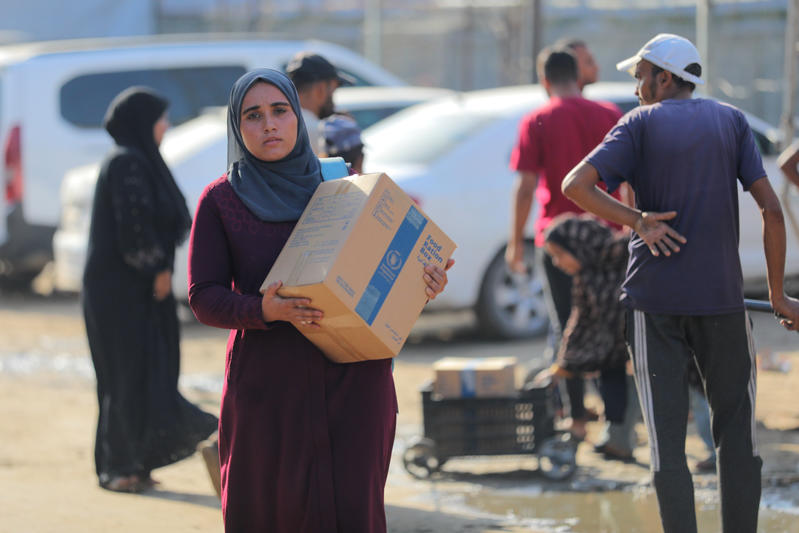
World Food Programme (WFP) provides food parcels to displaced people in Gaza City, October 23, 2025.
World Food Programme (WFP) provides food parcels to displaced people in Gaza City, October 23, 2025. Photo by Ali Hassan/Flash90

What’s happened: The International Court of Justice in the Hague issued an advisory opinion asserting that Israel is legally obligated to allow UN agencies to provide aid to Palestinians in Gaza, the West Bank, and East Jerusalem.

  • The Court said that Israel “is under the obligation to agree to and facilitate relief schemes provided by the United Nations and its entities, including Unrwa.”
  • The Israeli Ministry for Foreign Affairs called the decision “entirely predictable from the outset” and “yet another political attempt to impose political measures against Israel under the guise of ‘International Law.’”
  • The Knesset yesterday voted on two preliminary readings of bills which would apply Israel “sovereignty” on part or all of the West Bank. The Government opposed both bills, but an unusual mixed-motive alliance of right-wing rebels from within the governing coalition and opposition MKs seeking to embarrass the Government saw both preliminary readings pass.
  • US Secretary of State Marco Rubio, due to arrive in Israel today, told reporters just before boarding his flight that any move on West Bank annexation would be “threatening for the peace deal.” Regarding yesterday’s Knesset vote, he said, “They’re a democracy, they’re going to have their votes, and people are going to take these positions. But at this time, it’s something that we … think might be counterproductive.”
  • Rubio’s visit continues an uninterrupted chain of high-profile American officials in Israel coming to monitor and assist implementation of the ceasefire, which has now been in effect for two weeks. Yesterday, Vice President JD Vance arrived in Israel, joining Trump envoys Steve Witkoff and Jared Kushner.

Context: The ICJ, also called the World Court, is a body of the United Nations tasked with setting disputes between states. It is the same court that will rule on South Africa’s case against Israel, which alleges that Israel is committing “genocide.” It is a separate court from the International Criminal Court (ICC), which has issued arrest warrants for Prime Minister Netanyahu and former Defence Minister Yoav Gallant.

  • Israel vehemently denies the “genocide” charge, pointing out that the numbers of deaths include over 20,000 Hamas combatants. In addition, Israel argues that the nature of the fight against Hamas – which began after the massacres on October 7 – which is embedded in a densely populated civilian population and uses hospitals, schools, and mosques – in addition to hundreds of kilometres of tunnels – is inherently complicated and difficult.
  • The case regarding Israel’s obligations to facilitate aid was referred to the Court by a vote of the United Nations General Assembly in December 2024 at the instigation of the Norwegian delegation. This followed the passing of a new law in Israel in October 2024 which banned UNRWA in Israel limiting greatly Israel’s cooperation with it in Gaza and the West Bank.
  • According to Israeli law, East Jerusalem is part of Israel and not part of the West Bank, so the law has already led to the closure of UNRWA facilities there.
  • Israel has not objected to aid coming into Gaza, especially not during the ceasefire. It objects to the role of UNRWA, an organisation it charges with fueling the conflict rather than mitigating it.
  • Besides the Gaza Humanitarian Foundation, which Israel has been heavily involved with, Israel also facilitates aid coming in through the World Food Program, World Central Kitchen, and other humanitarian organisations. COGAT reports nearly 6,000 tons of aid entering Gaza since the ceasefire went into effect on October 10.
  • The Court’s decision stated that Israel had not substantiated its charge that UNRWA violated its neutrality obligations. The rejection of the Israeli claim came in two parts.
    • First, the Court argued that neutrality applies to UNRWA’s obligations to the population it was serving and, implicitly, not to its stance on the conflict.
    • Second, the Court said that Israel had not provided sufficient evidence that a significant number of UNRWA employees were members of terrorist organisations.
  • Israel’s Court submission documented widespread Hamas infiltration of UNRWA, including Hamas use of at least 32 of its facilities. It also provided evidence of UNRWA employees taking part in the October 7 massacre and alleged that some 1400 of UNRWA’s 13,000 Gaza employees were members of Hamas.
  • The advisory opinion is non-binding, and Israel has made clear that it will not be changing its stance on UNRWA. A report on Israel’s Kan radio quotes an unnamed Israeli official saying that UNRWA “will not set foot in Gaza again.”
  • The US State Department condemned “this so-called ‘court’” for issuing “a nakedly politicised non-binding ‘advisory opinion’ [that] unfairly bashes Israel and gives UNRWA a free pass for its deep entanglement with and material support for Hamas terrorism.”
  • One of the Knesset bills that was passed yesterday was tabled by Avigdor Liberman, and would see the effective annexation of Maaleh Adumim, a West Bank city adjacent to Jerusalem which has been slated for annexation in every peace proposal since 2000. Thirty one members voted in favour, and nine voted against. The other bill, tabled by far-right MK Avi Maoz, would effectively annex the entire West Bank.
  • Neither measure has a realistic path to passing into law. 25 members voted in favour and 24 against. The timing is not coincidental – opponents of the government are looking to embarrass it during the visits of senior US officials. The government has made assurances to both the US and some of the moderate Arab states backing the ceasefire that annexation is not presently on the agenda.  

Looking ahead: Conflicting media reports give various hints as to American plans for Gaza reconstruction.

  • From the new Civil-Military Coordination Centre in Kiryat Gat, where a multinational team led by 200 American officers, with contributions from Britain, Denmark, Jordan, the UAE and others, is operating, there are reports of a technocratic government for Gaza being established, composed of Palestinian and international experts.
  • Yediot Ahronot reports that Hamas will select some of its members, though Israel says it will not allow any Hamas involvement.
  • A report in the Wall Street Journal suggests American officials are considering a de facto partition of Gaza, at least as a temporary measure, until Hamas is disarmed.
  • According to this idea, investment and reconstruction would be focused on areas of the Strip that are free of Hamas control. For now, that would mean the 53% of the territory on the Israeli side of the so-called “yellow line.”

Newsletter sign-up

Please enter your information below to subscribe to our daily newsletter and stay updated and informed.

Donate to BICOM

At BICOM, we rely on the generosity of people like you to keep our website and services running. Your donation, no matter the size, makes a real difference. Please consider supporting us today. For further information please email: [email protected]